A SaaS referral program rewards your users for recommending your software. Each user gets a link or code, and when someone they referred becomes a paying customer, they get a thank-you. To make one work, reward both sides when the new customer starts paying, and make sure the reward reaches the person who referred.
SaaS companies run some of the best referral programs out there, and some of the worst. The difference usually isn't the reward or the software. It's whether the program fits how the business actually sells. This guide walks through how to build one that does, with 5 real examples.
What is a SaaS referral program?
A SaaS referral program gets your current users to share your product with peers. It rewards them when a referral becomes a paying account. How you build it depends on how you sell.
| Product-led SaaS | Sales-led SaaS | |
|---|---|---|
| How people buy | Sign up, try it, pay by card | Book a demo, go through a sales cycle, sign a contract |
| Who refers | Any user, often to a friend or a former coworker | A user or champion, often to a peer at another company |
| When to reward | When the referred account pays its first invoice | At closed won, with an update at the demo |
| Where it runs | In the product, plus email | Through your CRM, plus your customer success team |
If you run a product-led app and have engineers to spare, you can build simple referrals in-house, inside the product. Once you need tracking across several steps, CRM sync, fraud checks and payouts to people, it takes real engineering time to build and keep up, so a dedicated referral software is usually a better fit to run the program. For the general setup, see how to build a referral program.
Why referrals fit SaaS
Most software buyers ask peers before they buy, and few take a vendor's word alone. In G2's 2024 Buyer Behavior Report, 82% of 1,940 B2B decision makers said peers' experiences play a big role in choosing a provider. A referred account shows up already halfway sold.
SaaS also has room for a real reward. A customer who renews for years is worth many times their first invoice, so you have room for a thank-you people notice. It doesn't need to be large: pick an amount that gets attention, then leave it alone.
FeedXL, a B2B software company, got 216 referrals in 4 months by running two programs at once: one for customers and one for partners.
But a referral program doesn't create word of mouth. It amplifies what's already there. If users aren't already recommending your product, a program won't change that.
6 signs you're ready for a SaaS referral program
Check these first, here in SaaS terms.
| Sign | What it looks like for a SaaS company |
|---|---|
| 1. Word of mouth | New signups or deals already say "a colleague told me about you" |
| 2. Easy to talk about | Users can name a result your product got them in one sentence |
| 3. Community | Your users know peers in the same role at other companies |
| 4. A service team | Customer success and support follow up and fix problems fast |
| 5. Business software | Accounts and deals live in a CRM or billing tool, like HubSpot, Salesforce or Stripe |
| 6. Steady marketing | New users or pipeline arrive every month, so there's always someone new to ask |
If several are missing, work on those first. A program gives word of mouth somewhere to go; it can't make people talk.
How to build a SaaS referral program in 8 steps
1. Invite every user on the account
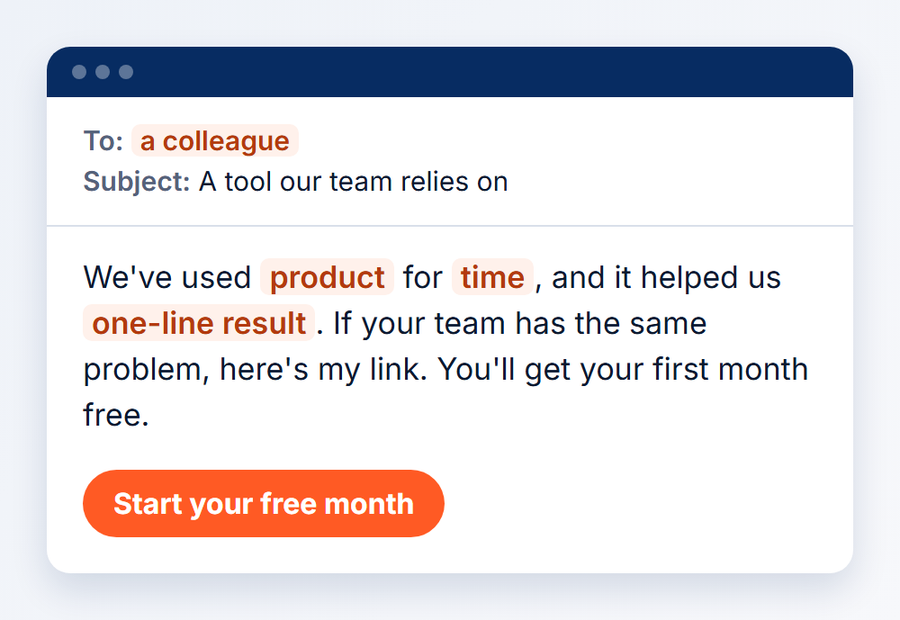
In SaaS, one customer account can have dozens of users. Any of them might know someone who needs your product. Give every user a referral link by default, with no form and no join button. You'll find fans you'd never have picked.
2. Reward the person, not the account
A mistake I see a lot: a SaaS company offers account credit, because credit is easy to give and feels cheap. But a customer account is a company with many users, and a referral comes from one of them. The credit lands on the company's invoice, which the actual sharer may never see. So the reward doesn't motivate the person who did the work.
A gift card or cash goes straight to them. Credit still fits when the person who referred also pays the bill, like a founder or an owner.
| Reward | Who actually feels it | Fits when |
|---|---|---|
| Account credit | Whoever pays the company's bill | The referrer is the owner or pays the bill |
| Gift card or cash | The person who referred | Your software is B2B, as almost every B2B account has more than one user |
| A free month or discount for the new account | The friend's company | Always fits: it's the friend's reason to say yes |
In our October 2023 data on more than 500 programs, 61% paid referrers with gift cards and 30% with cash. The B2B referral program guide covers rewards for longer sales in more depth.
3. Give the referred account a reason to start
The friend's reward is what turns a share into a favor. A free month, an extended trial, or a discount on the first invoice works well in SaaS, because it costs you little until they pay. Send the friend to a page that names who referred them and shows their offer, not to your homepage or a generic demo form.
4. Pay when the account starts paying, not at signup
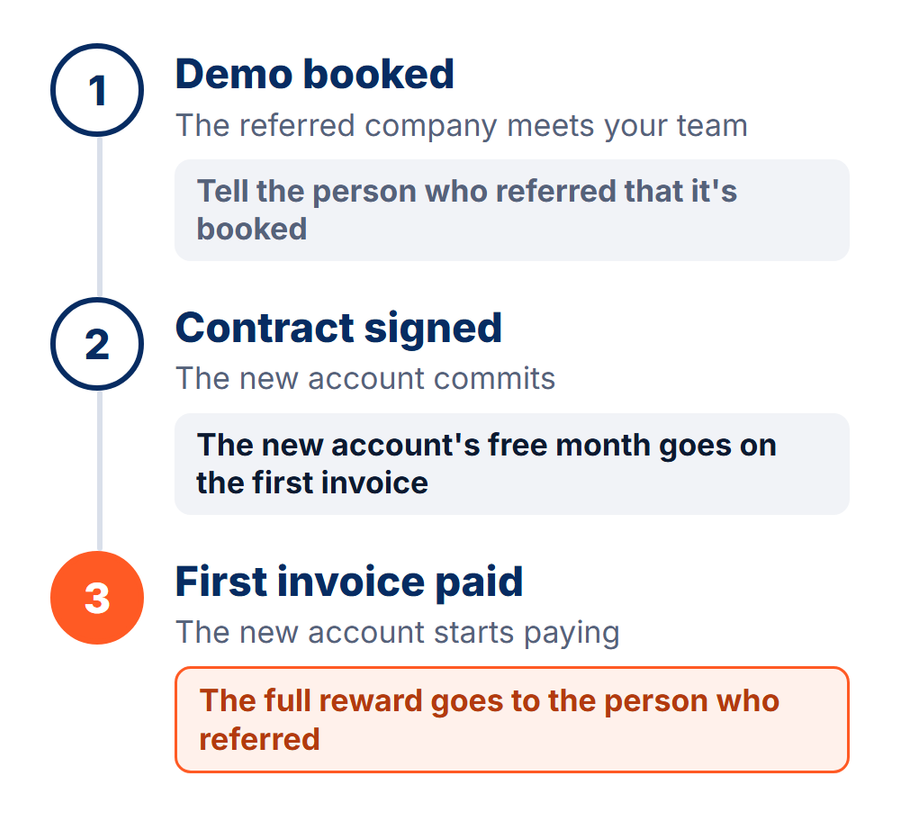
Reward both the referrer and the referred account when the new customer starts paying. A signup costs nothing to create, so paying for signups invites fake accounts and pays for trials that never become customers. One SaaS team told us on a call that they didn't want to pay commissions on signups that never paid.
Whenever you pay, tell the referrer when their referral signs up, and again when the reward goes out.
For a long sales cycle, pay the full reward at closed won or the first paid invoice, and keep the referrer posted along the way. An update when the demo is booked keeps them in the loop. Some teams pay in steps instead, with a small thank-you at the demo.
5. Invite users when they're getting value
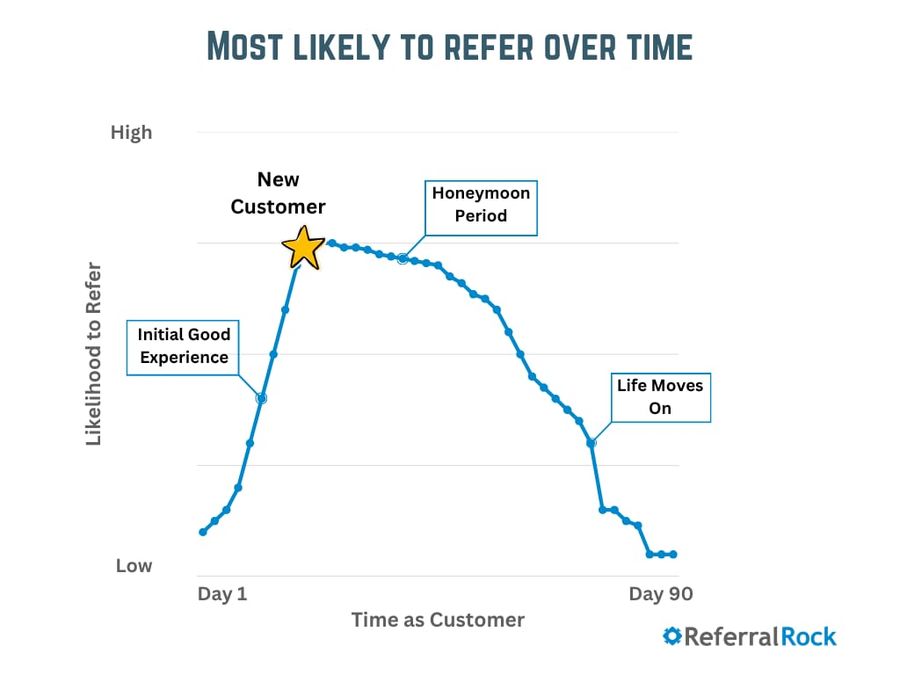
There's no single perfect moment to ask. There's a window, and it opens when a user gets value: they finish onboarding, hit a goal in your product, or renew. Invite them then, and keep following up while the window is open.
6. Put the program inside your product
Users spend their day in your app, not on your website, so put the referral link in the app menu and on the screen after a win. Add it to the emails you already send: onboarding, monthly summaries, renewal notices. Then keep it there. Most programs that stall simply stopped promoting after launch.
7. Let customer success do the asking
Your customer success managers and account managers hear "my old boss should see this" long before marketing does. Give each of them a link of their own, and make the ask part of business reviews and renewals. Senior contacts often prefer to make a direct introduction over sharing a link.
The CSM starts the ask, and the program's emails follow up with the link and reminders. Word it as a favor to a peer: the new account gets a discount, and the person who referred gets a thank-you of their own.
8. Track shares and reach before referrals
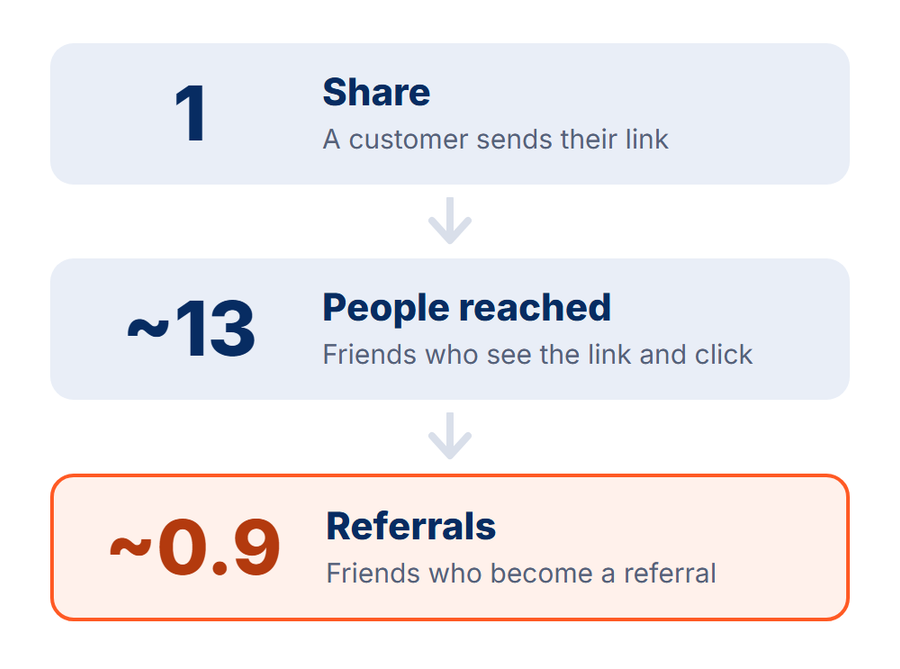
Referrals come last, so first watch whether users share, then whether those shares get clicks. In our data, each share brings close to 1 referral across all program types on our platform, so shares warn you early. Our guide to referral tracking shows how to set it up. The SaaS referral metrics worth watching: shares, referral visits, referred trials or demos, new paying accounts, and their renewals.
5 SaaS referral program examples
These are offers as listed on each company's own page in November 2026.
| Company | The referrer gets | The referred account gets | When it pays |
|---|---|---|---|
| ActiveCampaign (email marketing) | An Amazon gift card, $25 to $100 by plan | $10 account credit | After the friend has paid for 60 days |
| Hiver (shared inbox) | $500, plus 20% commission | The first month free | Within 30 days of the friend's paid invoice |
| GetResponse (email marketing) | $30 account credit | $30 account credit | When the friend buys a paid account |
| DigitalOcean (cloud hosting) | $25 credit | Credit to start (no amount stated) | After the friend's first $25 in billing |
| Dropbox (file storage) | Extra storage | Extra storage in the classic version (not stated today) | When the friend joins |
ActiveCampaign gets two things right. Its referrer reward is an Amazon gift card, so it reaches the person who actually shared. And it pays only after 60 paid days, which filters out quick cancels. Every customer is enrolled automatically, with the link in their account.
Hiver's program is open to anyone, users or not, which makes it closer to a partner program. GetResponse and DigitalOcean pay in credit on both sides. That fits when the person referring also pays the bill, which is common with small teams and solo founders.
Dropbox is the program everyone cites: its founder said in his 2010 talk that a two-sided reward permanently raised signups by 60%. But Dropbox was a consumer program, which reached companies because people brought it to work. Its viral burst didn't last either, as Lenny Rachitsky notes in "Virality is a myth (mostly)". It's a weak model for a sales-led company.
Referral software for SaaS
You can build referrals into your product, run them by hand, or use a referral management platform. Most referral software is built for ecommerce, with one purchase and high volume. SaaS needs tracking across a trial or a sales cycle, and rewards that wait for payment. The first three options below are free tools of ours.
| Option | Good for | The catch |
|---|---|---|
| Manual referral tracker | A few introductions a month | Tracking and rewards are all by hand |
| Referral link and code generators | Testing whether users will share | No tracking or rewards on their own |
| Referral fee calculator | Checking that a reward fits within what an account brings in (referral fees) | It plans the reward; it doesn't pay it |
| Building it yourself | Product-led apps with engineers to spare | Multi-step tracking, fraud checks and payouts take ongoing work |
| Referral software | Sales-led SaaS, a CRM, rewards by stage | A monthly cost |
Want partners, resellers or agencies to refer instead of users? That's a partner program, with different rewards, tracking and often a written referral agreement. See B2B partner programs.
How Referral Rock runs it for SaaS companies
The feature that fits SaaS best is referral program recruiters. Each customer success manager or account manager gets their own portal and link. They invite contacts at go-live or a business review, and every referral that follows is credited to them.
The rest runs in the background. Referrals reach HubSpot or Salesforce, and Stripe, Chargebee or QuickBooks approves the reward when the referred account pays. Rewards can pay in steps, by deal stage, and go to the person as a gift card or cash, with the whole thing on automation.
Every plan includes a program advisor who helps set it up. See how it works for B2B software companies.
Start with your next happy customer
You don't need a big launch. Invite the users at your next customer to finish onboarding, and have your CSMs ask at the next business review. Pay the person when the account starts paying. Then add everyone else.
If you're not sure your product is ready, the readiness check takes a few minutes.

About the author
Founder and CEO
Josh founded Referral Rock in 2014 and has spent more than a decade studying how and why people recommend the businesses they love. He writes about reward design and the human side of a recommendation.