
Every referral counts, however it arrived
A referral is a conversation before it is a click. Referral Rock records the ones that come through a shared link and the ones that arrive by form, by name, or as a sale landing in a CRM, then credits each one back to the customer behind it.
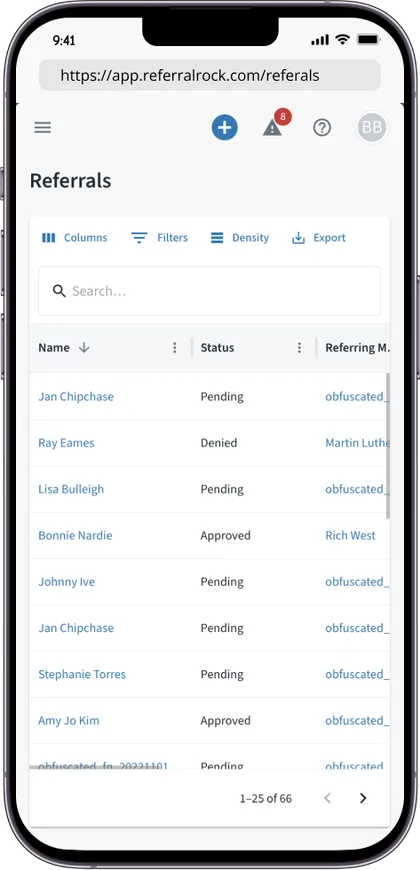
Join 1,000+ companies growing referrals with Referral Rock








How a referral gets recorded
Four playbooks, and one to start with
Each playbook answers two questions differently: how the friend arrives, and what confirms the referral afterwards. All four land in the same place and are credited the same way, so reporting does not fragment by how a referral happened to come in. Most programs run two or three at once.
| Playbook | How the friend arrives | What confirms the referral | Best for |
|---|---|---|---|
| Recommended Share link into a Referral Form | A member shares a link or shows a QR code. The friend lands on a Referral Form led by the person who sent them. | The friend submits the form and the referral is recorded on the spot, before any purchase exists. | Almost every program. Start here unless something rules it out. |
| A form already on the site | The friend goes straight to the site and uses the contact or quote form that is already there. | Invisible form tracking matches the submission back to the member who referred them. | Businesses that would rather not send anyone to a separate page. |
| A member names the friend | No click at all. The member submits the friend’s name and contact details on their behalf. | The referral is created immediately, then confirmed once the sale is marked won. | Service and high-touch businesses where a referral arrives as a conversation. |
| The system of record | Any route, including ones carrying no tracking at all. | A paid order or a won deal in a connected CRM or billing tool approves the matching referral. | Sales recorded somewhere other than a website checkout. |
Why the Referral Form is the one to start with
- The friend sees who referred them. That is the reason a referral converts at all, and no other playbook puts it in front of them.
- Attribution is stated rather than inferred. The referral is written down when the form is submitted, so nothing has to be matched up later.
- The reward appears on the confirmation screen and can be claimed immediately, instead of arriving in an email later.
- Nothing has to be added to an existing site to make it work. See the sharing experience for what the friend actually sees.
When the sale lives elsewhere
Let the system of record confirm the referral
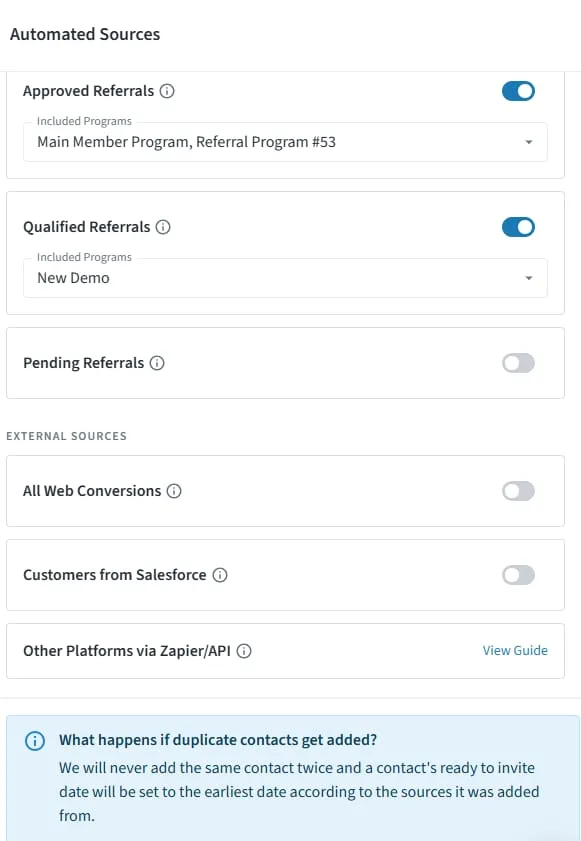
In plenty of businesses the moment a referral becomes real is not on the website at all. It is a deal marked won in the CRM, or an invoice paid in the billing system. Connect that system as a Customer Feed and a paid order or a won deal approves the matching referral across every program and triggers the reward.
- Nobody has to remember to mark a referral as converted, because the system that already knows does it.
- Approval runs across every program at once, so a customer appearing in two programs is handled consistently.
- The same connection has a promotion side, where a new customer is added to the program and invited. See program promotion.
Which platforms connect natively, and what each connection supports, is on the integrations page.
Records solid enough to pay against
A referral record is the basis for sending someone money, so the controls that keep it honest matter as much as the tracking that created it.
-
Duplicates get caught
Duplicate detection and IP tracking flag the same person arriving twice under different details.
-
Hold before paying
Suspect referrals can sit in a review queue so a person approves them before any reward is issued.
-
Corrections stay visible
Rolling a status back warns first when a reward has already been earned, so the consequence is clear before the change.
-
Rule-based, not predictive
The controls are rules rather than machine-learning anomaly detection. Worth knowing for a public offer that is financially attractive to game.
Link attribution
How the link half works
When a friend clicks a member's link, Referral Rock sets a first-party cookie on the brand's own domain rather than a third-party one. That is the mechanism behind link attribution, and it is also what makes visit tracking possible, so traffic a program brings in shows up before any of it converts.
Worth keeping in proportion, though. Cookie behaviour is rarely what decides whether a program works, and most referrals in most programs are recorded by a form submission or a confirmed sale rather than by a cookie. What the visit data is good for lives on analytics and reporting.
For developers
Where more technical help is worth having
Most programs never touch these. They matter when the qualifying event lives somewhere a standard connection cannot reach.
Referral.js SDK
A first-party script that records referral visits and fires conversion events from the brand’s own pages. Needed when visit tracking matters as well as conversions.
REST API conversion calls
Record a conversion from a backend when the qualifying event lives somewhere no script can reach, such as an internal system or a delayed approval.
Webhooks for downstream systems
Referral and reward events push out as they happen, so a data warehouse or an internal tool stays current without polling.
Conversion redirect
A URL-based method for capturing a conversion when adding a script to the confirmation page is not an option.
Common questions about referral tracking
Make sure every referral gets credited
See how Referral Rock records referrals that arrive by link, by form, by name, and by a sale landing in a connected system.
Not ready to talk? See a free referral flow →