A referral reward is what you give when a customer sends you a new customer. It's a thank-you for the person who referred, and usually a gift for the friend they sent. This guide is for businesses setting up a customer referral program, or fixing one that isn't working.
It walks through the 4 decisions behind every reward: who gets it, what type, how much and when it pays. In short: reward the friend every time, thank the customer who sent them, pay once the friend buys, and choose an amount people notice. Each decision comes with the research behind it and real offers from 14 programs.
What is a referral reward?
A referral reward is a thank-you or a gift that a business gives in return for a referral. A customer referral program usually has two. The sharer's reward (also called the referrer's reward) goes to the customer who passes your name on. The friend's reward goes to the person they send.
Many programs (or schemes, in the UK) call them incentives, bonuses or referral credits. A referral reward isn't a loyalty point: loyalty programs reward customers for buying again, while referral rewards thank them for bringing someone new.
A referral reward is different from a referral fee or a finder's fee. A business pays those to a partner or another professional, often as a share of the deal. Customers want a thank-you that feels like one. Partners usually want a fair cut.
Why referral rewards matter (and what they can't do)
Your customers already recommend you when friends ask. A referral program amplifies the word of mouth you already have. What a program does (the ask, the reward, the wording, the reminders) changes how many customers refer. The reward is the part people notice first.
The main benefit of a reward is that it makes the ask comfortable. When the sharer can say "here's $50 off your first job," sharing feels like doing a friend a favor. In field tests, the friend's reward does the most work. In one, a free month for the friend brought in nearly three times as many new customers as the same free month for the referrer.
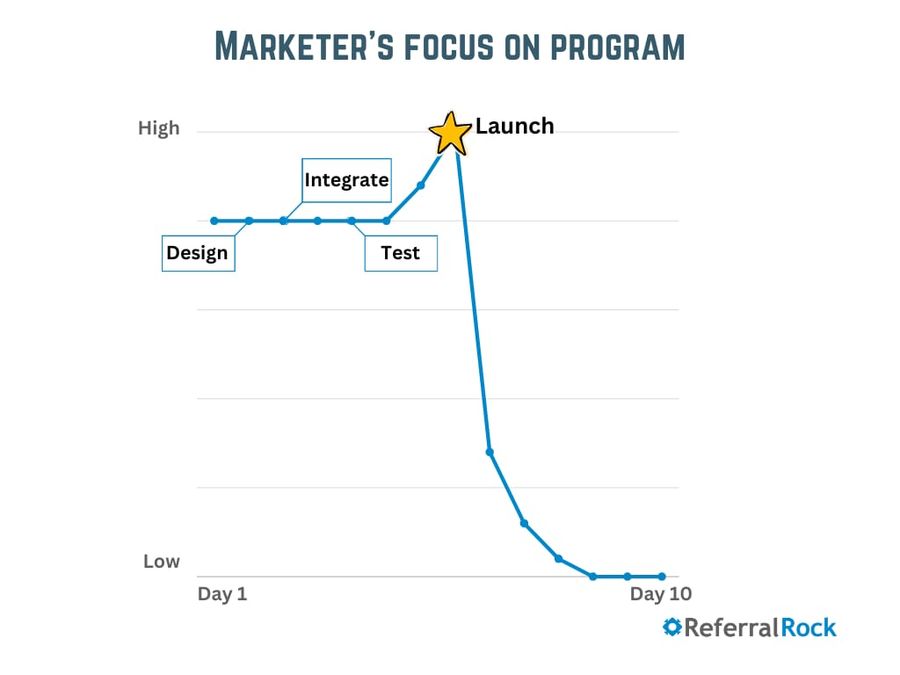
What a reward can't do is promote itself. In our October 2025 review of 952 programs over 9 years, 82% of the ones that stalled had stopped promoting after launch. A bigger reward won't fix that. Steady invites and reminders will; we call that continuous promotion.
The 4 decisions at a glance
| Decision | What we recommend | Why |
|---|---|---|
| 1. Who gets it | The friend, every time, and the sharer as a thank-you | The friend's reward is what turns a referral into a customer |
| 2. What type | One that reaches the person: a gift card, cash, or credit they'll use | A reward nobody personally feels doesn't motivate anyone |
| 3. How much | An amount people notice that your margins carry easily | Bigger isn't always better, and fine-tuning rarely pays off |
| 4. When it pays | Once the friend is a real customer, with updates along the way | You carry the risk of refunds, and the sharer needs to know it's coming |
1. Who gets the referral reward
There are 4 setups to choose from. Each has its place, and its advantages and disadvantages.
| Setup (who's rewarded) | Good for | The catch |
|---|---|---|
| Two-sided ("give and get"): the sharer and the friend | Most customer referral programs | Two rewards to budget for |
| Referrer only: the customer who referred | Partners and affiliates, who refer as part of their work | The friend has no reason to act now |
| Friend only: the person referred | Trades that limit rewards for referring, and brands where paying feels off | Sharers may expect a thank-you |
| No reward: nobody | Free products, and testing a program before adding rewards | Fewer people share, and fewer friends act |
Never skip the friend. In our own data, 54% of 339 programs gave the friend nothing (November 2024). Most never considered it. The habit comes from affiliate programs, where only the referrer gets paid, and it gets copied into customer referral programs where it doesn't fit.
The outside research is clear. In a field test at a video game subscription company, 4.77% of customers asked brought in a new customer when the friend got a free month. When the referrer got the free month instead, it was 1.71%, and with no reward, 0.61% (Gershon, Cryder and John, 2020). Customers shared about as often either way; the gap opened when the friend decided whether to sign up.
Keep the referrer's reward as the thank-you. Sharers expect one, and they expect it more at bigger price points.
Word the offer in that order, too: what the friend gets first, then the thank-you. That way the sharer opens with a gift, which is easier to pass on. Two field experiments with about 100,000 customers each found that wording the share as a gift beat the usual wording, with the same reward.
In B2B (selling to other businesses), the two rewards go to different places. The sharer's reward should be personal, like a gift card, because account credit lands on an invoice they never see. The friend's reward should go to their company's account, like a discount, since a personal gift for picking a vendor looks like a kickback. More in our B2B referral program guide.
Can a referral program work without rewards?
Yes, in a few cases. Some trades, like healthcare, dental and legal, limit what you can give for a referral. There, a friend-only offer, a small thank-you gift or no reward is the safe route, after a check with your compliance team or attorney.
A free product, like a newsletter, has nothing to discount. And some businesses start without a reward to see how many customers share on their own.
Remember that a program without rewards still needs the rest of the system. Make sharing easy, direct the friend to a page that names the person who sent them, and thank every sharer, even with a handwritten note. Our referral thank-you notes are a good place to start. Expect fewer referrals than you'd get with a reward on offer, and add one once you know the program works.
2. What type of referral reward to give
No reward type is proven best: the right one is the one the person actually feels. Before you pick, ask whether the sharer will notice it and use it. If the value goes to someone else, like their employer's account, they have no personal reason to share. For the friend, pick something that helps them try or buy, like money off the first order.
| Reward | Good for | The catch |
|---|---|---|
| Gift cards | Almost any business; people can pick a brand they like (referral gift cards) | A single store's card won't suit everyone |
| Cash (PayPal, Wise, a check) | Higher-priced sales, and partners who refer often | Can make a recommendation feel paid |
| A discount or coupon (referral coupons) | The friend's first purchase | Only useful to people who'll buy from you again |
| Account or rent credit | Customers who pay their own bill, like residents or owners | Useless if someone else pays the bill |
| A free month, product or upgrade | Subscriptions and products people can try | The sharer may already have it |
| A donation | A choice for the referrer, or a local fundraiser | Few people refer for it alone |
| Swag | Brands with fans who want the merch | Rarely enough on its own |
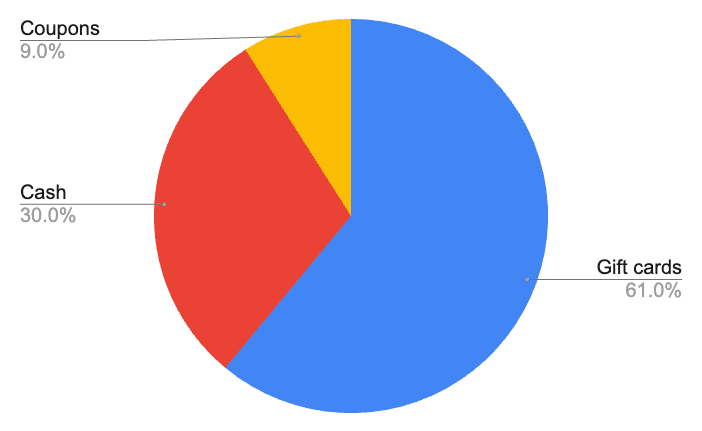
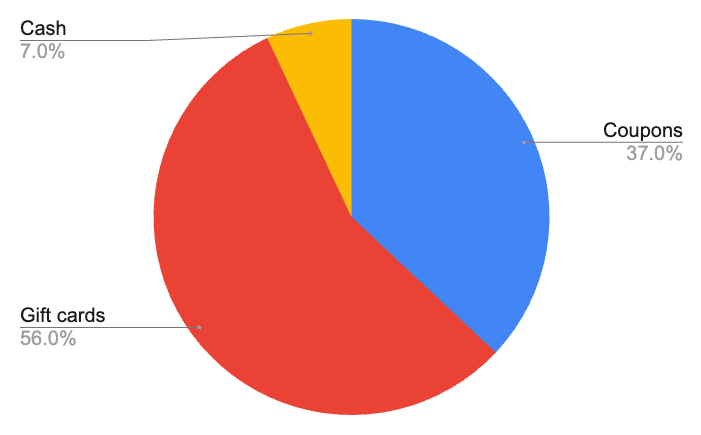
Programs on our platform mostly pay in gift cards. For referrers, 61% use gift cards, 30% cash and 9% coupons or discounts. For friends, 56% use gift cards, 37% coupons or discounts and 7% cash (500+ programs, October 2023). It shows how programs are set up, which isn't proof of what works best.
A donation works best as one option a sharer can choose, or as a gift to a local cause. A roofing company can give $50 to the local school for every referral, the way a restaurant runs a fundraiser night.
Just don't count on a donation to bring in more referrals. In a second field test by Gershon, Cryder and John, a $5 donation did no better than no reward. A $5 gift card for the friend did much better.
For more ideas, see our lists of referral gift ideas and refer-a-friend rewards.
3. How much to give
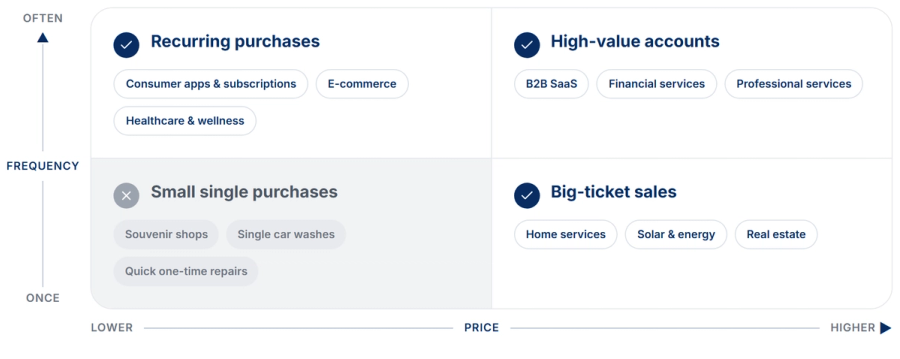
What a new customer is worth shows how much room you have for a reward. Within that room, pick an amount the sharer notices and the friend would act on, one your margins carry easily. Then leave it alone. Fine-tuning the amount rarely pays off, and a bigger reward isn't always a better one.
The research points the same way:
- Small rewards beat none. A free month and a $5 gift card both lifted referrals well above no reward, in Gershon, Cryder and John's two field tests above.
- Bigger rewards bring in less profitable customers. In a study of bank customers, bigger rewards brought more new customers, but considerably less profitable ones.
- Small changes don't show up. At Lyft, amounts close to the current offer made no measurable difference; only an offer more than twice as big did.
- Big rewards draw fraud. As Lenny Rachitsky, who led supply growth at Airbnb, put it: the juicier the incentive, the likelier you are to see fraud.
A bigger reward can even backfire. A Wharton researcher tells the story of a tour company's delighted customer who wouldn't use her $500 referral reward. Being paid for her friend's booking felt wrong, though she kept recommending them.
We see the cost of fine-tuning in onboarding calls. Some teams keep a program in draft for weeks, debating whether the reward should be $25 or $30. Others pick something simple, like $50 for both sides, launch, and see referrals within weeks. Most of the programs below pay $25 to $500 per referral.
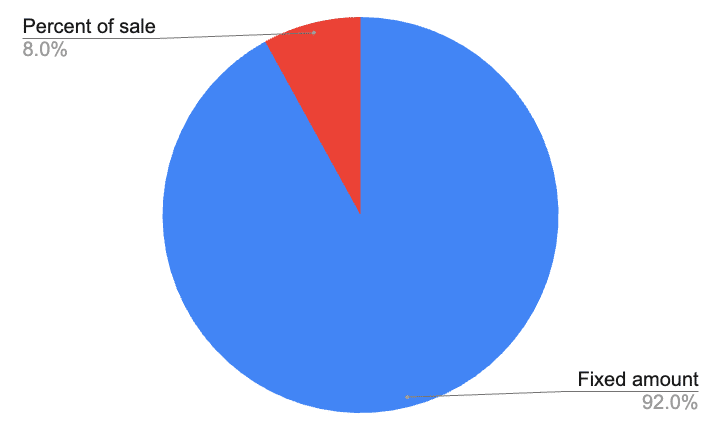
Fixed amounts are the norm. 92% of programs on our platform pay a fixed amount and 8% a percentage of the sale (October 2023). A fixed reward is easy to explain in one line and easy to budget. A percentage suits affiliates and partners, whose referrals vary a lot in size.
To check that a reward fits what a sale brings in, try the referral fee calculator. Use it to check a number you've already picked.
4. When the referral reward pays
When to pay is your call, because you carry the risk of returns, refunds and fraud. Paying once the friend has bought, or once a return window has passed, is often right. A waiting period of a set number of days covers returns before the reward goes out.
The friend's side is different. Their offer should be in their hands right away, when they're most ready to buy, and it shouldn't expire. Some friends buy within a day; others take months.
Whenever you pay, tell the sharer the day their friend comes in, and again when the reward goes out. A sharer who hears nothing assumes the referral was lost. Put the timing in your program terms (the short page of rules for your program), so everyone knows what counts and when.
Multi-step rewards for long sales
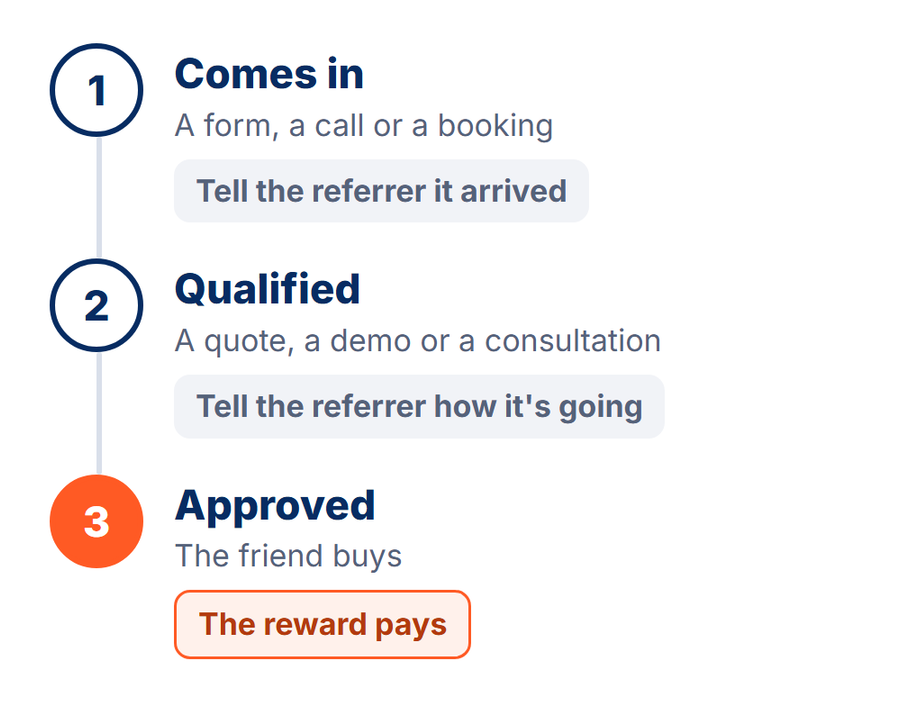
When a sale takes weeks or months, a single reward at the end can feel too far away to the sharer. The usual fix is an update at each step. Tell them when their friend has had a demo, a site visit or a quote, and pay when the friend buys.
Some businesses with long sales pay in steps instead: a small thank-you at the qualified stage, and the main reward at the sale. Directive, a marketing agency, pays $500 at the proposal stage, then a share of the contract once the client signs. A paid first step pays for referrals that may never buy. If you choose one, keep it small and reward only steps your team can confirm.
A multi-step reward isn't the same as a tiered one. Multi-step follows one referral through your sale. Tiers grow with the number of referrals one person sends (see Getting started, below).
One-time or recurring rewards?
For a customer referral program, a one-time reward is simpler and almost always enough. People refer because they like you, and because they get to give a friend something. A recurring payment doesn't change whether they know someone who needs you, and it's harder to explain.
Recurring rewards fit partners, affiliates and agencies, for whom referrals are part of their work and an ongoing relationship matters. Teamwork.com, for example, pays the account owner 15% of every payment a referred customer makes, up to $1,000. If you go recurring, set a cap or an end date.
What 14 real referral programs pay
These are real offers from businesses like our customers. The first two are our customers' programs; the rest are what each page offered on November 10 or 11, 2026.
| Company | The referrer gets | The friend gets | When it pays |
|---|---|---|---|
| Catapult (UK staffing) | £20 | Not stated | When the referred candidate works a first shift |
| SIR Glass (auto glass, partners) | PayPal cash: $10 per chip repair, $20 per replacement, $40 per insurance replacement | Not stated | When the referred customer buys |
| Culligan (water treatment dealers) | A $100 gift card | $100 off their system | When the friend buys or rents a system |
| Paschal (plumbing, electrical, HVAC) | A gift card of $30, $250 or $500, by job size | Not stated | When the job is done and paid |
| NW Maids (cleaning) | $50, no limit | $50 off the first cleaning | When the friend books |
| Sunsense Solar (Colorado) | $250 cash, or a gift to one of 4 nonprofits | Not stated | After the install's final invoice is paid |
| CRCU (credit union) | $25 cash | $25 cash | Once the friend's direct deposits reach $400 within 60 days |
| StuyTown (apartments, New York) | $200 rent credit | $200 rent credit | At the friend's move-in |
| Culdesac Tempe (apartments) | A $500 gift card | Not stated | 30 days after the friend's lease starts |
| Exclusive Motorcars (car dealer) | A $150 check; 5 referrals pay $750 | Not stated | Within 30 days of the purchase |
| GetResponse (email software) | $30 account credit | $30 account credit | When the friend buys a paid account |
| Directive Consulting (marketing agency) | $500, then 2.5% of the contract for 12 months | Not stated | $500 at the proposal, the rest once they sign |
| Teamwork.com (project software) | 15% of every payment, up to $1,000 | Nothing | As the referred customer pays |
| Tesla (US) | A free month of Full Self-Driving, or a $99 credit | A free month of Full Self-Driving | When the friend starts paying for it |
A few patterns stand out. Most pay a fixed amount between $25 and $500. Service businesses tie the reward to a finished, paid job. The programs that reward the friend give them something to use right away, like money off, credit or a free month.
5 referral reward mistakes to skip
These are the mistakes we see most in program reviews. For the rest of the refer-a-friend best practices, see our best practices guide.
- Sizing the reward from what a customer is worth. That number shows the room you have. Within it, choose a reward big enough to notice, and move on.
- Leading with the referrer's reward. "You'll both get $50" sounds like a pitch. "Give your friend $50 off" sounds like a gift.
- Giving B2B referrers account credit. It lands on the company's invoice, where the sharer never sees it. Reward the person, and give the discount to the friend's company.
- Changing the amount every few weeks. Sharers lose track of what they're owed, and small changes rarely move results. Set it, and change it only for a reason.
- Expecting the reward to do the promoting. A program stalls when nobody hears about it. Invite new customers soon after they buy, follow up while they're still excited, and keep the program where customers will find it.
Getting started: your first referral reward
Start simple, launch, and improve from there. A program with one clear reward that's live this month beats a perfect one still in draft. We call that good enough beats perfect.
- Pick the friend's gift. Something they can use on their first purchase: money off, a credit, a free month or a trial.
- Pick the sharer's thank-you. A gift card or cash for most businesses, or credit if they pay their own bill.
- Set an amount people notice. Make sure your margins carry it easily. Same amount for every referral, to start.
- Decide when it pays. Usually once the friend is a paying customer, or past your return window. Give the friend their offer right away, and tell the sharer at each step.
- Write it down. Put the rewards, the timing and who qualifies in your program terms, in plain words.
Add the extras later: tiers or milestone bonuses, like Exclusive Motorcars' $750 for 5 referrals, can come once the program is running. Most sharers refer once or twice, and a few refer a lot. Our guide to milestone referral programs shows how to design tiers for those few. A contest can give the program a short burst.
To work through all 4 decisions on paper, use our free referral program workbook.
For the rest of the setup, see how to build a referral program, and for ways to keep it going, our referral program ideas.
Paying referral rewards with software
You can pay rewards by hand from a spreadsheet while the program is small. Once rewards go out every week, or referrals come in through many channels, software keeps the payouts on time. If you're weighing whether to build or buy, count the payouts, which go on for as long as the program runs. For most businesses, software built for referrals is the better fit.
SIR Glass, an auto glass company in Portland, stopped sending its partners' gift cards by hand and now saves 3 to 4 hours a week.
With Referral Rock's reward management, sharers pick from hundreds of gift cards and charities, or take cash by PayPal or Wise. We add no fee to the payout. You can also set up custom rewards, multi-step rewards and milestone bonuses.
Rewards go out on the step you choose, after any waiting period, and sharers see the status of every referral in their own portal. Every plan includes a program advisor who helps you set the rewards up.
Whatever you choose, the decisions are the same. Give the friend a gift, thank the sharer, pay when the friend is a real customer, and pick an amount people notice. Then leave it alone and put your energy into telling customers the program exists.
About the author
Referral Rock Editorial is the team behind Referral Rock's guides and templates on referral, affiliate, partner and brand ambassador programs. Today's team writes, reviews and updates them, building on work by former staff and freelance writers over the years.