A B2B referral program gives the people at your customer companies an easy way to introduce peers who could buy from you. When a referred company signs, the person who made the introduction gets a thank-you, and your sales team knows exactly where the deal came from.
Most B2B companies already get these introductions. The hard part is seeing them: a deal shows up in the CRM as "inbound," and nobody knows a happy customer sent it. This guide builds the program around a long sale, from the first demo to closed won, when the deal is signed.
Why referrals fit B2B companies
B2B buyers lean hard on their peers. In G2's 2024 Buyer Behavior Report, 82% of 1,940 B2B decision makers said their peers' experiences play a big role in choosing a provider. A referred buyer arrives already half sold.
Buyers go looking for those peers, too. In TrustRadius's 2024 B2B Buying Disconnect report, 50% of buyers sought out former colleagues or peers to talk through their options. At enterprise companies it was 62%. And 56% talked with someone who used the product before they bought.
Referred customers also tend to be worth more once they sign. In a Journal of Marketing study of one bank's referral program, referred customers were worth at least 16% more than similar customers. They were also about 18% less likely to leave. The study looked at bank customers, so for B2B, read it as a signal.
Each new account is also worth a lot, and it keeps paying as long as the customer renews. That leaves room for a real thank-you.
FeedXL, a B2B software company, got 216 referrals in 4 months by running two programs at once: one for customers and one for partners.
The people your customers trust are their customer success manager, account manager and support team. They hear "my old boss at another company should see this" long before sales does. That makes them the most personal way to ask, and every referral they bring can be credited to them.
6 signs you're ready for a referral program
A referral program amplifies the word of mouth you already get. So check these 6 signs first, here in B2B terms.
| Sign | What it looks like for a B2B company |
|---|---|
| 1. Word of mouth | New deals already say "a peer told me about you" |
| 2. Easy to talk about | Customers mention a result your product or service got them |
| 3. Community | Your customers know peers at similar companies, through jobs, groups and events |
| 4. A service team | Customer success and support follow up and solve problems fast |
| 5. Business software | Deals and contacts live in a CRM like HubSpot or Salesforce |
| 6. Steady marketing | Content, events and outbound bring in new pipeline every month |
If several are missing, work on those first. The readiness check walks through all 6 in a few minutes.
How to run a B2B referral program in 8 steps
These steps follow the order our program advisors use when they set up a program with a new customer, answered for B2B companies.
1. Invite every customer contact, not just the admin
A B2B customer is a company, but a referral comes from one person in it. So invite every active contact, from the admin to the daily users, each with a personal referral link. No form and no new login: a link already in their inbox lets them refer a peer the moment it comes up. That's what we call keeping access open.
Then put your first effort where it pays off:
| Start with | Why |
|---|---|
| Accounts that just went live or renewed | Their good experience is fresh |
| The champion who bought you | They know the peers who face the same problem |
| Daily power users | They talk about the product with people in their field |
| Contacts who scored you 9 or 10 on a survey | They've said they'd recommend you, which earns them a personal note on top of the link |
Everyone still gets the ask. This list only decides who hears from you in person first.
If partners send you deals too, give them a program of their own. The section on customers and partners below covers the difference.
2. Reward the person, not the account
Many B2B programs reach for account credit as the incentive, because it's easy to give. But in B2B, the person who refers is rarely the person who pays the bill. Credit lands on the company's invoice, and the sharer never feels it. Cash or a gift card goes to them personally, which gives them a reason to share again.
| Reward | Where it lands | Who feels it |
|---|---|---|
| Account credit or a discount | The company's next invoice | Whoever pays the bill |
| A gift card or cash | Their own inbox | The person who made the introduction |
| A donation in their name | A charity they pick | The sharer, when gifts aren't allowed |
| An upgrade, extra seats or early access | The account, and the sharer's daily work | Someone who uses the product every day |
| A seat at a dinner or event with peers | Their calendar | Senior contacts who'd shrug at a gift card |
| Public credit, like a case study or award | Their reputation | People who want to be known as experts |
For senior contacts, money can feel awkward. A seat at a dinner with other leaders can mean more than $200. So can early access to what you're building, or public credit in a case study.
Credit still fits when the referrer also pays the bill, like a founder or owner. Some companies limit the gifts their staff can accept, which is why the donation row is there.
Give the new customer something too, on their account: money off the first year or the setup fee turns the introduction into a favor.
That last point matters more than most programs acknowledge. When a referral is purely transactional, that can look like a kickback, and the referrer can feel like they’re selling out their relationship for a personal gain. A dual-sided incentive reframes the whole dynamic: instead of asking a customer to bring you business, you’re giving them something valuable to pass along to a colleague.
This is what we call the Friend Factor. When your program messaging centers on what the friend gets (the exclusive credit or the discount applied at signup) the act of sharing feels generous, not self-serving. Design your program from the friend’s perspective, not just the referrer’s, and you’ll get more sharing.
For more ways to reward both sides, see our guide to referral rewards.
3. Send referrals straight to sales, with credit attached
The referred contact should land on a page that shows who sent them and what their company gets, with a button to book a demo. Lead with the sharer's name: the peer trusts that colleague more than your brand.
Then the referral should reach your CRM with its source and the sharer's name attached. That way the account executive, the salesperson on the deal, knows who made the introduction, and the referrer gets credit when it closes.
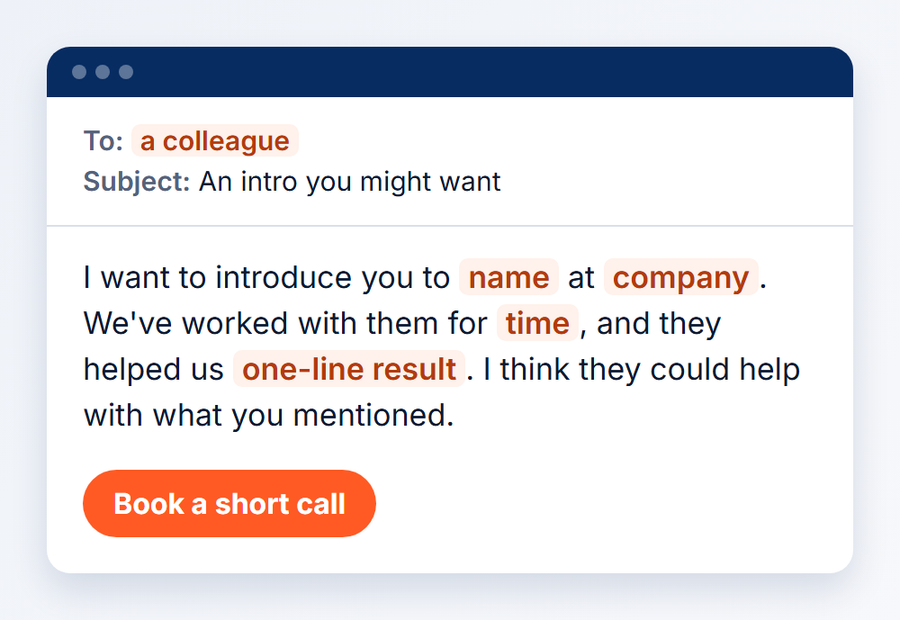
An intro email the sharer can forward: "I want to introduce you to [name] at [company]. We've worked with them for [time], and they helped us [one-line result]. I think they could help with what you mentioned. Here's a link to book a short call: [link]." Swap in your own details.
4. Pay at closed won, and keep the sharer posted
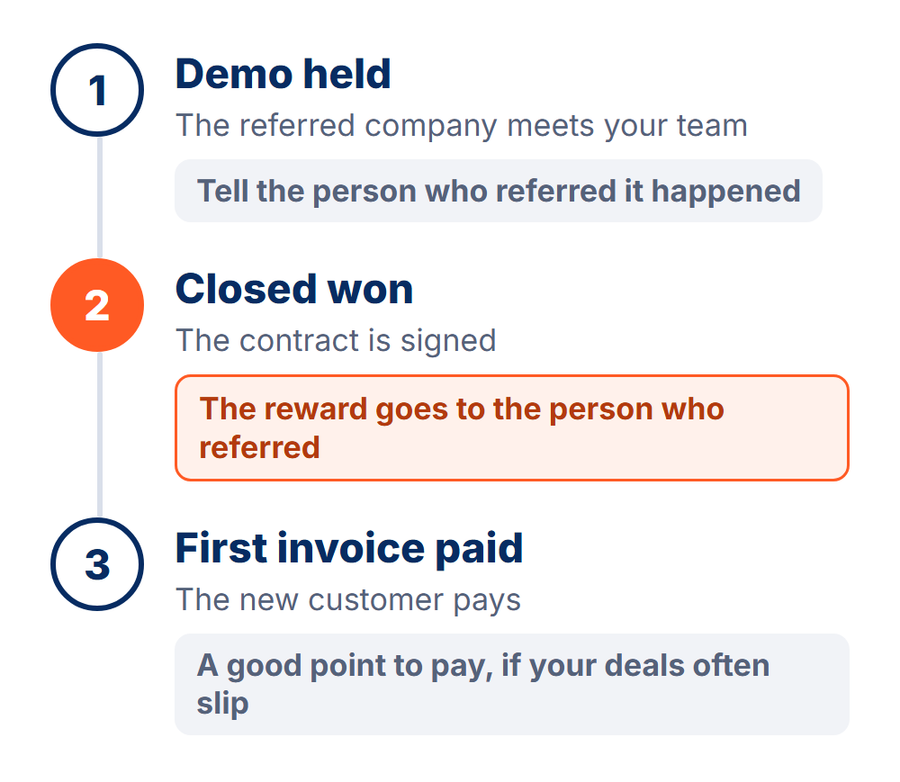
A B2B sale can take months. If the sharer hears nothing until the end, they may forget they referred anyone. So tell them at each step, like when the demo happens, and pay the full reward at closed won.
Paying at the end means you never reward a deal that stalls. Keep the new customer's offer open for as long, too: some peers take months to decide.
5. Ask soon after a great experience
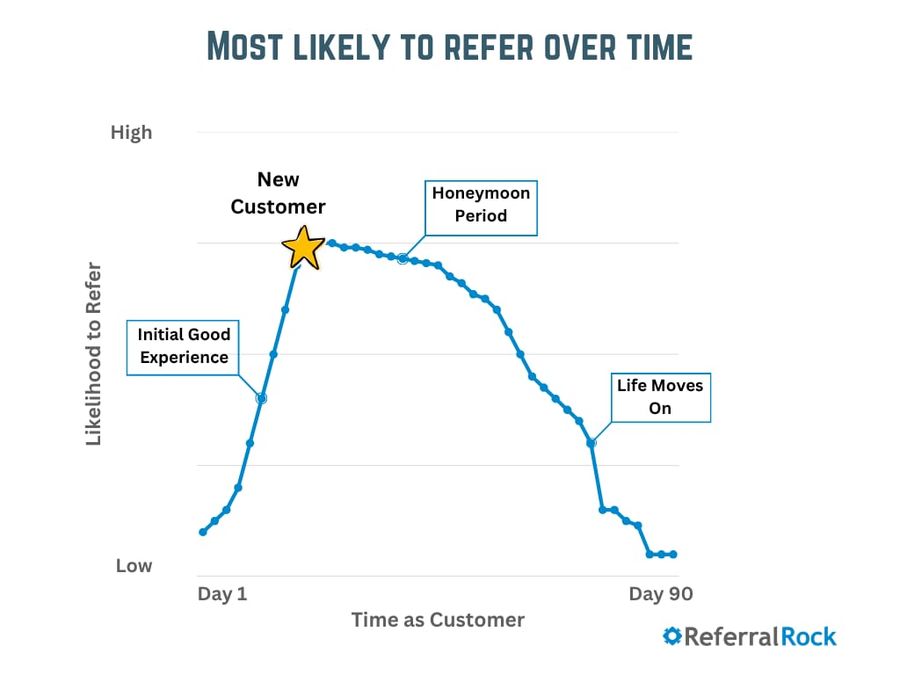
People are most willing to recommend you right after a good experience, and the urge fades as life moves on. One of our customers found 86% of their referrals came within 90 days of someone becoming a customer. We call this span the sharing window.
The window lasts weeks, so one perfectly timed ask isn't the goal. Ask early, then follow up gently while it's open. In B2B, it opens at go-live, the day the account starts using you, and comes back with every win they can point to.
4 good times to ask for referrals in B2B:
- Right after go-live, with their link in the welcome email
- After their first clear result
- At a quarterly business review, the regular results meeting with the account
- At renewal, or after a 9 or 10 on a customer survey
6. Put the program where customers already look
Customers forget a program they saw once. Put it in 3 to 5 places they already see, each with a short message and a clear way in:
- Inside your product or client portal
- Your help center and customer newsletter
- Customer success and support email signatures
- The last slide of every business review
A support signature, for example, might say "Know a team with the same problem? Introduce us," linked to the program. Programs that stall usually stall after launch, when the reminders stop. Placements like these keep the program in view without a big push; see how to promote a referral program for more places and messages.
7. Let customer success do the asking
Your customer success managers (CSMs) and account managers talk to customers every week. Their ask is the most personal one, and the program's emails follow it up. Give each one a personal link, so the right person gets credit for every referral their accounts send.
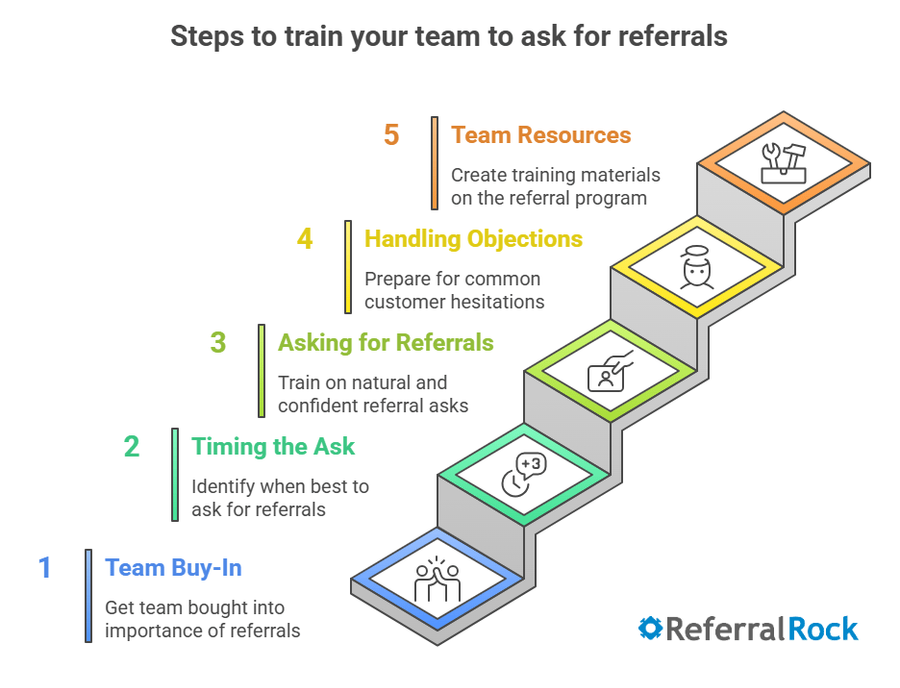
Senior contacts often prefer to make an introduction rather than forward a link. So let your CSMs offer both: a link to share, or a short intro email they can send for the customer.
3 things your CSMs can say, in their own words. Each puts what the peer's team gets before the thank-you, so the ask reads as a favor:
- At a business review: "It's great to see these results. If you know someone at another company dealing with the same problem, I'd love an introduction. Their team gets [your offer], and we'll thank you when the deal closes. Here's your link."
- After a support win: "Glad we got that sorted. If anyone in your network runs into the same thing, I'm happy to help them too. Here's a link you can pass along, with [your offer] for their team."
- At renewal: "Thanks for another year with us. Most of our best customers came from introductions like yours. If someone comes to mind, your link is in this email. They'll get [your offer], and a thank-you goes to you once they sign."
8. Watch shares before deals
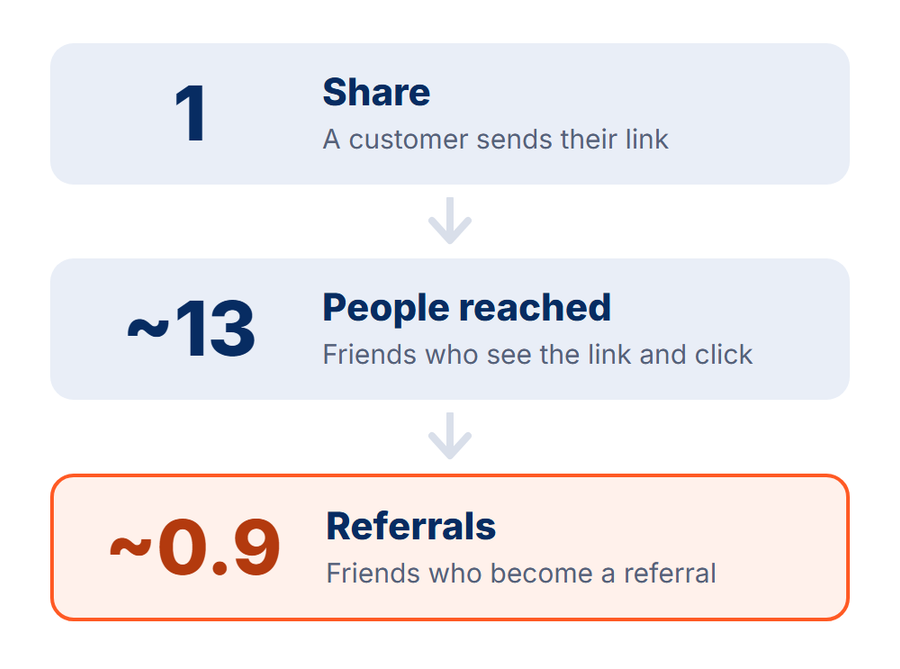
Closed deals are the last number to move, so watch shares first and how many people they reach. In our June 2024 data, one share reached about 13 people and led to about 0.9 referrals, across all program types on our platform. If shares climb, pipeline follows. Our referral tracking guide covers what else to watch.
In B2B, follow each referral all the way through your CRM:
| What to watch | Where it shows | What it tells you |
|---|---|---|
| Shares and reach | Your referral program | Whether customers are passing it on |
| Referrals and demos held | Your CRM, by lead source | Whether the right people are coming in |
| Closed won and deal size | Your CRM, by lead source | Whether referred deals beat your other sources |
| Time to close | Your CRM, by lead source | Whether referrals move faster than cold leads |
Compare referred deals with your other sources on win rate, deal size and time to close. If they win more often or close faster, that's the case for more of your CSMs' time.
Customers, partners or both
Customers refer as a favor. Partners refer as part of their business. Put both in one program and you end up with one reward that fits neither. Run them side by side instead.
| Customer program | Partner program | |
|---|---|---|
| Who refers | People at companies that use you | Agencies, consultants, resellers and other vendors |
| How often | Now and then, when a peer asks; a few refer again and again | Several deals a year, as part of their work |
| The reward | A gift card, cash or a donation for the sharer; money off for the new customer | A referral fee or commission |
| What they need | A link and an intro email to forward | A written agreement and a way to see where each deal stands |
FeedXL ran its two programs this way, each with its own reward. Put a partner's fee in writing before the first deal; our referral agreement templates are a free start.
B2B services work a little differently
Everything above fits software. If you sell a service, like managed IT, marketing or staffing, three things change.
- Fewer, bigger deals. A services firm may close a handful of new clients a quarter, so each referral matters more. Each one can carry a bigger thank-you, plus a discount on the new client's first project.
- The owner often asks. In a small firm, the person who leads the work is the one clients trust. Put the ask on the agenda of every project wrap-up, so it doesn't depend on memory.
- Partners matter more. Accountants, agencies and software vendors next to your service send steady work. A partner program with a written fee is worth setting up early.
4 rules for which referrals count
In B2B, two people can claim the same deal, and a referred company may already be talking to your sales team. Decide the rules before launch and put them in the program terms, so nobody argues later.
- New business only. Upsells and renewals at current customers don't count; that work belongs to account management.
- Not already in the pipeline. If the company is an open deal, pay a smaller reward (or no reward at all). One B2B company we spoke with halves the reward when the referred company was an open deal in its CRM in the past 6 months.
- A real fit. Count a referral only after a qualified call, one where your team confirms the company could buy, so a junk referral costs nothing.
- One deal, one referrer. The first person to refer gets the credit, by date. If a CSM and a customer both pass it along, credit the customer and thank the CSM inside your team.
7 real B2B referral programs
What 7 B2B software companies' referral pages offered in November 2026:
| Company | The sharer gets | The new customer gets | When it pays |
|---|---|---|---|
| ActiveCampaign | An Amazon gift card, $25 to $100 by plan | $10 account credit | After the new customer has paid for 60 days |
| GetResponse | $30 account credit | $30 account credit | When the new customer buys a paid account |
| FreeAgent | 10% off their subscription | 10% off their subscription | From the first paid month, for as long as both stay |
| UserGuiding | A $250 prepaid gift card, then 10% of the first year's deal value | Not stated | The gift card after a qualified discovery call; the 10% if they buy |
| Custify | A $250 Amazon voucher | Not stated | When the referred company becomes a qualified sales opportunity |
| Torii | $150 to $500, by the plan bought | Not stated | When the referred company signs a 12-month contract |
| DigitalOcean | $25 account credit | Not stated as an amount | After the new customer's first $25 in billing |
Three of the seven pay the referrer in account credit, which lands on the company's bill. The other four send the person something of their own. UserGuiding pays the sharer in two steps, a choice some companies with long sales make (that's known as a multi-step reward, which pays a smaller amount after a lead is qualified to keep sharers' motivation high, and then a significant amount after the sale).
Only three put a number on the new customer's offer. The other programs are missing that opportunity. So, there's plenty of room for your B2B to take advantage of offering a reward to the new customer and increase conversions.
Dropbox is the program everyone cites: its founder said in his 2010 talk that a two-sided storage reward permanently raised signups by 60%. But it was a consumer program that reached companies because people brought it to work. It's a weak model for a long B2B sale.
Referral software for B2B [Free Tools]
You can run a program by hand, build your own, or use software. The first three options below are free tools of ours.
| Option | Good for | The catch |
|---|---|---|
| Manual referral tracker | A few introductions a month | Links, follow-ups and rewards are all by hand |
| Referral link and code generators | Giving each contact something to share | No tracking or rewards on their own |
| Referral program workbook and fee calculator | Planning rewards and stages before you start | They plan the program; they don't run it |
| Building it yourself | Teams with developers to spare | You build and maintain every part, payouts included |
| Referral software | Running it every week, tied to your CRM | A monthly cost |
How Referral Rock runs it for B2B companies
The feature that fits B2B best is referral program recruiters. Each customer success manager or account manager gets their own portal and link. They invite contacts at go-live or a business review, and every referral that follows is credited to them.
You see which accounts and which people bring in pipeline. The rest runs in the background. Referrals reach HubSpot or Salesforce as leads, and each reward fires when the deal hits the stage you pick, like closed won. Rewards go straight to the sharer, by gift card or cash.
Every plan includes a program advisor who helps set it up. See how it works for B2B software companies.
Start with your next go-live
You don't need a big launch. Invite the contacts at your next customer to go live, ask at their first business review, and pay the person when the deal closes. Then add the rest of your customers.
If you're unsure it fits yet, the readiness check takes a few minutes.
About the author
Referral Rock Editorial is the team behind Referral Rock's guides and templates on referral, affiliate, partner and brand ambassador programs. Today's team writes, reviews and updates them, building on work by former staff and freelance writers over the years.