A financial services referral program lets customers send friends to your bank, credit union, lender, insurance agency or advisory firm. It also shows who sent each one. In finance, the rules shape that program more than anything else. So settle three things with your compliance team first: who you can thank, with what, and when.
The answers differ by kind of firm. A bank can often give both sides a bonus once the new account is funded and in use. An insurance agency usually sends a small gift when the friend gets a quote, buy or not. Then your tellers, loan officers, agents and advisors do the asking.
This guide is written for the firm that runs the program: its marketing, branch and compliance teams. It covers what changes by kind of firm, then points you to the guide for yours.
The call quotes in this article come from our sales and customer calls, shared without names.
What is a financial services referral program?
A financial services referral program asks customers to send friends your way. They pass on a personal link, card or code, or a friend names them at the branch. The firm tracks who sent each new account, loan, policy or client and thanks the sharer within its rules.
Financial institutions also call it a financial referral program or a refer-a-friend program. A bank's "refer a friend" bonus page is the same program, seen from the customer's side.
Two other things show up in the same searches. Advisors and CPAs sending clients to each other is a partner program, covered in the advisor guide's section on centers of influence. Staff passing a customer to another department is an internal referral, handled as staff pay outside the customer program.
Why referrals fit financial services: people trust a friend with their money
Picking a bank, a lender or an advisor means trusting someone with your money for years. So people ask a friend who already banks there, or who got a fair rate on a loan, and that trust carries over. In a 2011 study of one German bank, referred customers were worth at least 16% more than similar customers. They were also about 18% less likely to leave.
A program doesn't create that word of mouth. It amplifies what your customers already say. It gives them something easy to pass on, and gives your front line a reason to bring it up.
What a new customer is worth shows how much room you have for a thank-you. Accounts, loans and policies are kept for years, so the room is real. In finance, though, the rules set the ceiling, and they come before anything the numbers suggest.
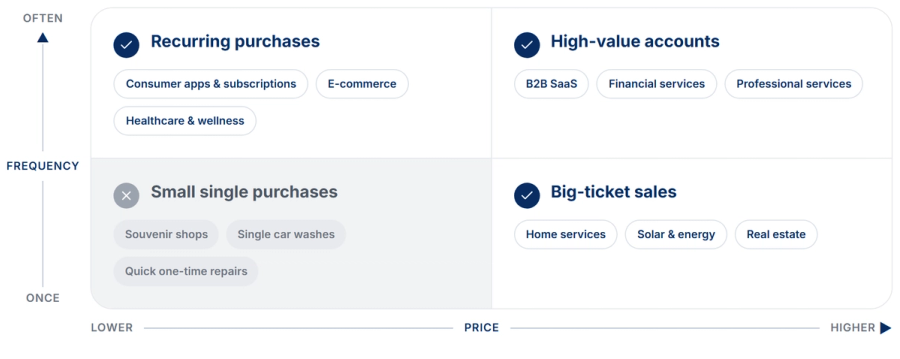
6 signs your firm is ready for a referral program
Check these 6 signs before you start, here in finance terms.
| Sign | What it looks like at a financial firm |
|---|---|
| 1. Word of mouth | The "who referred you?" line on the account, loan or quote form gets filled in |
| 2. Easy to talk about | Customers mention a fast loan close, a claim handled well or a rate that beat the big bank |
| 3. Community | Your customers know people like them: neighbors, coworkers, employer groups, members' families |
| 4. Service team | Tellers, member service reps, loan officers, agents and advisors know customers by name |
| 5. Business software | New accounts live in a core system, a CRM (customer database) or an agency management system you can export from |
| 6. Established marketing channels | Branch traffic, search and rate ads bring in new customers every month |
If several are missing, work on those first. The readiness check walks through all 6 in a few minutes. In finance, one more thing comes before launch: the rules, covered next.
Settle the rules first: who you can thank, with what, and when
Before you choose a reward, agree on three answers with compliance. Who you can thank: your customers and the referred friend, with partners on separate written terms. With what: a bonus, a small gift card, a donation or a note. And when: a step your own records prove, such as a funded account, a funded loan, a quote or a first meeting.
Here is how the answers usually fall by kind of firm. Each row links to the full guide.
| Your firm (its customers) | What it can usually give | When it usually pays |
|---|---|---|
| Banks (account holders) | A bonus to both sides, in terms compliance signs off | Once the new account is funded and in use |
| Credit unions (members) | A reward to both members, often a deposit to their account or a gift card | Once the new account is funded and in use |
| Lenders and mortgage companies (borrowers) | Consumer loans: a reward to both sides. Mortgages: nothing until compliance clears it | When the referred loan funds |
| Insurance agencies (policyholders) | A small non-cash thank-you, like a gift card, within your state's limits and never tied to the sale | At the quote, buy or not |
| Financial advisors and investment firms (clients) | A small, personal thank-you or a donation, within your firm's gift limit | At the friend's first meeting, client or not |
These are common patterns, and your own rules may differ. Check yours with your compliance team before you write a word of the offer.
Who you can thank: customers and the referred friend, with partners on their own terms
The customer program covers two people: the customer who shares and the friend who comes in. Thank both if your rules allow. When a business customer refers, thank the person who made the introduction. A credit on the company's account lands with nobody.
Partners who send you business are a second program. Realtors, builders, CPAs, attorneys and employer groups expect written terms. A payment to a mortgage partner needs a compliance check before any amount is set. The referral partnerships guide covers how to set those up.
Keep your own staff out of the customer reward, and handle any thank-you to them as staff pay. Your HR and compliance teams set what a teller or loan officer may earn for bringing someone in.
What you can give: a bonus, a small gift, a donation or a note
Banks and credit unions mostly give a cash bonus or a deposit to the account. On our calls, the live question for credit unions is deposit or gift card. A gift card can be sent automatically, and while a deposit is felt right away in the new or existing account, someone at the credit union has to post each deposit by hand. Insurance agencies and advisors usually give a small non-cash gift under a yearly limit.
Where gifts are tight, some firms let the sharer pick a donation in their name instead. A credit union might give to a local school or food bank, for example. A handwritten note works everywhere. Whatever you give, pick an amount people notice that your rules and margins allow, keep it the same for everyone, and leave it alone.
Plan the friend's welcome under the same rules; step 2 below covers what to offer. The rewards and incentives guide covers the choices in more depth. A referral fee is income for whoever receives it. Ask your accountant how to handle the payouts.
When it pays: the step your own records can prove
In the majority of cases, the thank-you goes out when the friend becomes a customer: a funded account in use, or a funded loan. Two kinds of firm thank earlier, and each guide explains why. Insurance agencies thank at the quote, because the reward can't hinge on the sale. Advisors thank at the friend's first meeting, client or not.
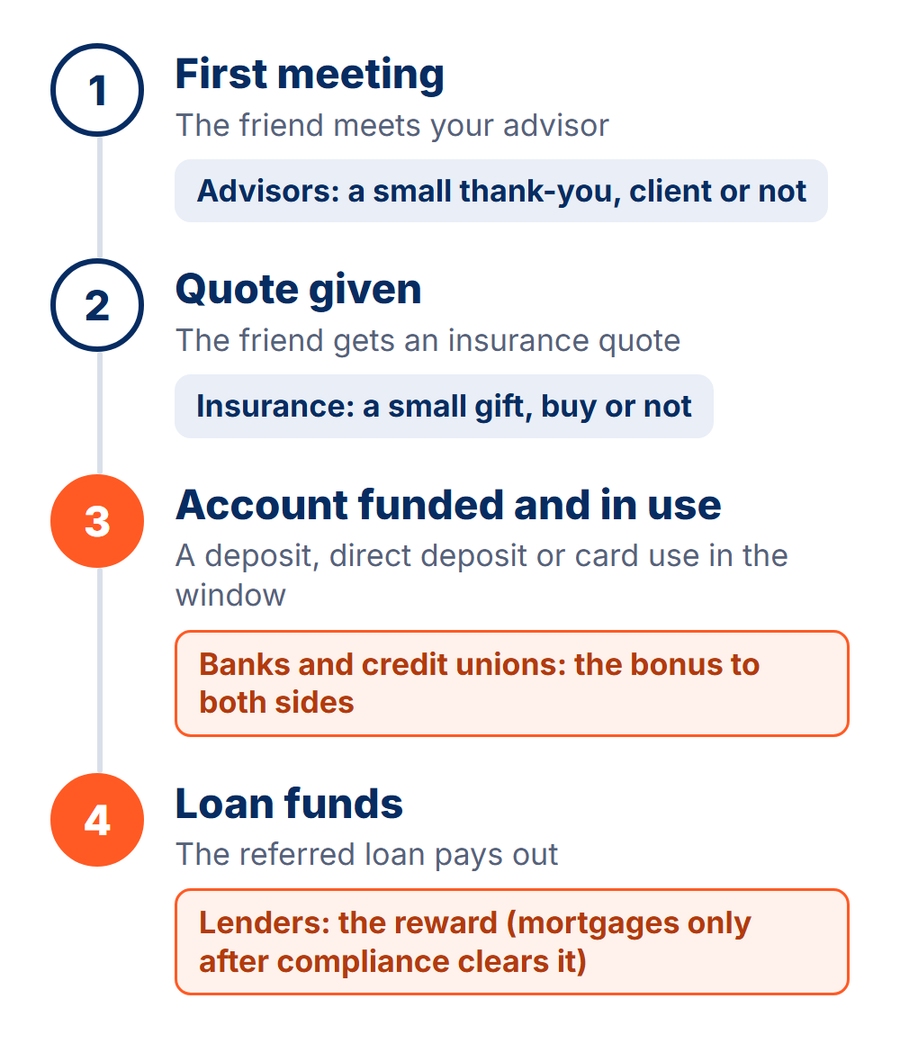
The friend's welcome usually goes out at the same step, as the real programs below show. Keep the friend's offer open as long as your terms allow, since some friends act within a day and others take months.
Sharers want to know their referral landed, so tell them when the friend comes in and when their thank-you is sent. Do it only as far as your privacy rules allow. Some credit unions don't confirm that the friend opened an account. They say only that a reward is on its way, and they put that in the terms.
So do you know whether or not showing the referrer that [the friend] opened an account with us is a violation or not?
8 questions to settle with your compliance team before launch
Referral program compliance covers more than the terms. Every email, landing page and message the friend sees goes through review too, so plan for a few weeks.
So all content, all the emails that we create, any landing pages, all of that, I'm going to have to route for approvals.
These are the questions compliance teams raised on our calls. Settle them before launch:
- Who can share. Customers or credit union members, any partners, and whether staff are left out.
- What the sharer gets. The form (bonus, deposit, gift card, donation) and any yearly cap.
- What the friend gets. And whether your rules count that welcome as a bonus, or as an inducement to sign up.
- The step that triggers the reward. One your records can prove, from the table above.
- What you may tell the sharer. Whether the friend came in, opened an account or became a client.
- The terms wording. Who's eligible, when the offer ends, any expiry on a gift card, and the disclosures your kind of firm needs.
- Who approves each reward. And the record that shows it was approved before it went out.
- The vendor review. Security and data handling, if software will hold customer names.
Bring these to compliance with a draft in hand. A one-page draft of the offer and terms gets a faster answer than an open question.
How to run it once the rules are set, in 5 steps
These steps follow the order our program advisors use. Each trade guide has the full version, and so does our guide on how to build a referral program.
1. Invite every customer, starting with new ones
Start with customers from the last few months, then add each new one once their account, loan, policy or plan is in place. People are most willing to share soon after a good experience. One business on our platform found 86% of their referrals came within 90 days of someone becoming a customer. We call that span the sharing window.
Invite everyone, the quiet ones too, and follow up while the window is open, since a single email is easy to miss. Every customer should already have a personal link, with no extra sign-up or password standing in the way. We call that keeping access open.
2. Plan the referred friend's welcome
In our November 2024 review of 339 referral programs, 54% gave the friend nothing. That's a missed opportunity. A welcome turns the recommendation into a gift: a matching bonus, money toward a loan, a free coverage review or a free first meeting.
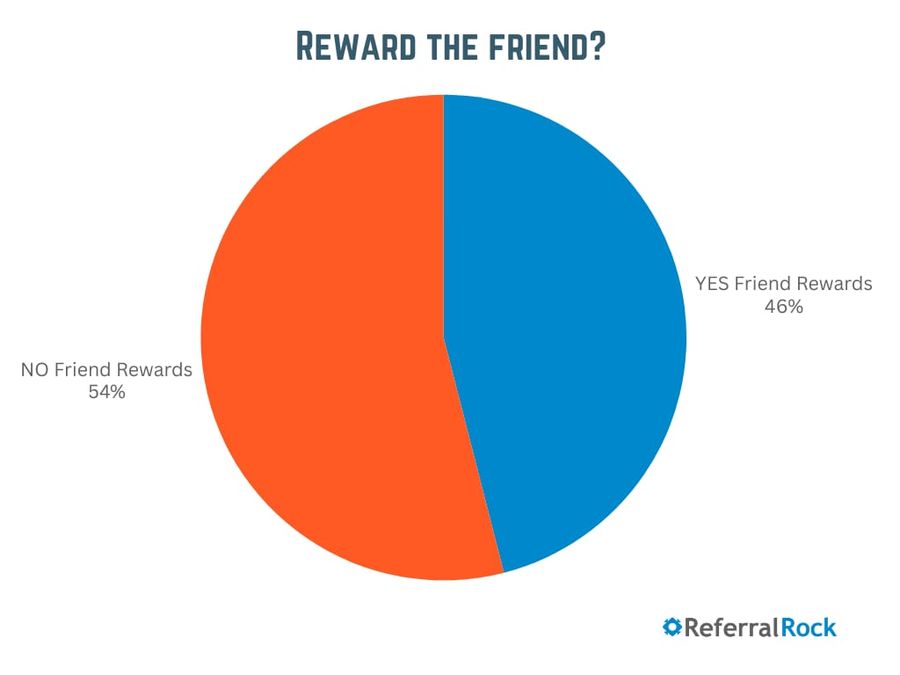
The friend's welcome matters most where the sharer can't be paid much. A 2020 field test at a video game subscription company shows why. When the friend got a free month, 4.77% of customers asked brought in someone new. With no reward at all, only 0.61% did.
That test wasn't at a financial firm, but the lesson fits anywhere the sharer's reward is capped. The friend's offer needs your compliance team's OK too.
3. Let tellers, loan officers, agents and advisors ask
The most personal ask comes from the person who opened the account, closed the loan, bound the policy or ran the review. They start the ask, leading with what the friend gets. The program's emails then follow up with the link and a reminder, so nothing rests on memory.
So we have our tellers in our branches that are talking about it.
Give each person on the front line their own link, so the referrals they start are credited to them. Then you can see who asks, and thank your best askers.
4. Log the referrals that arrive by name at the branch or on the phone
In finance, many friends walk in or call and say who sent them. They never touch a link, so nobody gets credit unless someone writes it down. Put a "who referred you?" field on the account, loan or quote form, and make sure it gets recorded for branch and online openings alike.
When they open an account, they're prompted.
One credit union on our platform saw almost no referrals in its first weeks. Its account-opening question told a different story: five new members said a member had sent them. Those members had passed the word on at the branch, and their friends never used a link. The credit union added those referrals by hand, so each sharer was thanked, then asked members to send their link next time.
5. Keep it where customers already look, and watch shares before referrals
Customers forget a program they heard about once. Put it in 3 to 5 places they already look. Online and mobile banking, statements and the welcome email all work, and so do renewal and review-meeting follow-ups and a card at the branch counter. In our October 2025 review of 952 programs, 82% of the stalled ones stalled because promotion stopped after launch.
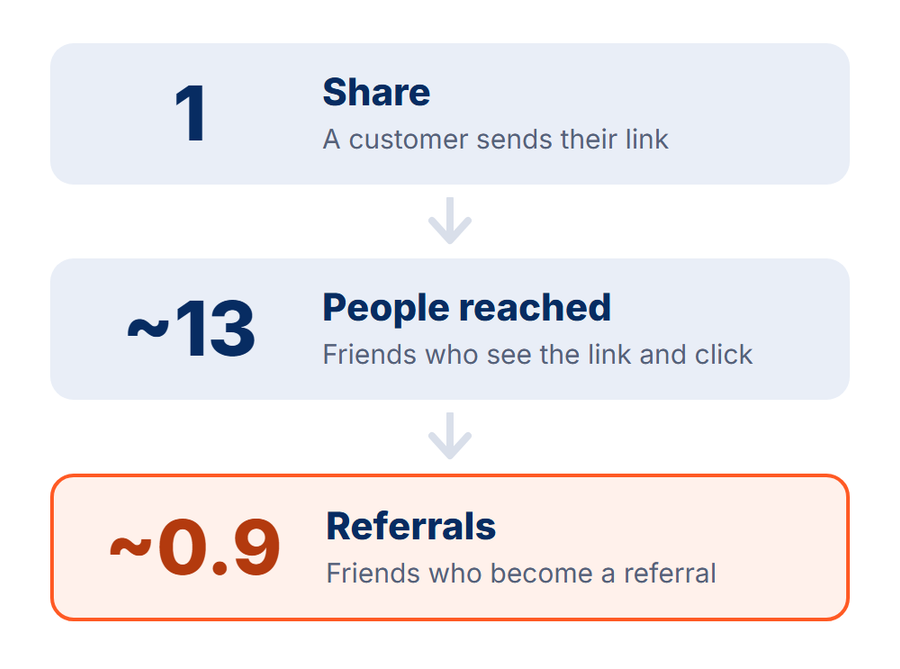
Referrals are the last number to move. Watch first whether customers open the invites and share, then how many people those shares reach. In our June 2024 data, one share reached about 13 people and led to about 0.9 referrals, across all program types on our platform.
Real referral programs from banks, credit unions, lenders, insurers and advisors
What 5 firms' referral pages offered in November 2026, one for each kind of firm:
| Firm | The referrer gets | The friend gets | When it pays |
|---|---|---|---|
| TBK Bank | $50 Mastercard card, up to $500 a year | $50 Mastercard card | New checking opened and used |
| OnPoint Community Credit Union | $50 | $50 | Checking with direct deposit |
| Vantage Credit Union (auto loans) | $100, up to $500 a year | $100 | Auto loan complete |
| Root (car insurance) | Amount not stated | Amount not stated | Quote viewed in the app |
| The Private Office (UK advisors) | Gift card or donation, £400 | Free first consultation | Friend qualifies for that consultation |
Four of the five give the friend a reward; The Private Office gives a free first consultation instead. All five pay at a step the firm can prove. As the rules table suggests, Root thanks at the quote, before any sale, and The Private Office at the first meeting. Its gift is larger than most US firms could give, and Root's page doesn't say how much its offer is.
Referral software for financial services and other ways to run it
You can run a program by hand, build your own, or use referral software. For a financial firm, the best fit keeps a record of every reward your compliance team can check. The first four options below are free tools of ours.
| Option | Good for | The catch |
|---|---|---|
| Manual referral tracker | A pilot at one branch or office | Links, follow-ups and thank-yous are all by hand |
| Referral link and code generators | Giving each customer something to share | No tracking or approvals on their own |
| Referral program workbook | Planning the offer, the terms and the timing for compliance | It plans the program; it doesn't run it |
| Referral fee calculator | Checking what a reward costs per new customer | It sizes the cost, not what your rules allow |
| Building it yourself | Firms with developers and room in the IT queue | You build, secure and maintain every part |
| Referral software | Running it every week, with a record of every reward | A monthly cost and a vendor security review |
How Referral Rock runs it for financial firms
The feature that fits financial firms best is referral program recruiters. Each teller, loan officer, agent or advisor gets their own portal and link. At the counter or after a review meeting, they sign the customer up on the spot, and every referral that follows is credited to them.
The rest runs in the background. New customers come in through native integrations, including HubSpot and Salesforce, or a regular file upload, and get invited on the days you choose. Each reward waits for approval at the step you set, and every referral and reward stays on record for your compliance team.
Every plan comes with a program advisor at no extra cost. Your advisor sets the program up with you, including the wording your compliance team will review. Then they stay with you for as long as you're a customer: regular check-ins, strategy advice and technical help with your integrations. See how it works for financial services.
Start with your compliance team, then your front line
You don't need a big launch: a program builds over months, as each new customer is invited. Sit down with compliance and settle the three answers for your firm: who gets a thank-you, what it is, and when it goes out. Write them into the terms, along with the friend's welcome.
Then give your front line a link, and ask the next happy customer, leading with that welcome. If you're not sure a program fits yet, the readiness check takes a few minutes.
About the author
Referral Rock Editorial is the team behind Referral Rock's guides and templates on referral, affiliate, partner and brand ambassador programs. Today's team writes, reviews and updates them, building on work by former staff and freelance writers over the years.