A bank referral program gives your account holders an easy way to send friends your way. When a friend opens and funds an account, both of them get a bonus, and you know exactly who sent whom. It works the same way at a credit union, where the people referring are your members.
Most banks and credit unions already grow by word of mouth. The hard part is making it count: a name on a paper slip, a bonus posted by hand, and terms that compliance sends back. This guide builds the program around how accounts really open, from the first deposit to the teller window.
Why referrals fit banks and credit unions
People choose a bank on trust, and they borrow that trust from people they know. In Deloitte's Banking CX Maturity Study 2025, 50% of retail banking customers named personal recommendations as the most important factor in picking a bank. The survey covered 1,250 customers in Switzerland, so treat it as a signal for US banks.
It works for big banks too. At Ally, referrals make up about 15% of account volume and cost under $100 per new customer. An Ally executive shared those numbers with Banking Dive in 2025. By the bank's own count, that's 3 to 4 times more efficient than its other marketing.
An account is also worth a lot over time. People keep a checking account for years, then add savings, a card or a loan. That leaves room for a real bonus on both sides.
The asking usually starts with your tellers, member service reps and loan officers, the faces people see at account opening or a loan closing.
6 signs you're ready for a referral program
A referral program amplifies the word of mouth you already get. So check these 6 signs first, here in banking terms.
| Sign | What it looks like for a bank or credit union |
|---|---|
| 1. Word of mouth | New account holders already say "my sister banks here" |
| 2. Easy to talk about | People tell friends about your fees, your app or the teller who knows their name |
| 3. Community | Your account holders live and work near people who could bank with you |
| 4. A service team | Branch staff follow up and fix problems fast |
| 5. Business software | Account holders live in your core banking system, a marketing file or a CRM (a customer database) |
| 6. Steady marketing | Rate offers, branch events and ads bring in new accounts every month |
If several are missing, work on those first. The readiness check walks through all 6 in a few minutes. Banks and credit unions have one more step before launch: bonus terms that compliance can sign, covered in step 3 below.
How to run a bank referral program in 8 steps
These steps follow the order our program advisors use to set up a new program, each answered for a bank or credit union.
1. Invite every account holder, starting with new ones
Start with accounts opened in the last few months, then add each new account holder the week they open. People who just opened an account are the most likely to recommend you, so they come first.
Everyone gets a personal referral link right away, with no form and no extra login. A sign-up step loses people, while a link already in their inbox or app lets them refer a friend the moment money comes up. That's what we call keeping access open.
Jefferson Bank, one of the programs below, puts each account holder's link and QR code inside online and mobile banking. A link in an email works just as well, and it doesn't touch anyone's banking login.
2. Give the friend a bonus too
Many programs reward only the sharer, the account holder who passes the link on, but that's a missed opportunity. In our November 2024 analysis of 339 referral programs, 54% gave the friend nothing. Skipping the friend makes the ask feel like a sales pitch. A bonus for the friend turns it into a tip between friends: "Open an account here and you'll get $25 too." It also gives the friend a reason to act.
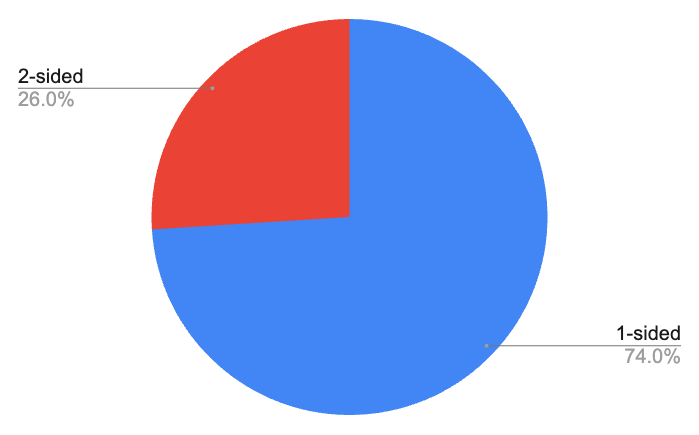
In our calls with credit unions, $25 to each side came up most often, and the banks below pay $50. Then decide how to pay it: a deposit into each person's account, or a gift card. Pick the one your back office can post without doing it by hand.
Points work too, but they need a catalog and a balance people remember to check, so the programs below all pay cash or gift cards. For more ways to reward both sides, see our guide to referral rewards.
3. Agree on the terms with compliance
A bonus offer usually goes through compliance before it goes out. Agree on four things before launch: the steps the friend must take, the time limit, the minimum balance and when the bonus is paid. Then show those terms on the friend's page and in every email, so nobody is surprised.
Sample terms to adapt: "Open a new checking account with a friend's referral link, set up direct deposit and deposit $400 within 60 days. You and your friend will each get $25, deposited within 30 days after you qualify. APY and fees: see our rate sheet."
Two more decisions belong with compliance. First, what you tell the sharer: some banks only say "your bonus is on its way" and never name the friend's account. Whatever you can say, say it promptly: that their referral came in, then that the bonus(es) posted. Second, how bonuses get reported for taxes, a question for your tax team.
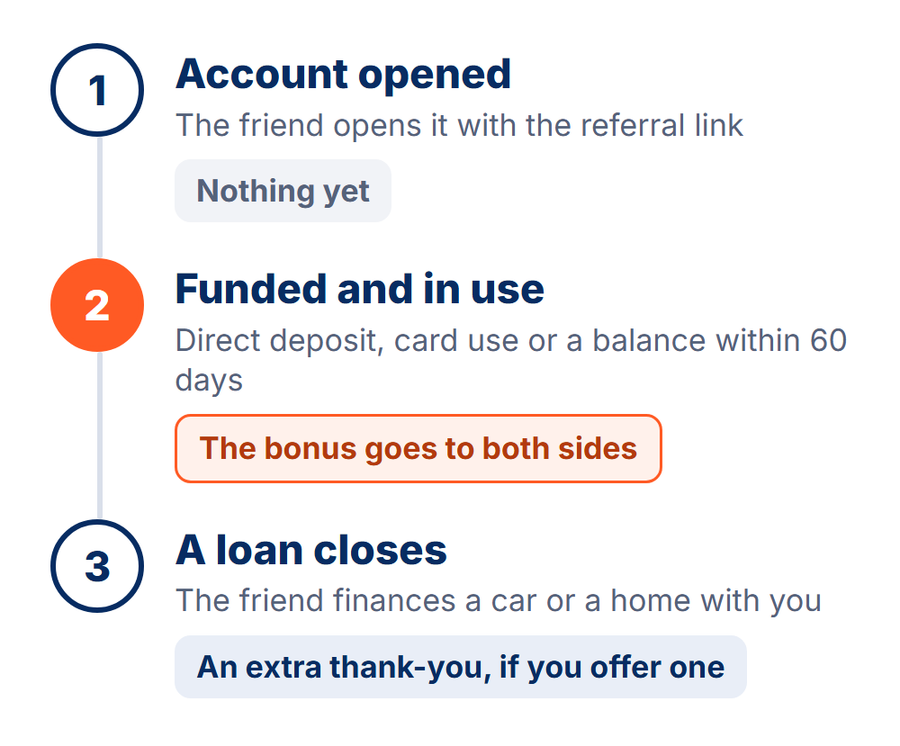
4. Pay once the account is funded and in use
The classic worry is the friend who opens an account, takes the bonus and leaves. So wait to pay until the account is funded and in use. TBK Bank, for example, asks for 10 debit card purchases or $500 in direct deposits within 60 days.
5. Ask soon after a great experience
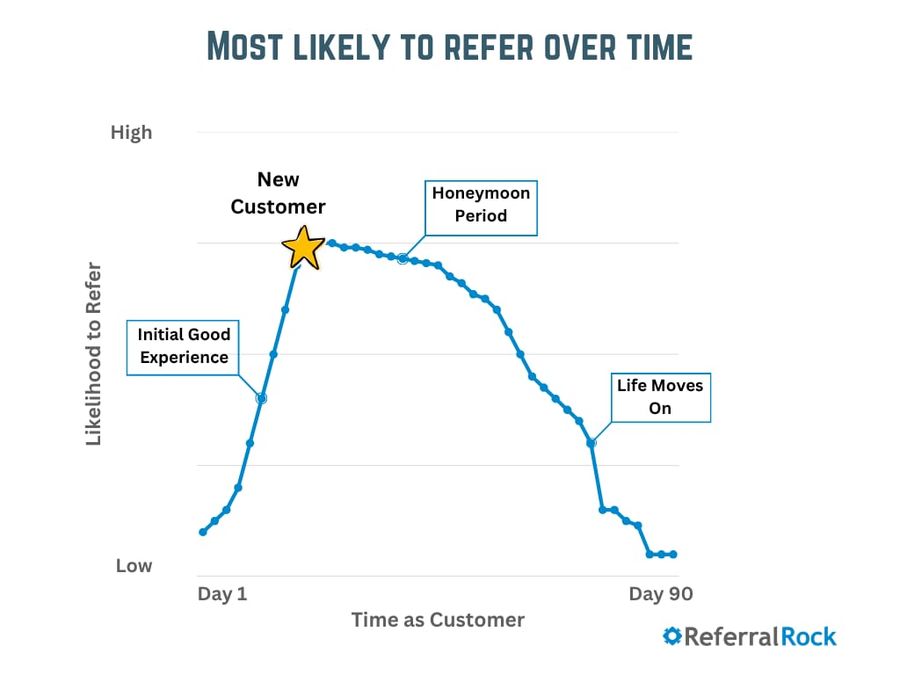
People are most willing to recommend you right after a good experience, and the urge fades as life moves on. One of our customers found 86% of their referrals came within 90 days of someone becoming a customer. We call this span the sharing window.
The window lasts weeks, so one perfectly timed ask isn't the goal. Ask early, then follow up gently while it's open. At a bank, the window opens with a new account and peaks when the first paycheck lands or a loan closes.
4 good times to ask for referrals at a bank:
- In the welcome email, with their link
- When their first direct deposit posts
- At a loan closing, in person
- At a 60-day check-in, then once a year
Lead each ask with what the friend gets, so passing the link on feels like giving a gift.
6. Put the program where account holders already look
People forget a program they saw once. Put it in 3 to 5 places they already see, each with a short message and a clear way in:
- A "Refer a friend" spot in online banking and your app
- Statements and e-statement emails
- QR codes at each teller station and the drive-through
- Your website and staff email signatures
Employer groups count too. If you offer accounts through local employers (a bank-at-work program), hand out the link at lunch-and-learns. Put it in the welcome kit as well, so new account holders can pass it to coworkers.
Programs that stall usually stall after launch, when the reminders stop. Placements like these keep the program in view without a big push. For more places and messages, see how to promote a referral program.
7. Let tellers, member service reps and loan officers ask
Your branch staff make the most personal ask, and every referral they bring can be credited to them. The teller starts the ask at the counter; the program's emails follow up with the link and reminders, so nothing rests on memory. Give each one a personal link and a QR card. Keep staff out of the bonus for sharers and friends, and thank them under separate rules.
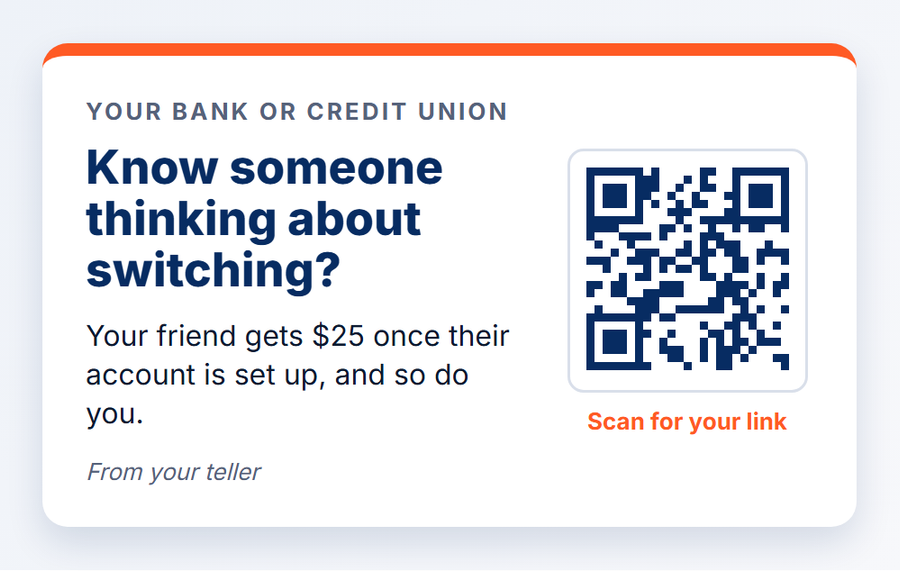
What to say at the counter: "Thanks for opening your account with us. If a friend or family member is thinking about switching, here's a card with your link. Your friend gets $25 once their account is set up, and so do you." Swap in your own offer.
8. Watch shares before new accounts
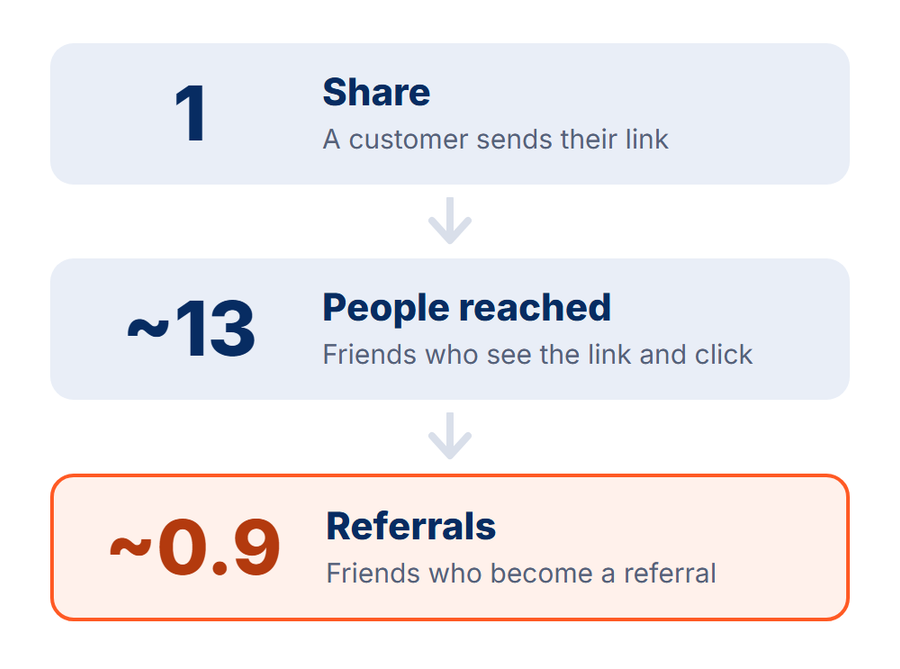
New accounts are the last number to move, so watch shares first and how many friends they reach. In our June 2024 data, one share reached about 13 people and led to about 0.9 referrals, across all program types on our platform. If shares climb, new accounts follow. Our referral tracking guide covers what else to watch.
Then look at funded accounts and balances after 90 days. Don't expect the numbers to show everything: some recommendations never touch a link, and some referred friends would have joined anyway.
4 real bank and credit union referral programs
Here is what each referral page offered when we checked in November 2026:
| Institution | What each side gets | When it pays |
|---|---|---|
| TBK Bank | A $50 Mastercard reward card each, with the sharer's capped at $500 a year | After 10 debit card purchases or $500 in direct deposits within 60 days |
| Jefferson Bank | $50 to the sharer per new household, up to $500 a year; the page states no bonus for the friend | Within 15 business days after the new checking account is funded |
| Bethpage Federal Credit Union | A $25 deposit each | When the friend joins and deposits $25 |
| CRCU | $25 each | After direct deposit and a $400 deposit within 60 days |
Three of the four give the friend a bonus too, and all four wait until the new account is funded, just like the advice above.
Referral software for banks and credit unions [Free Tools]
You can run a program by hand, build your own, or use software. The first three options below are free tools of ours.
| Option | Good for | The catch |
|---|---|---|
| Manual referral tracker | A pilot at one branch | Links, follow-ups and bonuses are all by hand |
| Referral link and code generators | Giving each account holder something to share | No tracking or bonuses on their own |
| Referral program workbook and fee calculator | Checking that a bonus fits, and planning terms and timing before you start | They plan the program; they don't run it |
| Building it yourself | Banks with developers and a long IT queue to spare | You build, secure and maintain every part |
| Referral software | Running it every week without posting bonuses by hand | A monthly cost and a vendor security review |
How Referral Rock runs it for banks and credit unions
The feature that fits banking best is referral program recruiters. Each teller, member service rep or loan officer gets their own portal and link. At the counter, they sign the account holder up from a phone or tablet, and every referral that follows is credited to them.
You see who brings in new accounts, so you can thank your best askers. The rest runs in the background. New account holders come in from HubSpot, Salesforce or a regular file upload and get invited on the days you choose. Each bonus is approved once the new account qualifies.
Every plan includes a program advisor who helps set it up. See how it works for banks and credit unions.
Start with this week's new accounts
You don't need a big launch. Invite this week's new account holders, ask when their first paycheck lands, and pay both sides once the account is in use. Then add the rest of your account holders.
If you're unsure it fits yet, the readiness check takes a few minutes.
About the author
Referral Rock Editorial is the team behind Referral Rock's guides and templates on referral, affiliate, partner and brand ambassador programs. Today's team writes, reviews and updates them, building on work by former staff and freelance writers over the years.