A retail referral program rewards your customers for sending friends to your store. Online, the referred friend clicks a link and the store knows who sent them. In a store, the friend walks in, picks out running shoes or a ring, and pays at the counter with no link at all.
So a store's program runs at the counter. Your staff ask for the referral, and the friend is recognized at checkout by the sharer's name or a code. Plan that first, then the reward. This guide covers both, for specialty stores with 1 to 20 locations that sell in store and online.
The call quotes in this article come from our sales and customer calls, shared without names.
What a retail referral program is: a friend sent in, recognized at checkout
A retail referral program gives your customers a simple way to send friends to your store. The customer who passes it on is the sharer. The referred friend gets a welcome offer on their first purchase, and the sharer gets store credit once that purchase is final.
An in-store referral program has one extra job: knowing who sent the friend, since most friends never click a link. A store can recognize a referred friend at checkout in 4 ways.
| The way | How it works at the counter | The catch |
|---|---|---|
| The sharer's name | Staff ask "Did someone send you?" and note the name with the sale | Names get misspelled, so someone matches them later |
| A code on a card | The sharer hands the friend a card with their code, and the friend gives it at the register | Cards get lost, so keep the name question as a backup |
| An offer claimed ahead | The friend opens the sharer's link, claims the offer before the visit, and shows the code from the confirmation email | The friend has to claim it first |
| A QR code | The friend scans the sharer's QR code and shows the offer on their phone at the counter | The friend needs their phone at hand |
We suggest two: a card or QR code first, with the name question as the backup. Gray & Sons, a jewelry and watch store, works this way. The friend presents the referral card or gives the sharer's name at the sale.
So basically, it could even be as simple as the client saying, oh, I was referred and this is my coupon sort of thing. And then the salesperson would just bring it out however they wanted.
Why referrals work for stores: people show off what they bought
Specialty stores win word of mouth on two things. What you sell is easy to talk about: new running shoes after a gait fitting, a ring, new glasses, a bike. And your customers live near the people who need you, so the friend who asks "where'd you get that?" can walk in next week.
Life stages help too. Friends get engaged, buy homes and start running in the same few years. So one happy customer often knows several people about to buy the same thing.
it seems like every summer when you're 28 to 33, there's usually four or five weddings, you know, taking place in that age group.
The ask comes from the people on your floor. The customer trusts the salesperson who fitted the shoes or sized the ring. That makes the salesperson the natural person to hand over a card.
What each new customer is worth depends on price and how often people buy. That tells you how much room you have for a reward; step 4 covers picking the amount.
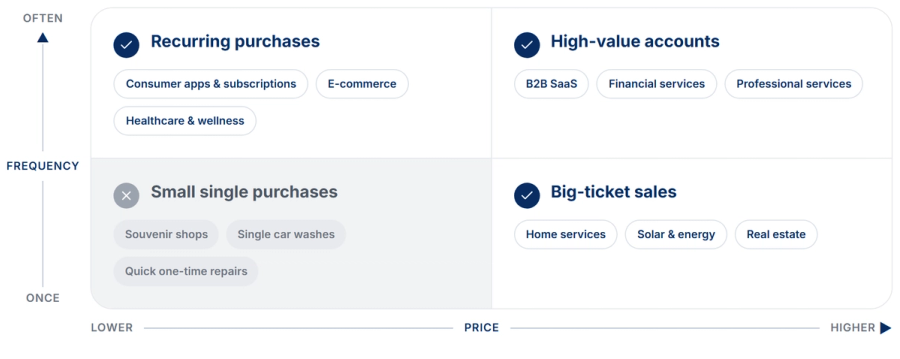
The counter still matters, since most US retail sales don't happen online. E-commerce was 17.9% of retail sales in the third quarter of 2026, by the US Census Bureau's count. A program amplifies the word of mouth your store already gets, so check first that it gets some.
6 signs your store is ready for a referral program
A referral program for retail stores works best when customers already recommend you. Check these 6 signs first, here in store terms.
| Sign | What it looks like for a specialty store |
|---|---|
| 1. Word of mouth | Staff hear "my friend told me to come here" every week |
| 2. Easy to talk about | What you sell gets noticed and asked about: a ring, new glasses, a bike, a sofa |
| 3. Community | Customers live and shop near the people who need you, often at the same life stage |
| 4. A service team | Floor staff know customers by name and follow through on fittings, sizing and delivery |
| 5. Business software | Each sale is recorded at the register or online with the customer's name and an email or phone number |
| 6. Steady marketing | A good location and steady foot traffic, plus ads, email or a website |
If several are missing, work on those first. A store that sells small one-off items, like a souvenir shop, will find a program hard to justify. A new store still building word of mouth can start with events (next section). The readiness check walks through all 6 in a few minutes.
Seed your community first, then hand out referral cards
Many specialty stores grow through events: group runs, fittings and demo days, clinics, tastings and trunk shows. A local partner helps too, like a café that hosts a run or a gym that hosts a clinic. Events bring people in and give them something to talk about.
Running stores do this well. Fleet Feet Montclair's weekly runs invite people to "Bring friends, family, co-workers or come alone." Fleet Feet Des Moines pitches its run club the same way: bring a friend along.
The events earn the word of mouth, and the program carries it further. The stores we looked at run their events and their referral offers separately. Our advice is to join them: hand every attendee a referral card or a QR code, with no signup first, regulars and first-timers alike. Picking who deserves one only slows you down, and there's no easy way to tell who will pass it on.
Here's your link. Here's your code. You know, we're having a wedding band event coming up. This will be the perfect time.
A new store is the clearest case. Before a referral card can do anything, people need a reason to talk about you. Start with the events, then give every person who comes a card for a friend.
How to run a retail referral program in 8 steps
These steps follow the order our program advisors use to set up a program, shown for a store.
1. Pick 2 ways your counter will recognize a referred friend
Choose a main way and a backup from the 4 above. A card handed over at checkout is the easy main way, and "Did someone send you?" catches the friends who forget it. Then decide how each gets recorded: the code entered at the register as the friend's discount, or the sharer's name logged with the sale.
Write it down so everyone on your team does the same thing at every register. One jewelry store we spoke with once ran its referral offer by hand. Friends didn't mention it at the counter, so staff had to look things up and apply the credit afterward. A card plus the name question closes that gap.
2. Have staff ask at checkout, and credit them for it
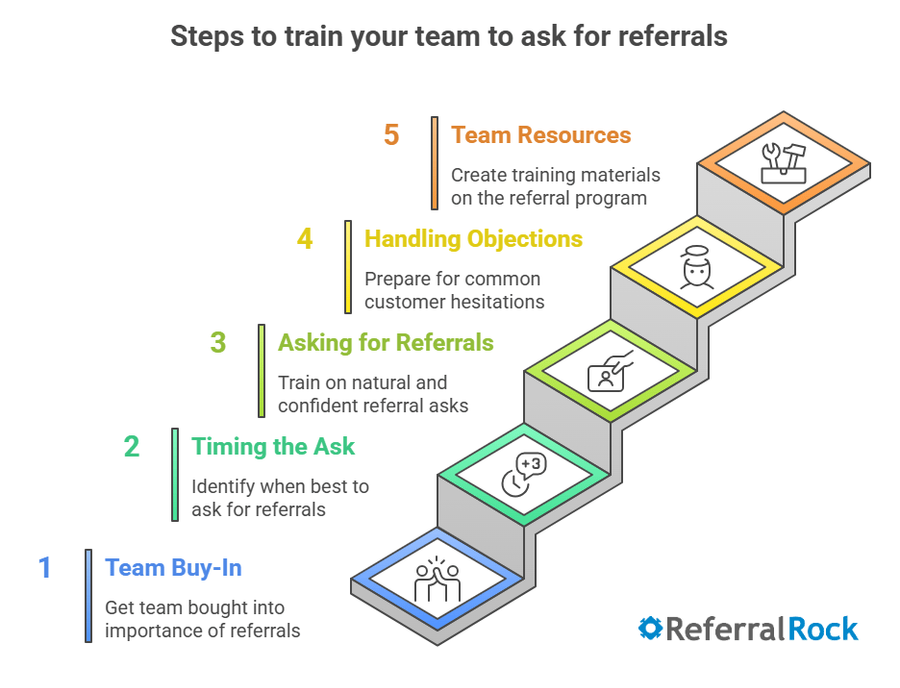
Your staff make the most personal ask, and it's the easiest to track. A salesperson starts it at the counter or the fitting, and the program's texts and emails finish it with the sharer's own link and reminders. The ask works best at a natural moment: the shoes fit, the ring is sized, the bike is tuned.
Hand your staff a short line to use (there's a script below), and credit each salesperson by name for the customers they bring in. Add a small thank-you for each referred friend who buys. On a sales floor paid by commission, like furniture or jewelry, fold it into the commission. Then compare staff and stores each month.
3. Give the referred friend a welcome offer for their first visit
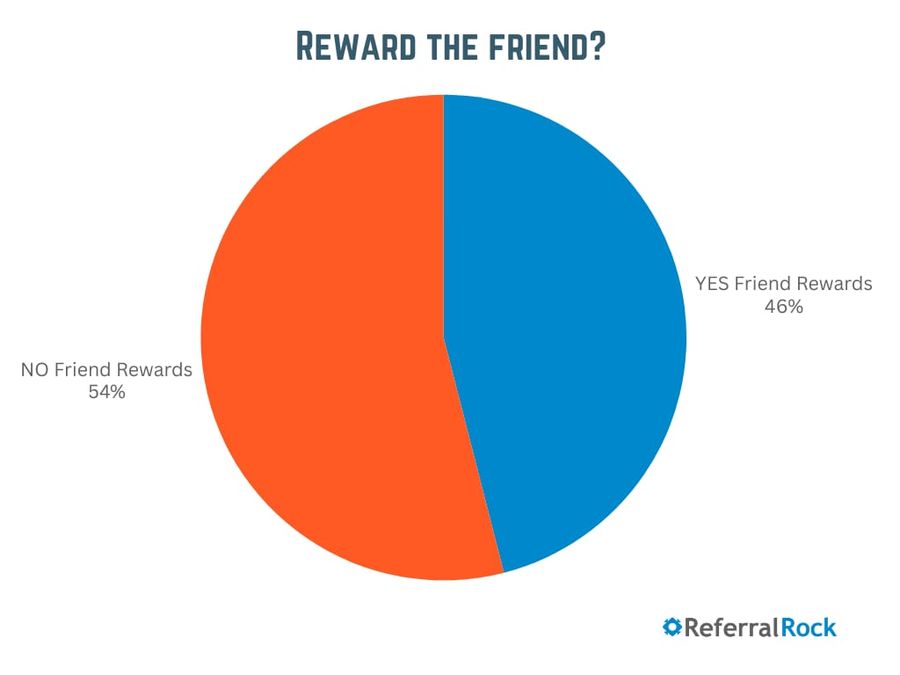
Start with the friend's side. A welcome offer turns "you should check out this store" into a gift: "Bring this card and you'll get $20 off."
In our November 2024 analysis of 339 referral programs, 54% gave the friend nothing. That's a missed opportunity: with an offer to pass on, the sharer is doing the friend a favor.
That offer is the referral discount: the money off a referred friend gets on their first purchase. Stores also give a gift with purchase, like free accessories with a new bike, or a free service, like a ring cleaning or a fitting. Make sure it works at the register and online. Keep it open with no short deadline, since some friends buy within a day and others take months.
4. Thank the sharer with store credit that brings them back
Store credit fits most specialty stores. The sharer comes back in to spend it, so the thank-you becomes another visit. A runner comes back for the next pair of shoes, and a jewelry customer comes back for repairs and gifts.
Where most customers buy once, credit doesn't fit. A gift card does. A door and home-improvement store we spoke with chose a gift card for that reason.
the advocate gets a Visa gift card, not store credit, because a lot of times. So that's the only front door they're going to buy for the next 20 years.
Pick an amount people notice that your margins carry easily, then leave it alone. Bigger isn't always better. Our advice is a fixed dollar amount over a percentage, since it's simpler to budget. For more ways to reward both sides, see our guide to referral rewards.
5. Pay the sharer once the friend's purchase is final
Hold the referrer's credit until nothing can come back. For most stores, that's after the return window closes, or after delivery for furniture and anything delivered. Both jewelers in our examples add the sharer's credit once the return period ends. Paying only once the friend has really bought also stops most fraud before it starts.
Tell the sharer when the credit will arrive, so the wait doesn't feel like a broken promise. A short text works: "Your friend picked up their new bike. Your $20 credit lands once our return window closes."
6. Hand every customer a way to share before they leave
Every customer should leave with something to pass on. That can be a card in the bag with the friend's offer, the code on the receipt, or a follow-up text with their own link. Nobody should have to sign up or log in first, because people pass it on in the moment or not at all. We call that keeping access open.
Customers are most likely to share soon after a good experience, and that urge fades. One of our customers found 86% of their referrals came within 90 days of someone becoming a customer. We call that span the sharing window. In a store, ask at the purchase, then again after the delivery, the fitting or the first ride.
Add every new buyer to the program each week, so nobody misses the follow-up.
7. Put the program in 3 to 5 places customers already look
A program that only lives on the website is easy to miss. Put it where your customers already are, each with a short message and a clear way in. We call these discovery paths. Start with 3 to 5:
| Place | The message there | The way in |
|---|---|---|
| A sign at the counter | "Know someone who'd love this? Ask us for a card." | Cards at the register, or a QR code on the sign |
| The receipt | "Give a friend $20 off their first visit." | The sharer's code, printed on the receipt |
| The bag or box | A referral card with the friend's offer | The card's code or QR code |
| The fitting room or delivery | A word from the salesperson or the delivery team | A card handed over in person |
| Your website and emails | A line in the footer and the order email | The sharer's own link |
So what a lot of our retail clients will do is they'll take the code to their registration page and disguise it as a QR code and then put it on like flyers, handouts, receipts, things like that. So as people receive material, they can scan it, join the program and participate from there.
8. Watch shares and counter mentions, then referrals
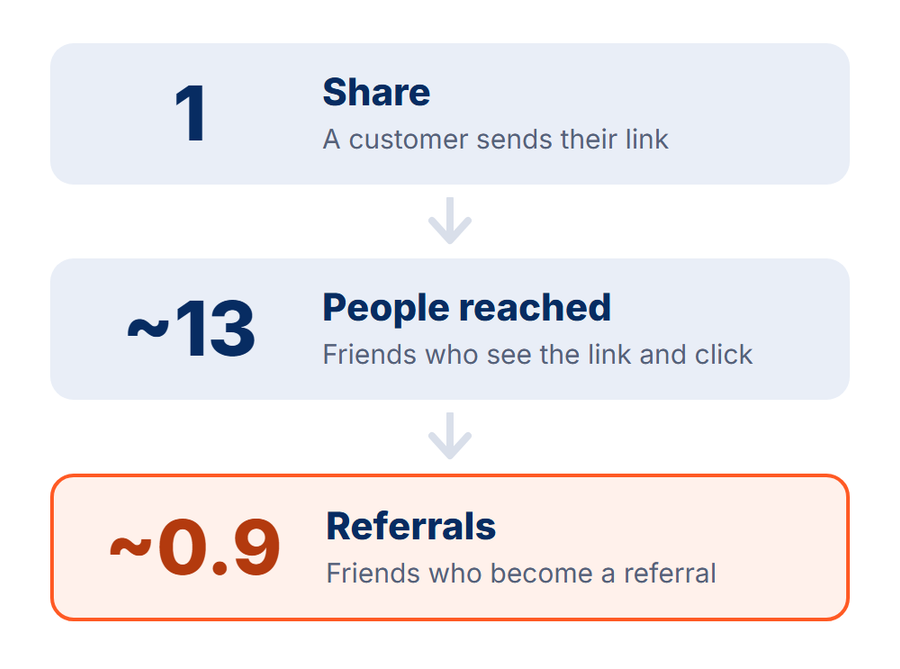
Referrals are the last number to move. Watch first how many cards go out, how many codes people share, and how often staff hear "a friend sent me." In our June 2024 data, one share reached about 13 people and led to about 0.9 referrals, across all program types on our platform.
Those early numbers are what we call leading indicators. Compare them by salesperson and by location. A store that hands out few cards will see few referrals a month later.
One program for the counter and your website
Most specialty stores sell online too, so run one program for both. Each sharer gets one code for the register and one link for your website. The friend gets the same welcome offer either way, and the sharer gets the same thank-you for every friend who buys.
The code suits the store, because a friend can say it or show it at the counter. The link suits a text or an email, where a click takes the friend straight to the offer. For the online side, like checkout codes and return windows, see our ecommerce referral program guide.
If you already run a loyalty card
Points and punch cards reward a customer's own repeat visits. A referral program thanks them for bringing a friend. Run both, and keep the referral thank-you separate. Our guide to referral vs loyalty programs covers the difference in full.
Many stores fold the referral into loyalty points, where it reads as one more way to earn. At one running store we checked, a referral earns the sharer points, with nothing stated for the friend. Run United, a group of running stores, keeps the two apart. Points and an in-store stamp card reward repeat visits, and a separate offer gives the friend $10 off their first purchase.
Running one program across several locations
Run one program for every store, with one offer everywhere. Credit each referral to the location and the salesperson who made it, so you can compare stores. One program is also far easier to promote than several, especially with signs in every store. A referred friend can then use the sharer's code at any location.
What to say at the counter: a staff script and a referral card
Ask right after a good experience, while the customer is still pleased, then follow up with a text. Below: a line for your staff, a card to hand over, and a follow-up text.
What to say at checkout: "If anyone asks where you got these, give them this card. They'll get $20 off their first visit, and we'll add $20 in store credit to your account once their purchase is final."
The referral card:
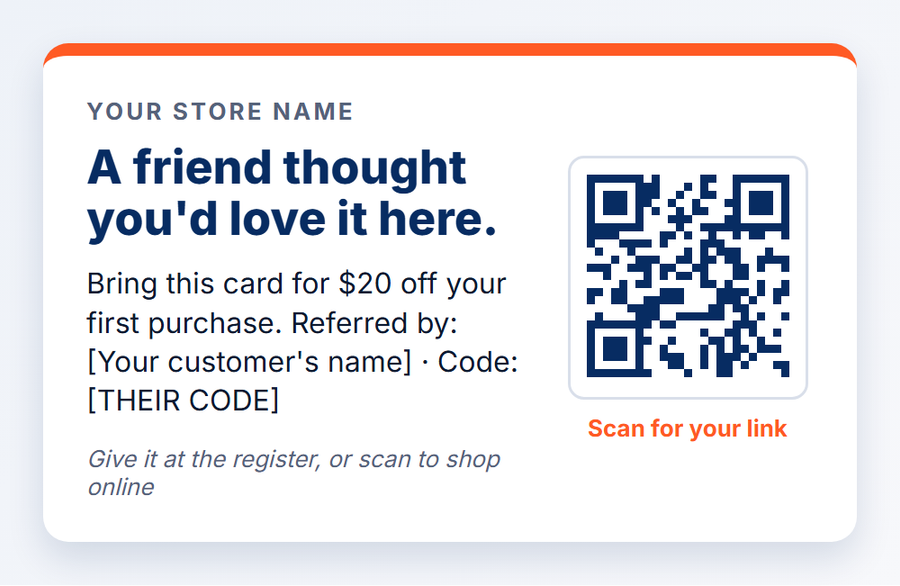
The follow-up text: "Thanks for coming in for your fitting, Sam. If a friend asks where you got your shoes, here's your link: [link]. Friends who use it save $20 on their first purchase."
Retail store referral program examples (November 2026)
What these stores' referral pages offered in November 2026:
| Store | The sharer gets | The friend gets | When it pays |
|---|---|---|---|
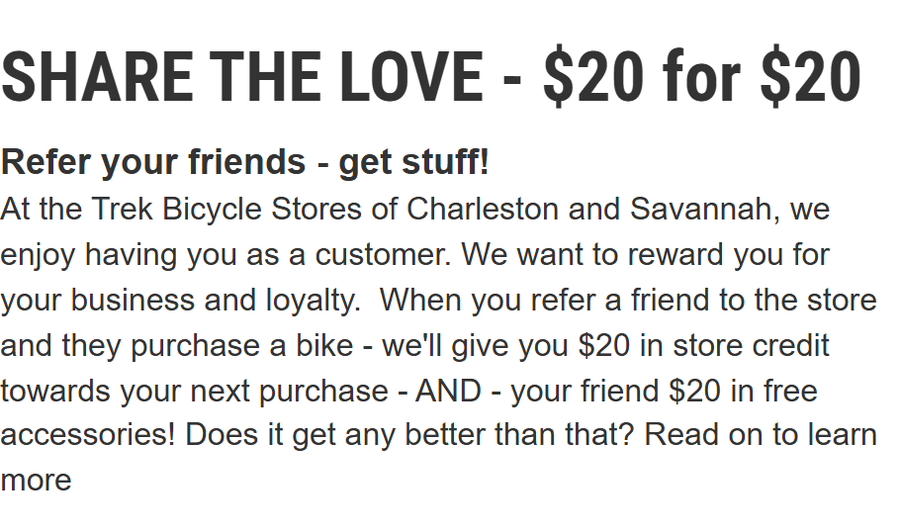
| Trek stores, Charleston and Savannah (bike shops) | $20 store credit | $20 in accessories | Bike bought, card shown |
| ECI Jewelers | $100 store credit | $50 off first purchase | After the return period |
| Gray & Sons (jewelry and watches) | $200 store credit | $200 credit on $1,000+ | After the return period |
| FYidoctors (eyewear, Canada) | $50 off next purchase | $50 in-store credit | Card brought to the appointment |
| Run United (running stores) | $15 coupon | $10 coupon | Friend's first order |
What these have in common:
- The friend gets something. All 5 give the new customer money off, credit or free accessories.
- The counter knows who sent them. The friend brings a card or names the person who sent them, except at Run United, where sharers pass on a link.
- The sharer gets credit once the sale is final. All 5 thank the sharer with credit or a coupon, after the purchase or the return period.
Retail referral software and free tools
You can run a program by hand, build your own, or use software. The first four options below are free tools of ours.
| Option | Good for | The catch |
|---|---|---|
| Manual referral tracker | A few referrals a month while you test | Names, codes and credit are all logged by hand |
| Referral code generator and referral link generator | Giving each customer something to share | No tracking or rewards on their own |
| Coupon code generator | Making the friend's offer codes for the register | Codes alone don't say who sent the friend |
| Referral program workbook | Planning offers, credit amounts and timing before you start | It plans the program but doesn't run it |
| Building it yourself | Teams with developers to spare | You build and maintain every part |
| Referral software | Running it every week, with codes, reminders and rewards automated | A monthly cost |
Software built for referrals is usually the better fit once the cards are going out every week.
How Referral Rock runs it for stores
Referral Rock is referral program software for businesses with teams. For stores, the feature that fits best is referral program recruiters. Each salesperson gets their own link and QR code. At the counter, they sign a customer up on the spot from a phone, and every customer they bring in is credited to them.
The rest runs in the background, and a referral counts even when no link was clicked. The friend is recognized by a code, the sharer's name or the form they fill out, and your team can add a referral by hand. Each program also has its own QR code for signs, cards and print. The program connects to the tools you already use, with native integrations, including HubSpot and Salesforce.
Every plan comes with a program advisor at no extra cost. Your advisor sets the program up with you, then stays with you for as long as you're a customer. That means regular check-ins, strategy and best-practice advice, and answers when something doesn't look right. See how it works for e-commerce businesses and stores.
Start at the counter
A store's referrals happen in person, so the program starts where the friend pays. Pick the 2 ways your counter will recognize a referred friend. Give your staff one line to say at checkout, and put a card in every bag. Then set the friend's offer and the sharer's store credit.
Not sure your store is ready? Take the readiness check.
About the author
Referral Rock Editorial is the team behind Referral Rock's guides and templates on referral, affiliate, partner and brand ambassador programs. Today's team writes, reviews and updates them, building on work by former staff and freelance writers over the years.