Most referral emails are written the same way: tell the customer what they’ll earn if they refer a friend. The problem is that approach makes sharing feel transactional — like the customer is monetizing their relationships.
The better frame: write the email as a gift the customer is giving their friend, not a payout they’re chasing. Emails written that way feel different to send and different to receive.
Below are 18 referral email templates — personal, mass, and bonus — that you can copy and customize. We’ve also pulled real examples from brands that use them well, plus the best practices that separate the emails people actually share from the ones they ignore.
Why referral emails work (and what makes them fail)
Referral marketing is a core part of any brand’s customer acquisition strategy. Potential customers trust their peers’ recommendations, so they’re more likely to purchase when a friend refers them.
There is plenty of referral marketing statistical data to back this up:
- 84% of people trust recommendations from people they know — making personal referrals the most effective form of advertising
- People are 4 times more likely to purchase a product when a friend refers them (Nielsen)
- 74% of consumers identify word-of-mouth as a key influencer in their purchasing decision
Referred customers also have a 16% higher lifetime value — they’re not just easier to acquire, they stick around longer.
A referral email gives customers a direct, easy way to share your program. Templates make it faster to deploy and easier to keep messaging consistent. But the templates that actually work do something most businesses get wrong: they write to the friend, not just the referrer. More on that in the best practices section.
There are many different ways to source customer referrals, and a referral email tends to be one of the easiest — especially with pre-written templates ready to go. We’ve got 18 proven options to swipe for yourself, including several straight from top brands.
Two types of referral email templates
There are two types of referral email templates you can use:
Personal referral email templates:
- These are sent out to individual loyal customers to ask for referrals
- Each personal email includes specific details about the customer’s relationship with the brand
- The content in these emails is warm and empathetic, and is meant to make loyal customers feel valued and appreciated
Mass referral email templates:
- These are used to promote your referral rewards program to many or all customers at once
- Since they are oriented for mass communication, they are designed to promote the program in a more general way
- They won’t feel as warm or exclusive as personal templates, although they are still beneficial to rapidly get new referrals
Both types of templates work well in conjunction with a referral program, but you need to know which to use and when.
Personal referral email templates are your best bet to invite your highest-value customers to refer their friends. These templates work best for B2B or SaaS businesses, as well as any other type of business with recurring or subscription-based services.
Mass referral email templates are a quick option to get the word out, without the need to segment your customer base.
- These emails are ideal if your business wants to inform many or all customers about a referral program, all at the same time.
- They work best for B2Cs, ecommerce businesses, and B2B businesses that don’t operate on a recurring model.
You don’t have to pick one. Most businesses use both types throughout their program — personal templates for high-value customers at key moments, mass templates for broader promotion.
When to send referral emails
Before you send a referral email, make sure these basics are in place:
- You have happy customers who would refer you. Check your reviews and feedback. It’s even better if customers are already referring friends organically — that’s a sign the program will have something to work with.
- You have a reliable way to track referrals. A referral program with built-in tracking is the cleanest option — it automates attribution and gives you analytics on what’s working.
- Your team can handle new customers. Make sure your customer support can maintain service levels while onboarding new people, especially if you’re running a mass campaign.
One thing to keep in mind: referral emails work best as part of a broader, ongoing promotion effort — not as a one-time blast. Emails are one touchpoint. The programs that generate referrals consistently are the ones that promote continuously, across multiple channels, as part of daily operations. Use these templates to fuel that system.
Personal referral email timing
Personal templates work best when you target long-standing customers loyal to your business. These customers are the ones who have had positive experiences with your brand, are repeat buyers, or have shared glowing reviews about your products or services.
Certain times are more ideal than others to send personal referral emails.
You’ll want to send personal referral emails when your customers have just completed a positive interaction with your brand, or an action that affirms their commitment to your business.
For example, you could send your email:
- Shortly after a purchase (especially if that’s a renewal)
- Shortly after they’ve given you positive feedback
- Shortly after they’ve left a positive review or social media comment
- After a high NPS score (Net Promoter Score) or a high score on another customer satisfaction survey
Mass referral email timing
Aim to promote your referral program monthly to quarterly using mass templates.
Besides that cadence, send mass referral emails whenever you’re launching a new program or making significant changes (like overhauling rewards). Customers appreciate the heads up.
Mass templates work well for B2C, ecommerce businesses, and B2B businesses that don’t operate on a recurring model — anywhere you want to inform a large group at once without segmenting.
Personal referral email templates
Use these personal referral email templates to engage your most loyal customers so they’re motivated to join your referral marketing program.
Here are some of the most common referral templates you can use at various key stages of the customer journey:
General template for personally inviting loyal customers
Use this template when you want to start the referral conversation without sounding overly salesy or pushy.
- Aim for a light, friendly and engaging tone.
- Build rapport by talking about how much the customer means to you, before asking for your referral.
- Close by offering an incentive, and by once again highlighting the value of the relationship.
After a loyal customer makes a repeat purchase
When a customer has made a repeat purchase, that’s a good indication that they have a preference for your products or services over other options. It also shows that the customer wants to stay with you, as they believe in the value you’re offering.
Shortly after a repeat purchase is a good time to follow up with the customer using a referral request email.
The following referral email template can get the conversation going:
After a positive review or social media comment
For the most part, customers don’t usually leave public feedback unless they’ve had a significant experience with a brand (whether that’s negative or positive).
Thus, when your customers leave a positive review or social media comment, they’re so satisfied with your products/services that they can’t help but let the world know.
This also means they’re already primed to share your brand through an individual referral!
Use this referral email template to thank your customers for the extra effort, and then move to your referral request.
After a high NPS score
When your customer gives you a high NPS rating (Net Promoter Score) – 9 or 10 out of 10 – it’s a confirmation that they love your brand so much, they’re highly likely to recommend it to others.
Use this template to acknowledge their appreciation, then connect the dots to promoting your referral program and how it can benefit them.
After a high customer satisfaction survey score (besides NPS)
High ratings on other customer satisfaction surveys can be addressed in a similar way.
Talk about the specific survey results, and remember to briefly touch upon any feedback they’ve given so they know you’ve paid attention. Then, ask for the referral.
Mass referral email templates
Since you’ll usually only send a mass referral email quarterly, you’ll need to maximize the emails you send to generate the most referrals.
Fortunately, we’ve got you covered with these tried and tested mass referral email templates. Many of them are inspired by top brands’ real referral emails!
The ‘don’t let your friends miss out’ email template
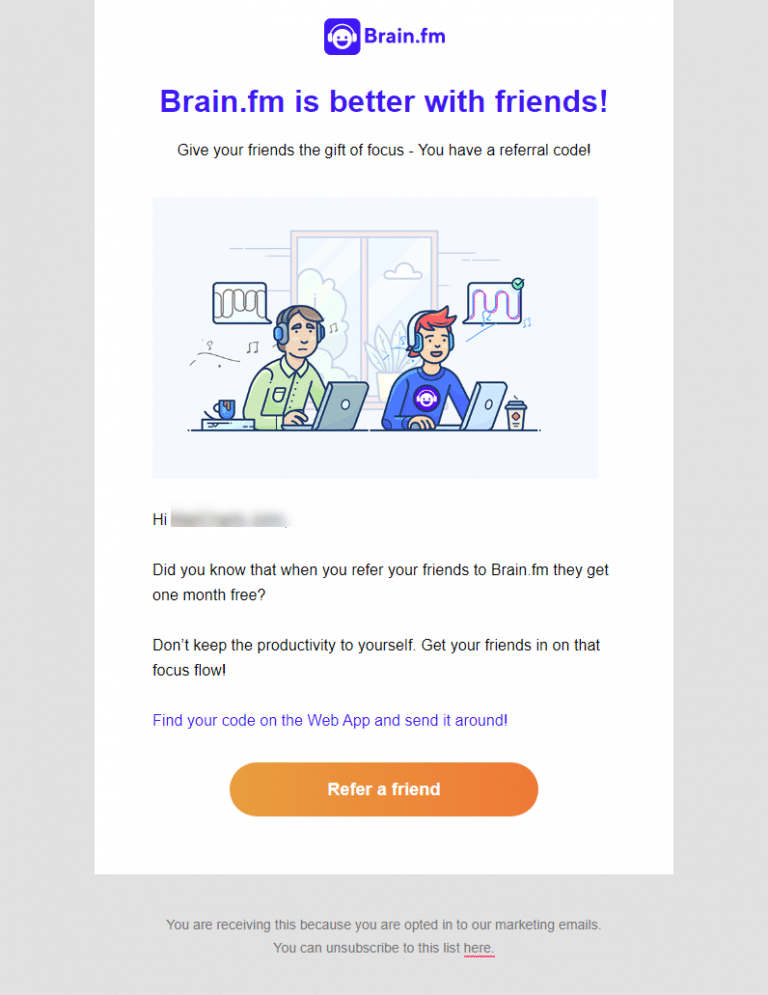
When you couple fear of missing out (FOMO) with the altruistic value of helping out friends, you’ve got a winning formula for a conversion-friendly referral email template. Here’s a great referral email template you can use to leverage both.
The “don’t let your friends miss out” template “in the wild:” Brain.fm
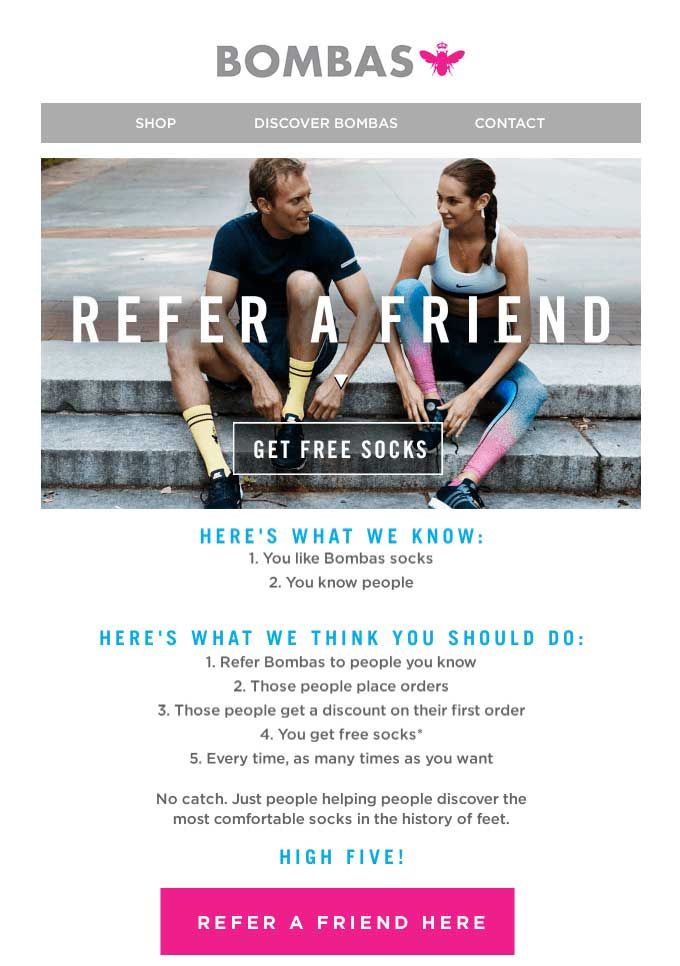
The quick bullet list template
Bullet lists are a godsend for busy customers who want the meat of the content without wasting time.
This template starts out in a fun way to capture your customers’ attention, and then lists out your referral program in a way that:
- Is easy to make sense of
- Doesn’t need a lot of time to understand
- Makes it easy to take action and go through the referral process from start to finish!
The quick bullet list template “in the wild:” BOMBAS
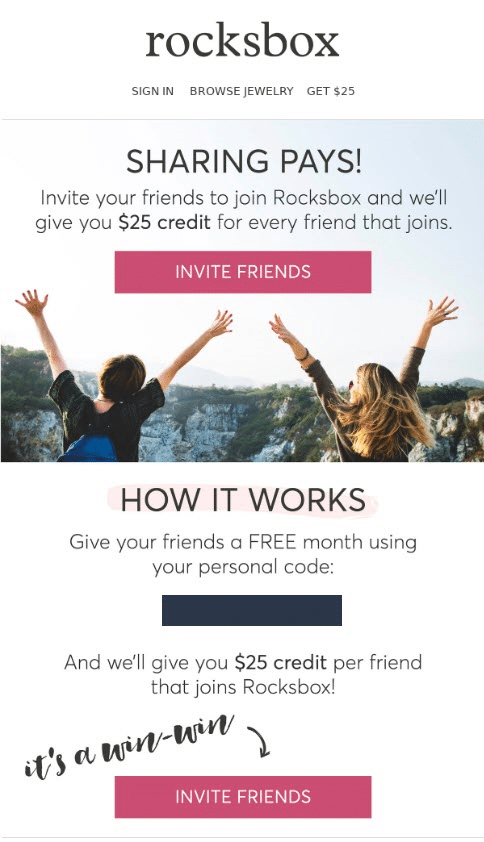
The ‘sharing pays’ email template
The ‘sharing pays’ email template is a feel-good template. Connecting sharing, friendship, and mutual rewards in a single email is an easy way to develop positive brand association.
It’s also a great motivator for customers to want to take action and start referring straight away!
The “sharing pays” template “in the wild:” Rocksbox
The reciprocal reward email template
This email template is perfect for when you want to engage your customers’ sense of community and leverage the relationship they have with their friends.
Customers prefer to give out rewards to their friends and earn rewards. They would like something for themselves, but they don’t want to seem greedy or appear to be taking advantage of their peers.
Giving a reward to the most trusted people in their circle – and receiving an equal reward for referring – looks fairest and makes the most sense.
The reciprocal reward template “in the wild:” Saje Wellness

The ‘pay it forward’ email template
The ‘pay it forward’ email is a variation of the ‘sharing pays’ email template we covered above – but focuses even more on the friendship and community factors. Use this template to switch up the way you ask for referrals in your email.
Remember to mention the referral incentives and insert a call-to-action for your program, just like with any mass referral email template.
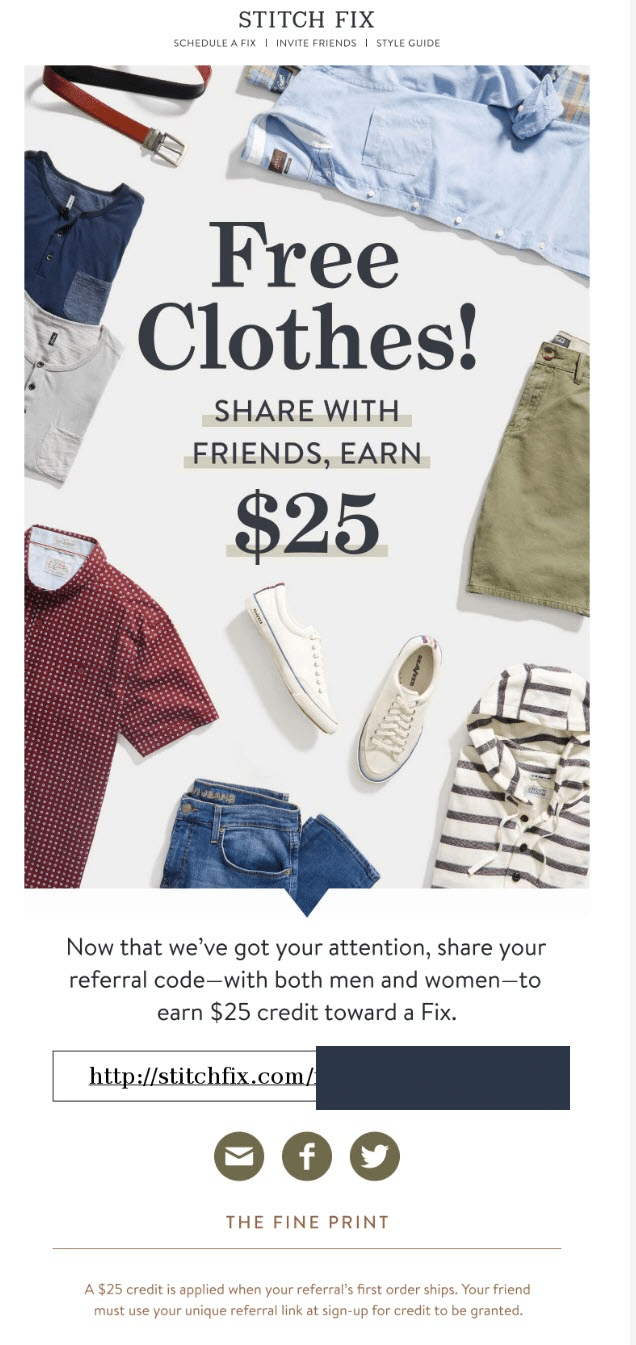
The free product referral email template
Free product rewards can work phenomenally well for getting referrals, as long as the product is something that existing customers will enjoy.
Do the research beforehand and talk to existing customers to find out what kinds of products would excite them the most. Or, give them the opportunity to try new products for free, before everyone else.
Then, excite them with this referral email template!
The free product referral email template “in the wild:” Stitch Fix
The ‘help your friends’ referral email template
This referral email template appeals with its honesty and simplicity. Who doesn’t want to help their friends? This template is an easy and effective referral ask because it tugs at the heartstrings.
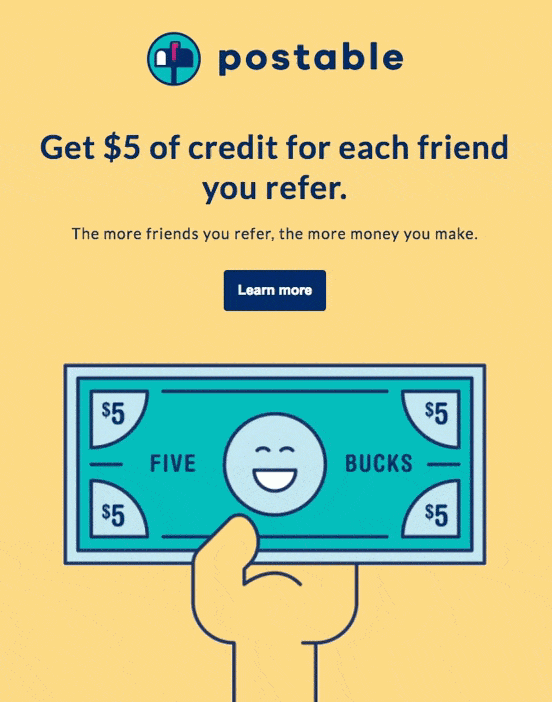
The quick cash offer email template
Nothing inspires quick action quite like instant cash. Use this short, punchy, and effective referral email to grab customer eyeballs and potentially get some easy referrals.
The quick cash offer template “in the wild:” Postable
The ‘you mean a lot’ email template
The ‘you mean a lot’ email can be very gratifying for a customer to receive, especially when you’ve taken the time to personalize it with their name.
Express appreciation for your customers and use the referral program as a means to thank them for their loyalty. Close by talking about the benefits and how easy the process is.
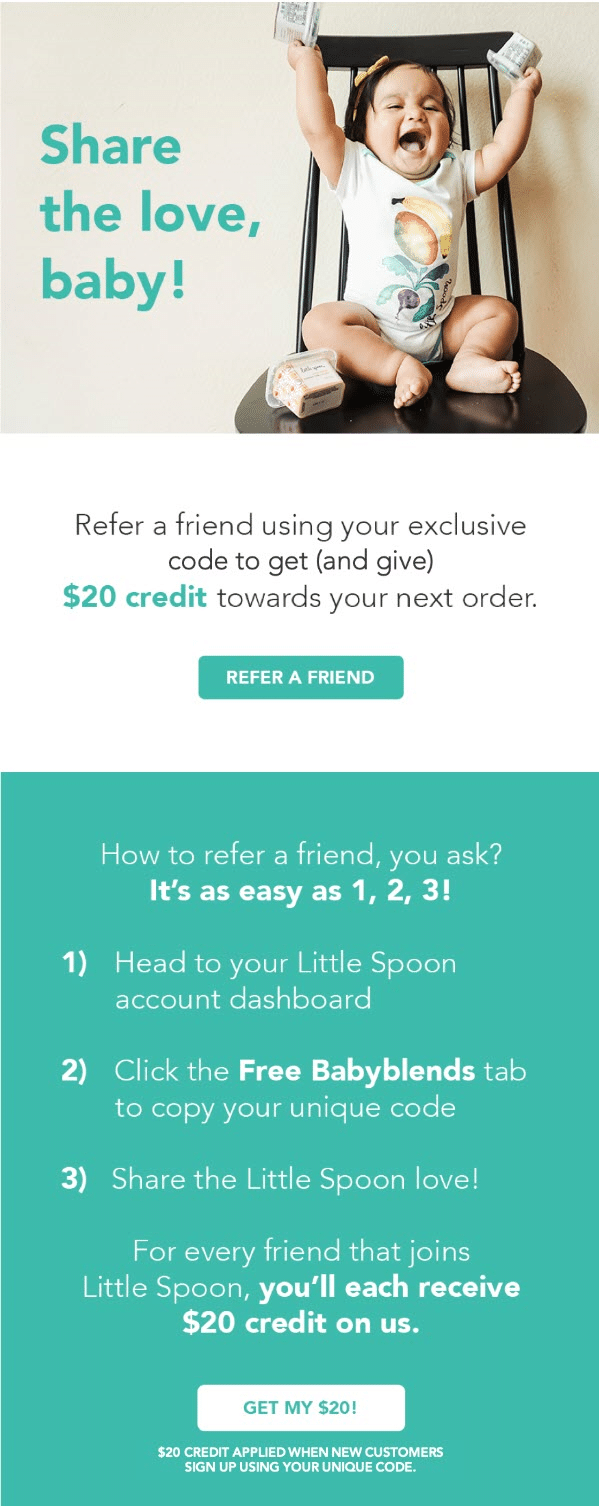
The ‘easy as 1-2-3’ referral email template
The three-step formula is a great technique for emphasizing how easy it is for your clients to refer friends.
Your email’s content should be just as simple – keep it short, punchy, and easy to read.
Also, make sure that when your referring customers land on the different pages, it’s easy for them to navigate and complete the desired actions.
The easy as 1-2-3 template “in the wild:” Little Spoon
The ‘seasonal flair’ referral email template
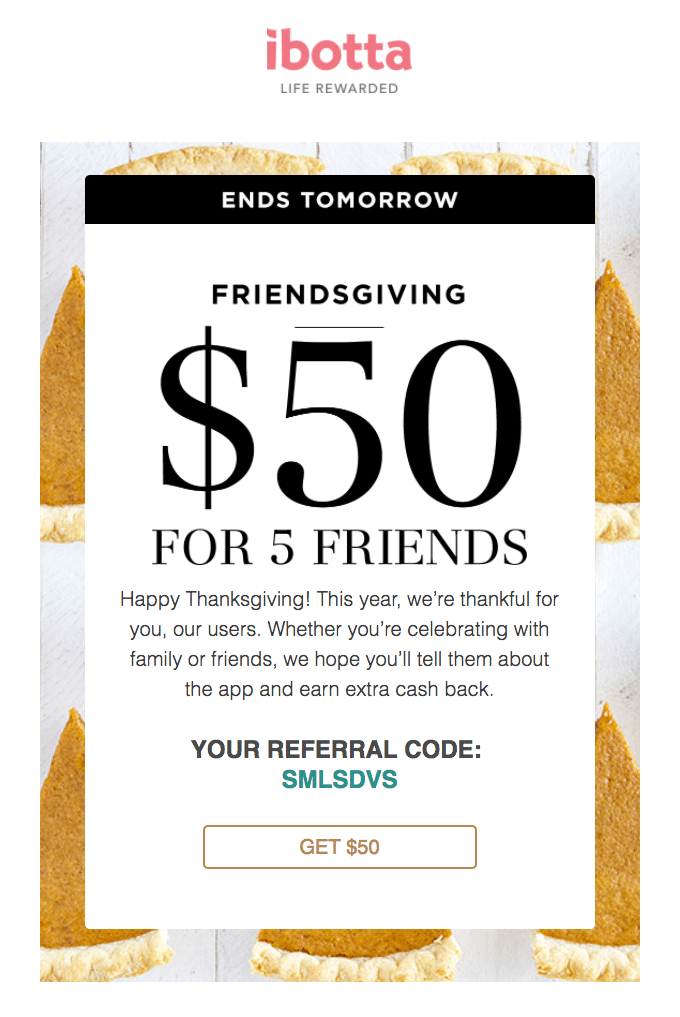
Yes, your referral program (and its opportunities to earn rewards) should be ongoing. But an email related to an upcoming holiday or season can inject some variety into your promotions. This might mean a “share the love” email specifically timed near Valentine’s Day – or a “Friends-Giving” email near Thanksgiving.
It’ll work even better if that’s paired with a limited-time reward increase to play to urgency, like our “in the wild” example from Ibotta.
Your exact email text will need to vary based on the season and your offer, but we’ve used “Friends-Giving” as the basis for our template.
The seasonal flair email template “in the wild:” Ibotta
Bonus referral email templates
These bonus email templates fall somewhere in between personal and mass emails: you’ll personally send them out every time someone meets the requirements (say, whenever someone earns a reward). But you can use a standardized email template.
After a reward is earned
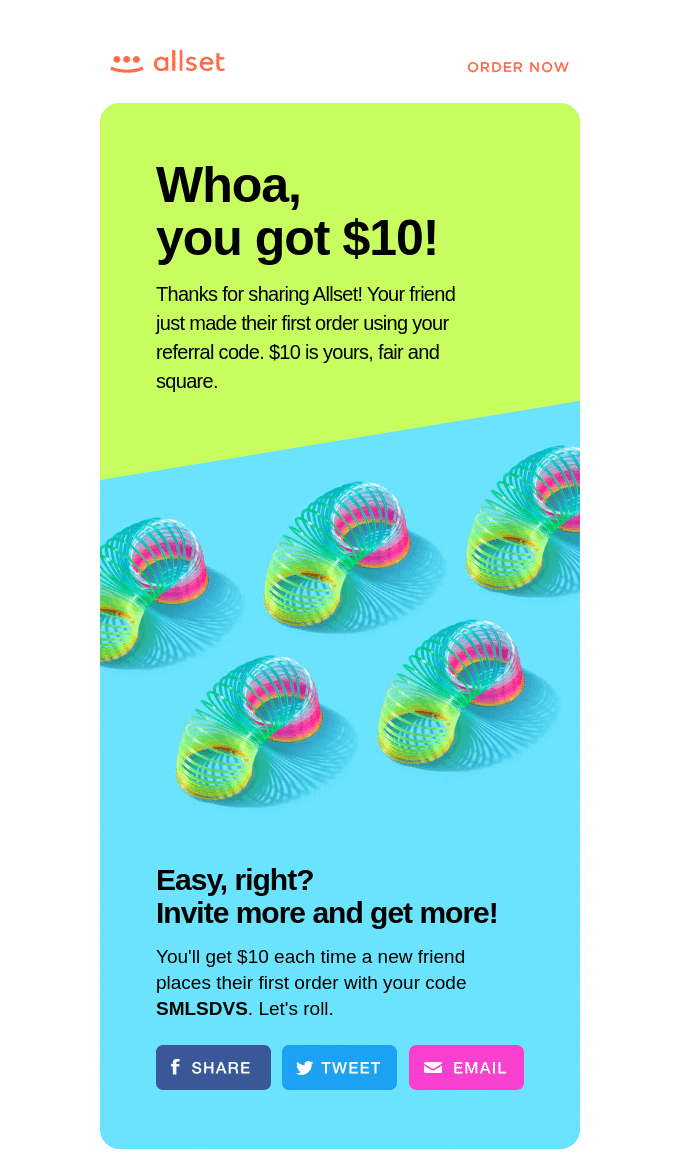
Another important referral email template you should consider sending is the one that notifies people when they’ve earned a reward. This email lets the sharer know what they’ve earned, right away. But it’s also the perfect opportunity to capitalize on their excitement and encourage more sharing (and earning).
The reward notification email template “in the wild:” Allset
Reminders for those who haven’t shared in a while
People get busy. Sometimes, they really want to share your brand and earn rewards, but can’t think of someone to share it with. And then… well, they forget about your program. It happens! So, it’s good practice to send out reminder emails to people who signed up for your program but haven’t shared within a certain quarter.
Who knows? They might just have a friend in mind to share with now that you’ve reminded them!
For this email, a subject line like “Don’t forget: Share [brand], earn [reward]” will work super well.
Referral email template best practices
Whether you stick closely to the templates we’ve shared or use them as a jumping-off point to write your own email, follow these referral email design best practices to get the best results:
Write the email as a gift, not an ask
Most referral emails are written from the referrer’s perspective: “here’s what you’ll earn.” The problem is that framing makes sharing feel transactional — like the customer is selling out their friends for a reward.
The better approach: frame the email around what the friend gets. Lead with the benefit to the person being referred. The referrer’s reward is secondary — a bonus, not the point.
This shift changes how the email reads. Instead of “refer a friend, earn $20,” it becomes “give your friend $20 off their first order.” The sharer feels generous, not calculating. And people are far more willing to share something that makes them look good to their friends.
When you write or customize these templates, ask: does this email make the referrer feel like they’re doing their friend a favor — or making a transaction? The former converts. The latter feels awkward to send.
Write subject lines that get opens
You’ll need to convince people to open your email before they can share referral links. Your subject line is key to increasing those all-important open rates.
- Keep it short. For mass emails, aim for 28–38 characters so it doesn’t get cut off on mobile.
- Include the referrer’s name and use “you.” Even in mass sends, this small personalization changes how the email lands.
- Lead with a number. The value of the reward in concrete terms (e.g., “$20 for your friend”) breaks up text and makes the offer tangible.
- Clarity beats cleverness. An Aweber study found subject lines that clarify what the email contains have 541% more clicks than purely clever ones.
Once they’re in, let them know how rewards work
Lay out the instructions and terms clearly in simple, easy-to-understand sentences.
For example, can customers easily understand:
- What they must do to earn the referral reward?
- Whether the friend they’re referring can earn a reward as well?
- How and when they’ll get the reward?
- The exact referral amounts for referring one or more than one person?
If the rewards can only be earned once the friend makes a purchase, it’s best to mention this at the outset.
If you don’t address this in the email, that’s ok. But be sure to link out to your referral program page, and cover the terms of the referral offer there.
Keep the message simple and to-the-point
Avoid long, meandering sentences and confusing structures. Always use the simplest language possible and opt for clarity over cleverness.
If you’re sending a mass email, try to keep it under 10 words or 40 characters as that’s where people have seen the most success.
And remember – you don’t have to explain everything about your referral program in the email. That can unnecessarily clutter your email or make things look complicated.
Instead, you can tell customers more when you link out to your referral program page.
Personalize wherever you can
Personalization creates an instant connection with your customer and improves how positively they perceive your brand.
Yes, mass referral emails are more generic in nature compared to personal referral emails. However, you can still personalize some aspects of your mass emails – such as including each customer’s name – by using software.
Include a clear call-to-action (CTA)
Make it easy to find the next step. If you use a button, make sure it sends customers straight to the referral program page. If you include a referral link, put it in a one-click copy format.
Having the unique referral link directly in the email is the best option — customers can copy and share it right from their inbox without navigating anywhere. A button is a solid backup that lets them share from the program page in other ways. For mobile: keep the CTA prominent and easy to tap. That’s where more than eight out of ten people open email, and how most people share with their friends.
Discover more referral best practices by downloading our Referral Program Workbook, with 15 actionable guides & 101 real-world examples.
Wrap-up
Referral email templates make it easy to get your program in front of customers without starting from scratch every time. Copy them, customize them, send them.
But keep this in mind: the emails are one part of the system, not the whole thing. The businesses that get consistent referrals aren’t just running monthly to quarterly email blasts — they’re promoting their program continuously, across multiple channels, as part of how they operate.
As one example, you should promote your program in your other email marketing, too. Include a sentence about your program in newsletters, transaction emails, and any other messages that potential sharers already receive.
The templates here will help you send better referral emails. A referral program woven into your operations is what makes referrals reliable.
Ready to put these templates to work? Start a referral program with Referral Rock, and run your program emails without bolting on another tool. The invite emails, reminders, reward alerts, and monthly nudges that keep a referral program alive are built in, ready to send from inside Referral Rock.

About the author
Guest writer
Irene Lopez is a freelance writer and content strategist who creates strategically crafted content that helps businesses build a strong presence online. For Referral Rock, Irene has written guides on employee referral programs, affiliate and partner programs, brand ambassadors, and the software behind them.