
Word-of-mouth marketing is the most trusted form of advertising — and the one you can’t fake. You can’t buy it, you can’t manufacture it, and no campaign will conjure it out of thin air. What you can do is build a business worth talking about, then put systems in place to make sure that word actually travels.
That’s what this guide covers. The 7 strategies below span earning the conversation in the first place all the way to capturing and amplifying it once it’s there. Start at the beginning — the foundation matters more than most businesses realize.
What is word-of-mouth marketing?
Word-of-mouth marketing (WOM marketing) happens when people talk to others about your brand, products, or services, in person or online. It also includes any actions your business takes to encourage people to share their experiences with your brand and recommend it to others. Common forms of word-of-mouth marketing are reviews, social media shares, and referrals from friends. This results in free (or nearly free!) advertising for your brand.
The power of word-of-mouth marketing comes from its high level of trust. Word-of-mouth recommendations usually come from friends, family members, and others within someone’s circle. When someone sees a friend or family member raving about a particular brand, they’re much more likely to buy because peer recommendations are seen as especially valuable
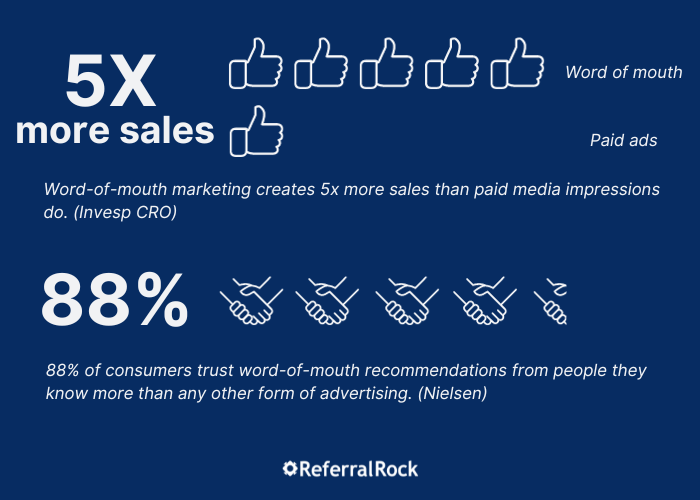
According to a Nielsen report, 92% of people trust word-of-mouth referrals from people they know over all other forms of advertising.
Plus, thanks to social media, when someone shares it can have broad reach in minutes. And word of mouth doesn’t just stop after one interaction – it has compounding interest. One person will tell another if they have a great experience, and another, and so on. With every share, repost, or retweet, word-of-mouth marketing carries the potential for exponential growth.
All this happens at a very low cost to your business – often, for free.
7 ways to build word-of-mouth marketing for your business
Based on our experience in the referral marketing space, these are the seven best ways to create reliable word-of-mouth for your business.
1. Build a business worth talking about
Before you think about referral programs, reviews, or social campaigns, the question is simpler: is your business actually worth talking about?
Word of mouth is triggered by four things:
- Product — Does it solve a problem in a way that exceeds expectations? Does it save time, remove pain, or delight in a way competitors don’t?
- Service — How do you treat customers, especially when something goes wrong? Great service can rescue an upset customer and turn them into your loudest advocate.
- Value — Is the return so strong that customers feel like they got more than they paid for? Value isn’t just ROI math — it’s the feeling you’d gladly pay more.
- Story — The intangible: your values, personality, the reason behind what you do. People share brands they feel connected to, not just brands they use.
The best businesses nail two or three of these. Being genuinely exceptional at even one can make you buzz-worthy.
The key to making your brand worth talking about is delivering on at least one of these in a way your competitors can’t match. Ask yourself: do you…
- Market differently than others in your space?
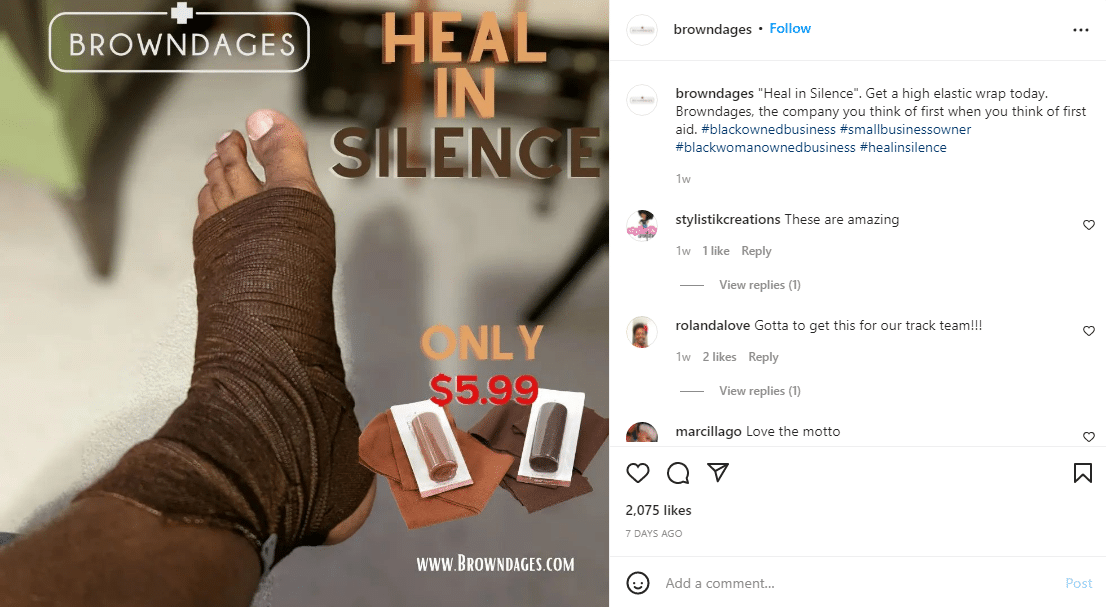
- Meet a need that no one else does with your product or service, like Browndages first did with their bandages and wraps made for darker skin?
- Solve a specific problem (even one that people didn’t realize they needed solving), like Omsom does with “starter” packets that include all the flavors needed to make authentic Asian dishes?
- Deliver above-and-beyond customer experience that competitors can’t match, like Zappos has built a reputation for?
- Provide a uniquely high-quality product at a lower pricing point than competitors?
Know, deliver on, and emphasize this unique selling point, and watch the word of mouth roll in.
2. Run a customer referral program
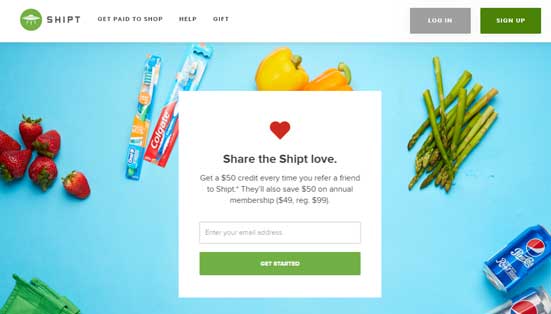
Once customers are already talking about you informally, a referral program gives that word of mouth structure. It doesn’t create the conversation — it captures it and makes it reliable.
The signal you’re ready: referrals are already trickling in organically, but there’s no system to make it easy, track it, or thank people for it.
“Are you getting word-of-mouth already? That means that you’re doing all the core business activities that make you refer-able.
“If you’re doing a good job as a company and you provide a great service or product, you’re already hopefully getting some organic word of mouth, which is the seed for a healthy referral program. Ask yourself – can I now lean into that word of mouth and get more referrals by asking?”
– Josh Ho, CEO of Referral Rock
Most businesses make two mistakes with referral programs. The first is framing it as a reward for the sharer — “refer a friend, get $20.” That makes it feel transactional, like the customer is monetizing their relationships. The better frame: the referral is a gift the customer is giving their friend. All messaging, program name, and offer should center on what the friend gets. Done right, it feels like a favor, not a transaction.
The second mistake is treating the referral program like a campaign — big launch, blast the list, hope for a spike. Referral programs that compound don’t work that way. They run continuously, integrated into customer touchpoints: post-service emails, account dashboards, team member handoffs, email signatures. A contact list goes stale in 2-3 months. The referral programs that win are the ones that are always on.
To achieve the most success with your program, you’ll need to:
- Choose incentives that customers love, so they want to share
- Align the incentives with your sales process – if you’re a B2B, you may want to reward for both leads and sales
- Make sharing super easy for customers (ideally, with no signups or logins)
- Promote your program well, so it’s at the top of customers’ minds after they have a great experience
- Have a reliable way to keep track of all the referrals each customer makes
- Keep program members in the loop about their referrals
- Reward customers in a timely manner, so they’re motivated to keep referring
These tasks can be tough to carry out with a manual program, so it’s best to enlist the help of referral program software to automate your program. Referral software lets you build a streamlined referral program that’s easy for customers to use – each advocate can quickly access their own unique referral link and send their friends directly to your business.
Plus, software can make it easy to promote your referral program, so customers remember to take advantage of the program’s benefits. And once your customers start referring, software ties every referral back to the customer who made it, and sends out rewards for those referrals right when customers earn them.
An added bonus? Referral software can help build even more trust, by letting your customers send a personalized message to the friends they refer. To make things easier, you can pre-draft the message on customers’ behalf so customers can send it right away, and then let customers add or change that message as they wish.
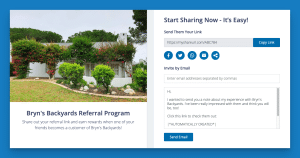
Pro tip: Pick software that lets you target referred customers with personalized promotions, to encourage them to join the program themselves and share with their own friends!
3. Ask for reviews
Reviews and testimonials, like referrals, are an especially powerful form of word-of-mouth marketing, as they’re highly trusted. 72% of potential customers will only make a purchase after reading positive reviews, and nearly half of customers trust online reviews as much as they trust personal product recommendations. In addition, 92% of B2B buyers are more likely to make a purchase after reading a trusted review.
Good reviews help build your brand’s social proof and boost your online reputation – both terrific ways to gain exposure and get even more people talking about you.
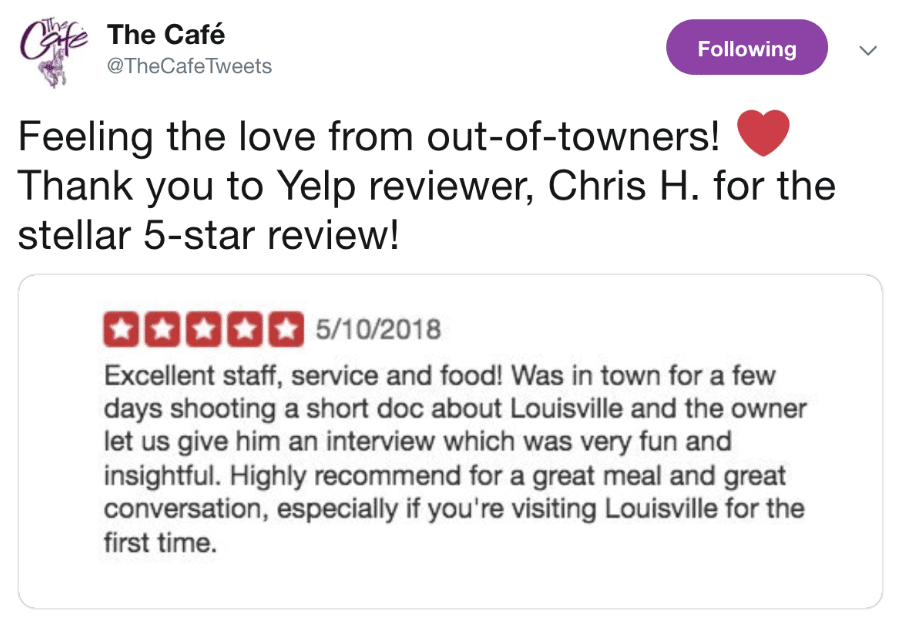
Reviews might seem unpredictable, but there are ways to encourage more (and better) reviews without gaming the system. The key is to ask the right people for reviews, and strategically time your ask. Directly ask for reviews when customers are happiest, such as:
- Right after they’ve purchased and received a product
- After they’ve given positive feedback
- When they reach the “aha” moment of getting value out of your product
- After they’ve made a stellar social media post
- After they refer a friend
For more tips on getting the most out of reviews, check out our comprehensive guide on how to ask for reviews.
4. Recruit affiliates, influencers, or ambassadors
If people hear someone talking about how good your product is, this word of mouth will make them more likely to try the product.
But when they see someone using your product in their everyday life – especially an expert in a field, or a blogger or social creator with lots of authority among an audience – this social proof gives word-of-mouth a bigger boost. That’s why it’s advantageous to recruit affiliates, influencers, or ambassadors to promote your product or service.

Ambassadors’ and influencers’ posts using your product, and affiliates’ product reviews on blogs and social networks, show off your product and further inspire people to try it for themselves.
There are key differences between each type of advocate, so pick what fits your needs:
- Affiliates send customers to your website with a trackable link and earn a cash commission on each purchase.
- Influencers promote your products in short-term paid campaigns, typically one to a few posts on social media.
- Ambassadors promote your products long-term, repeatedly posting about you or featuring your business on their website. You reward them with cash, store credits, or free products, with flexibility on timing.
While influencers are more common in the world of ecommerce and physical products, there’s a growing trend of B2B marketing influencers. And affiliates are quite common in the B2B space, especially in the SaaS industry.
5. Encourage user-generated content and social sharing
Paid promoters aren’t the only ones who can create powerful word-of-mouth on social media platforms. The more connected you are to your followers, the more likely they will become true fans and supporters.
And what do true fans usually do? Share your brand with others and increase word of mouth in new markets you may not have been able to reach otherwise. If you get lots of your fans to start talking about you at once, and create user-generated content (UGC), that has the potential to reach thousands or even millions of eyes.
How do you encourage your fans to keep creating UGC? Here are some of our top tips:
- Create branded hashtags for fans to use when they share
- Feature the best posts about your brand on your own channels (your social accounts and your website), with the creators’ permission
- Run contests and giveaways, where the creators of the best branded UGC earn valuable prizes or unique features (as Apple did with their #shotoniPhone campaign)

6. Create content worth sharing
Which digital marketing content would appeal best to your target audience – an interactive contest, a behind-the-scenes video, or something else? By continuing to give your audience what it wants through content marketing, you’re able to add to your social currency and generate word of mouth.
Social currency is all about reputation. People share what they think will make them look good in front of others, because every share puts their reputation on the line. They’ll only “spend” their social currency on your brand, and spread the word about you, if they think it will give their reputation a boost.
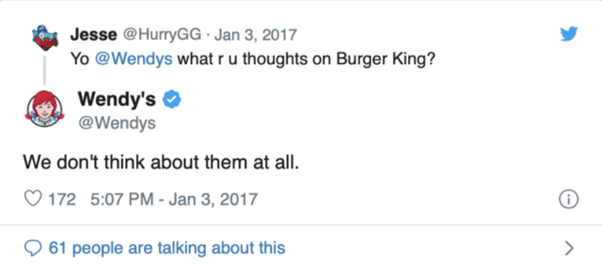
And if your brand has a unique personality, this can also stir up emotions. Use your personality for emotional appeal, in a way that stands out from the crowd, and customers won’t be able to stop talking. This works especially well if you’re appealing to humor. Think of how Wendy’s went viral thanks to their signature snarky, humorous tweets.
7. Tell a story worth sharing
Writing your brand story goes hand in hand with creating shareable content, and is another reliable way to generate word-of-mouth marketing. Your story could focus on your product, company culture, or point of view, as long as it’s something that your audience will be compelled to share – and as long as it genuinely reflects your brand and its values.
Creating a compelling story goes hand in hand with offering value and appealing to emotions. If customers love the “why” behind what you do – your mission and values – and that “why” is packaged in a story that’s moving and easy to tell, customers will share your story with others.
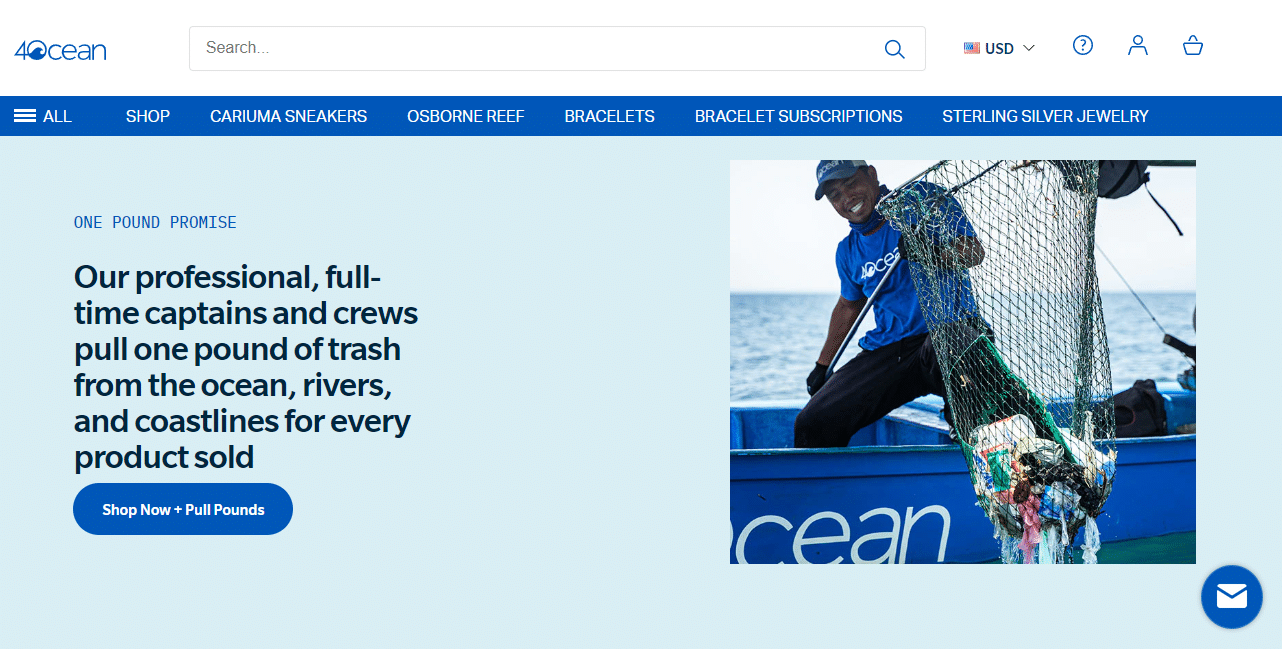
One example is 4Ocean’s story: they pull plastic from the ocean daily to help marine life, and then recycle much of that plastic into bracelets and other products. That story is the main reason 4Ocean’s bracelets have become so well-known.
Even if you’re a small business (and not a big brand), you can find a story worth sharing — we love this marketing exercise as a way to get started.
Word-of-mouth marketing FAQ
Still have questions about word-of-mouth marketing? We’re here to help.
How effective is word of mouth marketing?
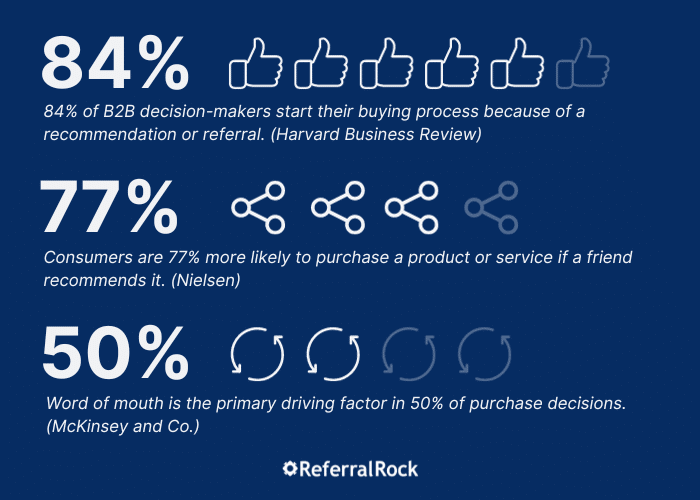
These word-of-mouth marketing statistics further prove how successful word-of-mouth marketing can be:
- 83% of Americans say that word-of-mouth recommendations from people they know make them more likely to purchase a given product or service.
- When it comes to products they have purchased, 74% of people identified word of mouth as a key factor in their purchase decision.
- Marketers rate the quality of leads brought in by word of mouth as a 4.28 out of 5.
What is amplified word of mouth vs. organic word of mouth?
Word-of-mouth marketing can be divided into two main types or categories: amplified word of mouth and organic word of mouth.
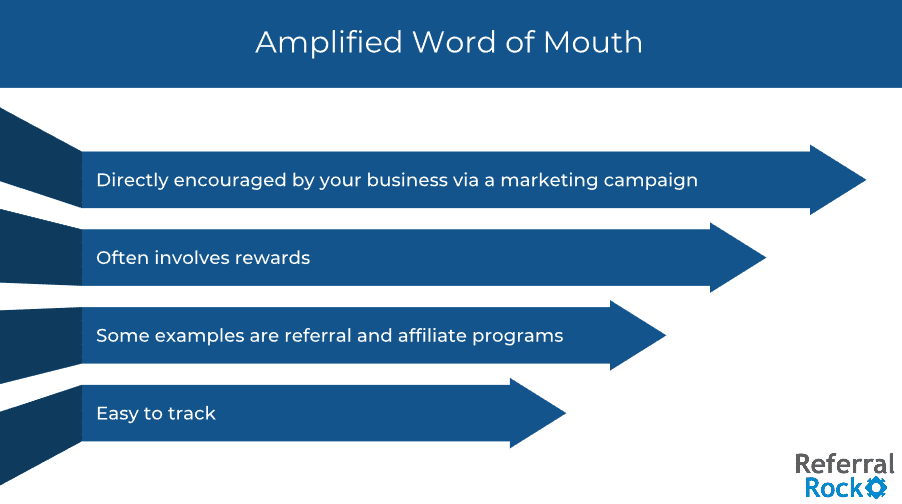
Amplified word-of-mouth marketing is directly encouraged by your business via a marketing campaign. Within the campaign, businesses will usually use some sort of reward to motivate this word of mouth. Amplified word of mouth strategies are also easy to track, since they are tied to a campaign.
Examples of amplified word-of-mouth marketing campaigns include:
- Referral programs
- Affiliate programs
- Brand ambassador programs
- Influencer marketing campaigns
- Other customer endorsements you encourage with rewards
- Other campaigns and contests to encourage social media sharing
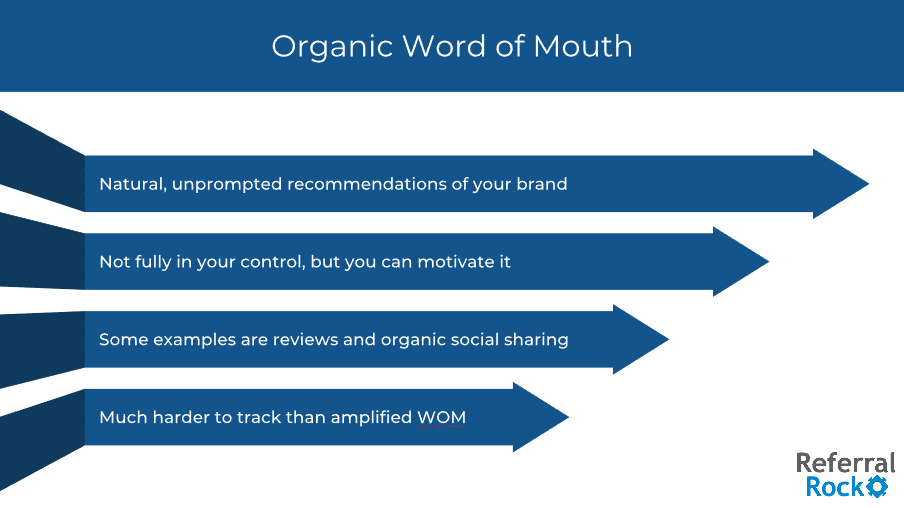
In contrast, organic word-of-mouth marketing occurs when someone recommends your brand naturally and without direct prompting from your business.
While it’s much harder to motivate and track, this type of word of mouth isn’t fully out of your control.
It’s usually triggered by an event experienced by the customer. Whether that’s amazing customer service or a free gift with purchase, triggers set your brand apart from the competition and keep you top of mind. Plus, they make for great talking points and organic word of mouth.
Some organic word-of-mouth marketing examples include:
- Spontaneous social media sharing (user-generated content)
- Reviews and comments from satisfied customers
- Natural sharing of a product through any type of conversation
- “Dark social” sharing in DMs and private emails, which doesn’t have a tracking tag
Learn more about specific types of word-of-mouth marketing.
How is WOMM different from referral marketing?
Word-of-mouth marketing is the broad category — it includes anything that gets people talking about your brand, from reviews and UGC to influencer posts and casual conversations.
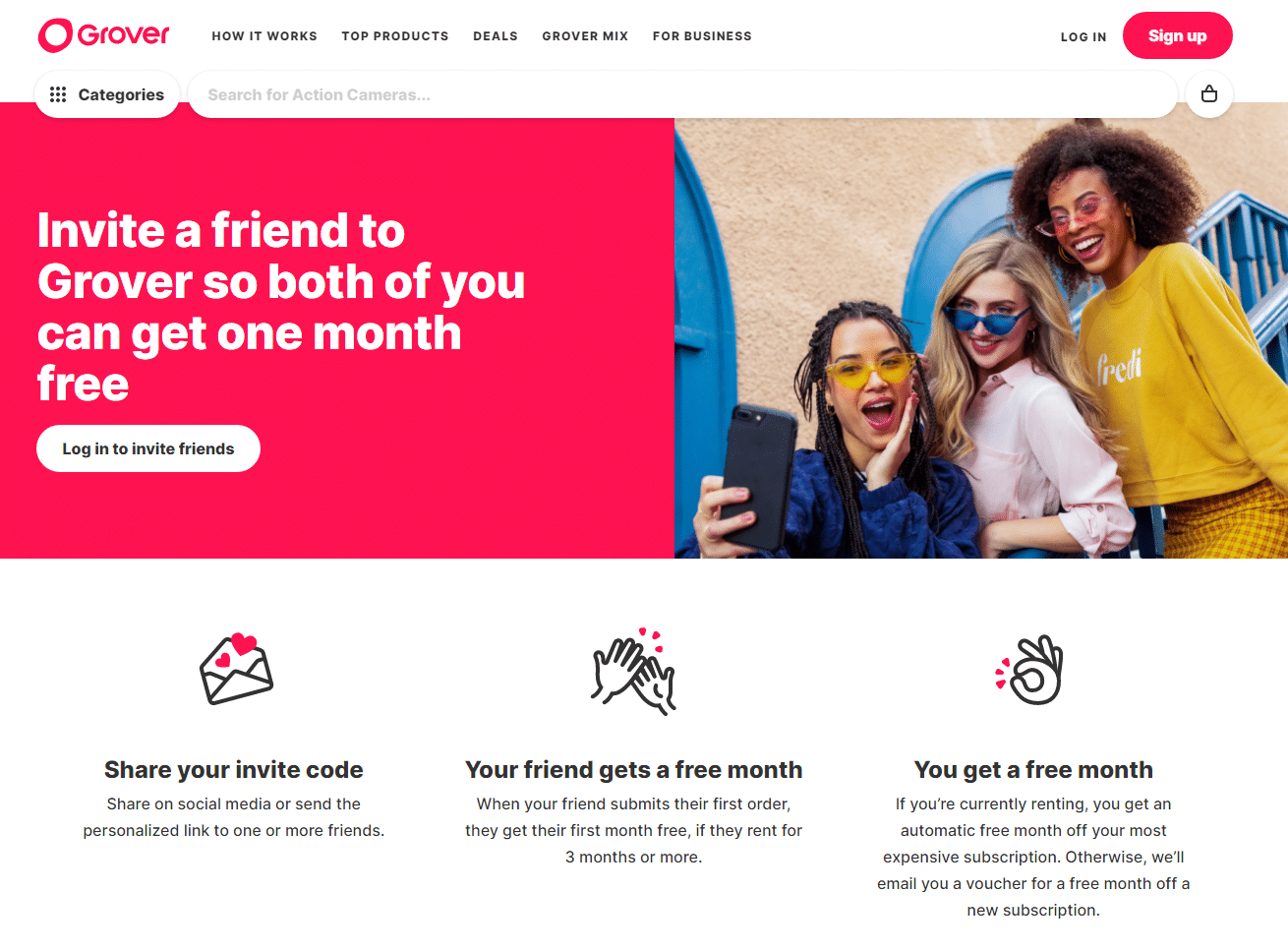
Referral marketing is a specific segment of it. At its core, referral marketing is a proactive, trackable strategy focused on getting existing customers to recommend your brand to people in their network — friends, family, colleagues. The recommendation is direct and purposeful, not just casually mentioned.
It helps to distinguish referral marketing from adjacent tactics that often get conflated:
- Customer referral programs — Existing customers refer people they know personally. Trust is the mechanism; the relationship is the channel.
- Affiliate programs — Content creators or publishers drive traffic to your site with a trackable link and earn a commission. The relationship is commercial, not personal.
- Ambassador programs — Curated advocates (often influencers or loyal customers) promote your brand long-term in exchange for rewards. Closer to referrals, but the arrangement is more formal.
All three generate word of mouth, but the approach, audience, and trust dynamics are different. A formal referral program lets you incentivize customer sharing, monitor conversions and engagement, and organize your entire referral process — with referral software handling the tracking and reward fulfillment automatically. To learn more, check out our referral marketing guide or referral program tips.
Buzz marketing and viral marketing are techniques that generate word of mouth in short bursts — through a buzz marketing campaign, for instance — but they generally don’t create a longer-term sharing engine the way referral programs do.
Start a referral program to drive more word-of-mouth business
Word-of-mouth marketing compounds when you treat it as a system, not a series of one-off tactics. Start with the foundation — be worth talking about. Then put structure around what’s already happening: a referral program that runs continuously, reviews that get asked for at the right moment, a story people can actually repeat.
The businesses that win on word of mouth aren’t the ones who launch the biggest campaigns. They’re the ones who show up consistently, make it easy for customers to share, and let that compound over time.
Ready to build that system? Referral Rock makes it easy to run a referral program that keeps working alongside your business:
- Give customers instant links to access their referral program without needing to log in
- Set up customized rewards to best appeal your customers
- Create a tiered referral program, where members can earn higher-value rewards as they make more referrals
- Automatically track all the referrals your customers make, for full visibility into your ROI
- Measure the impact of all your customers’ referrals by tracking the brand awareness they generate
- Instantly issue rewards when customers earn them, to keep advocates happy
- Access expert support from onboarding specialists, who know all the best practices for setting up a successful referral program
“Referral Rock has helped us grow our referral customer base by leaps and bounds. It’s easy to use and set up, and the team guides you through the process and is there to support you along the way.” – Stacie, Weed Man Lawn Care and Mosquito Authority
Learn more about how Referral Rock has helped companies like yours drive reliable word of mouth >