
A referral message is what your customer sends to a friend on your behalf. It’s the moment your business is being handed off: Recommendation in one hand, reward in the other.
Most referral messages flop because they’re written like ads. Brand voice. Marketing speak. A pitch dressed up as a personal note. Friends can smell it instantly, and the click never comes.
A good referral message sounds like the customer talking to their friend, with a clear gift attached. This guide breaks down how to write one. We’ll cover what to include, what to cut, and a few examples worth borrowing from.
Why is your referral message important?
A strong referral message is necessary for any successful referral marketing strategy. It’s the key to keeping your program’s reach metric high. Reach is all about how many people click on referral links to visit your brand, and the message is where that referral link is presented. The message has to be compelling enough to earn that click.
Think of the referral message as your introduction – it gives insight to people about what your business is about and what you offer. It’s also an opportunity to share what sets you apart from the competition.
A referral message plays a major part in drawing people to visit, use, or purchase from your business. While a well-written referral message can bring in new customers, not having a clear referral message often causes a program to fail. After all, the program won’t bring in sales (referrals) if it doesn’t bring in clicks (reach).
What every referral message needs
Pre-drafting a message for the customer to send makes referring easy. It also lets you control the parts that matter most: who the message sounds like, what the friend gets, and what they should do next.
Consider these points as you write (or rewrite) your referral message:
- Is the message written from the sharer’s point of view, without any marketing language?
- Does it highlight what’s in it for the friend (the referral reward)?
- Does it highlight the benefits of your business (why the referred friend should care)?
- Will the friend know exactly what to do next, and be compelled to click?
Let’s dive into these four essentials, in order of importance:
1. The customer’s voice, not yours
This is the difference between a referral that converts and one the friend ignores.
The message should read like your customer wrote it. First person. Casual. The way they’d actually text or email a friend. Not “Welcome to [Brand], your premier solution for…” — that gets deleted on sight.
Compare:
Your friend Reuben thought you’d like our pool cleaning service. Here’s a coupon for a free filter change and pool sweep.
vs.
Hey there, I wanted to share Pool Paradise with you. I use them for my pool every season and I think you’d like them too.
Here’s a coupon for a free filter change and pool sweep if you want to try it out.
Thanks, Reuben
Same information. Completely different feeling. The second one sounds like a friend; the first one sounds like a brand pretending to be one.
A few rules of thumb:
- Write in first person — “I,” not “your friend Reuben”
- Keep the tone friendly and casual, the way the sharer would actually talk
- After drafting, ask yourself: would this customer say this to a peer? If no, rewrite
It’s also worth giving customers room to edit the pre-drafted message before they send it. Some will use it as-is. Others will personalize. Both should work.
2. The friend’s reward
What’s in it for the friend? That’s the question the message has to answer, ideally in the first line or two.
A discount on their first purchase. A free trial. Store credit. A free product or service. Whatever the referral reward is — that’s the headline.
Crucially: the sharer’s reward does not belong in the friend’s message. What your customer earns for referring goes in their own dashboard, in their thank-you email, in the sharer-facing UI. Putting it in the friend’s message turns the gift into a transaction. The friend stops thinking “my friend wants me to try this” and starts thinking “my friend gets paid if I sign up.” The Friend Factor evaporates.
If you don’t already offer the friend a reward, start there. The friend reward is usually the deciding factor in whether the click happens at all.
If you do offer one and clicks are still flat, look at the reward itself. Is it tied back to your business (a credit, a discount, a free product)? Generic gift cards convert worse than rewards that pull the friend toward your product.
Pro tip: If the message is an email, you need to get people to open it before they even see your referral message. The subject line is another great place to put the referral incentive, because that reward entices people to open and learn more.
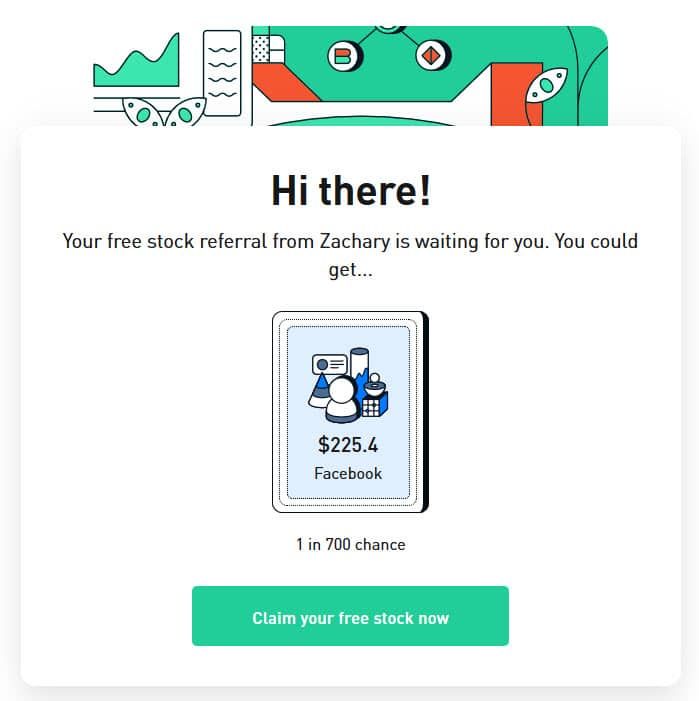
3. A short value pitch
The friend may have never heard of you. They need a quick read on what you do and why it’s worth their time.
Two sentences is plenty. Cover:
- What you do
- What makes you worth trying
Not your full mission statement. Not your founding story. The friend is deciding in seconds whether to keep reading. Give them a taste, link them to the rest.
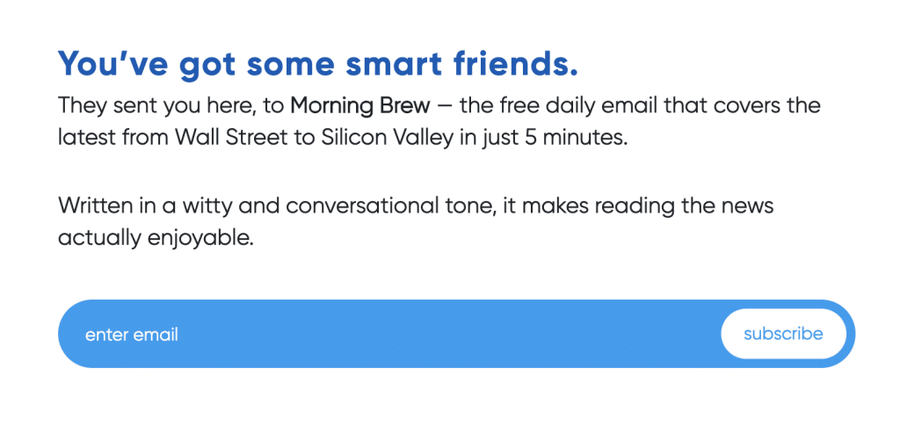
Morning Brew does this well — their referral message tells the friend exactly what the newsletter is in one line, then gets out of the way.
4. One clear next step
Every message ends with one obvious action: a link, a button, a code. Whatever fits the channel.
That’s it. One step, easy to find, no ambiguity about what happens when they tap it.
If the message lives in email, a button works. If it’s a text or social DM, a link works. The point is that the friend never has to guess what to do after reading.
A few touches that help
Aside from the elements already covered, there are a few other best practices to consider. While they aren’t necessary for every referral message, the following are a great way to add excitement to your referral message.
Add an image, GIF, or video
Visuals catch attention, especially in social shares. A product shot, a hero image of the reward, or a short GIF can lift open and click rates.
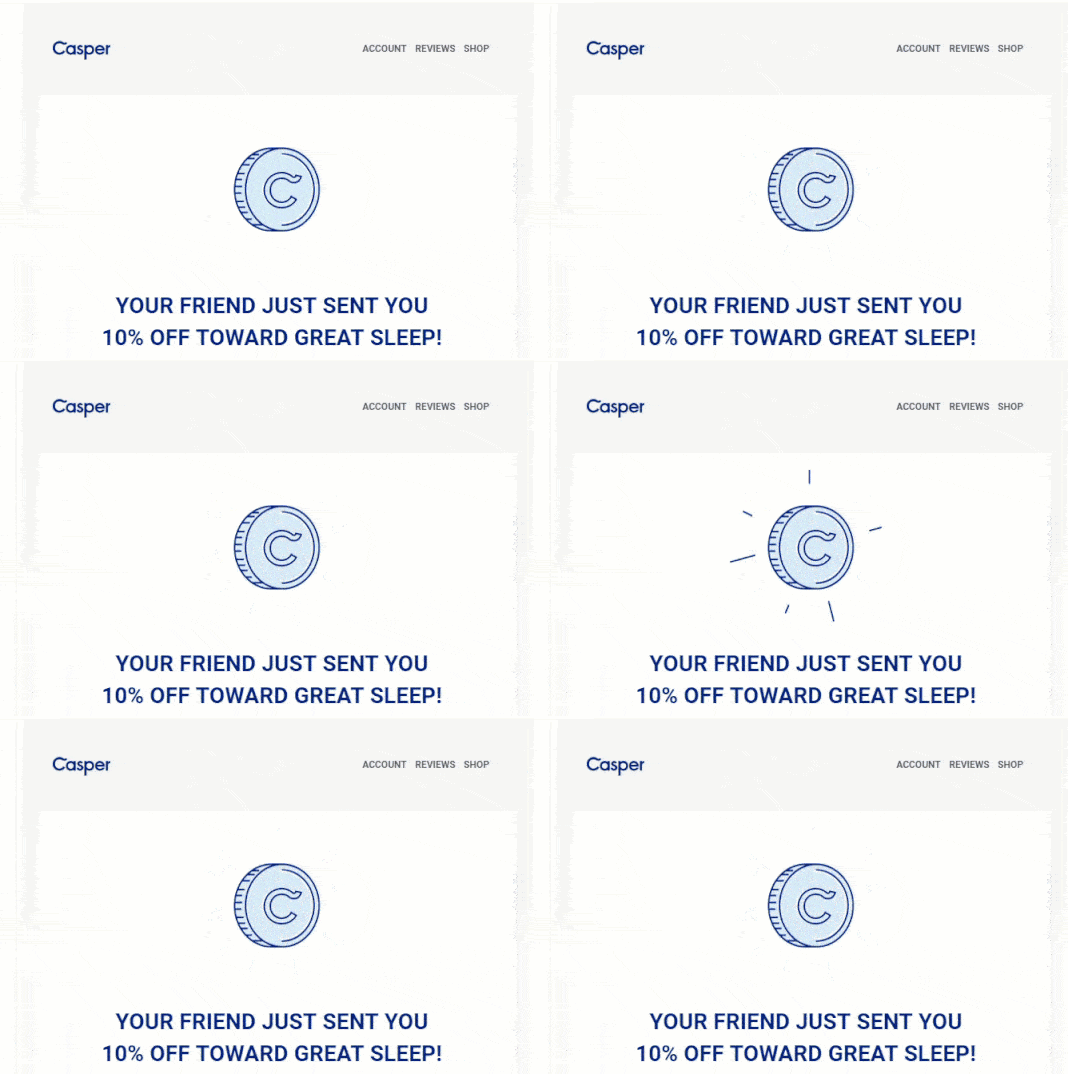
Casper’s referral program uses a small animated coin in their message — playful, on-brand, and a visual nod to the discount. It’s not required, but if your brand has any kind of visual personality, the message is a good place to use it.
Personalize where it counts
Drop the sharer’s name into the message and the subject line. It’s a tiny lift, and it pulls the message out of the “feels like a mass email” pile. Add the friend’s name where possible, too.
For social shares, name personalization gets harder, so don’t force it. Use it where the channel supports it.
What to leave out
A few things that quietly kill referral messages:
- Brand voice. Anything that sounds like your “About Us” page. Mission statements. Marketing taglines. The friend isn’t on your homepage.
- The sharer’s reward. “I’ll get $20 if you sign up” turns the message into a sales pitch. Keep what the sharer earns out of the friend-facing copy entirely.
- Urgency theater. “Act now!” “Limited time!” Friends don’t pressure friends. The reward itself is the incentive.
- Multiple CTAs. A “learn more” link plus a “shop now” button plus a “follow us” line splits attention. One next step.
- Long company history. Save it for the landing page. The message is the handoff, not the pitch deck.
Referral message examples
A few real referral messages worth studying. None of them are perfect, but each one gets something right.
Evernote
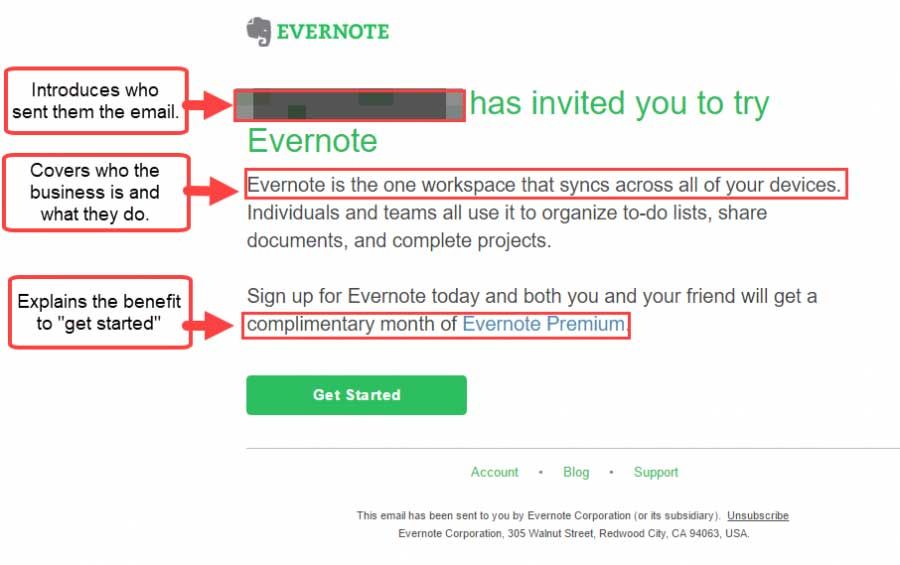
[Referrer Name] has invited you to try Evernote
Evernote is the one workspace that syncs across all of your devices. Individuals and teams all use it to organize to-do lists, share documents, and complete projects.
Sign up for Evernote today and both you and your friend will get a complimentary month of Evernote Premium.
Two short paragraphs cover what they do, what the friend gets, and what to do next. The brand logo carries the “this is from Evernote” signal so the body copy doesn’t have to.
Worth borrowing: How compact the value pitch is.
Could be improved: The message should be from the sharer’s perspective, and shouldn’t mention what the sharer gets.
Zulily
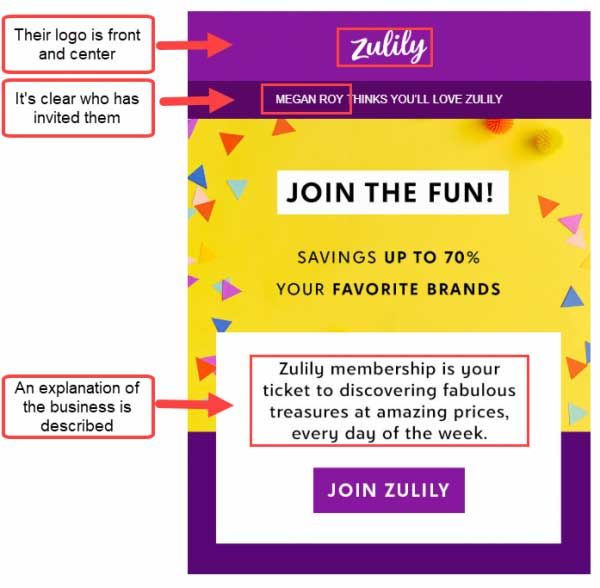
Join the fun!
Zulily membership is your ticket to discovering fabulous treasures at amazing prices, every day of the week.
Zulily’s message skips the explicit friend reward — they’re betting the deals themselves are the draw. It works because the value pitch is concrete (treasures, amazing prices, every day), and the sharer’s reward stays hidden from the friend.
Worth borrowing: keeping the sharer’s $15 referral reward out of the friend’s view.
Could be improved: The message should be from the sharer’s point of view, and less salesy.
Casper
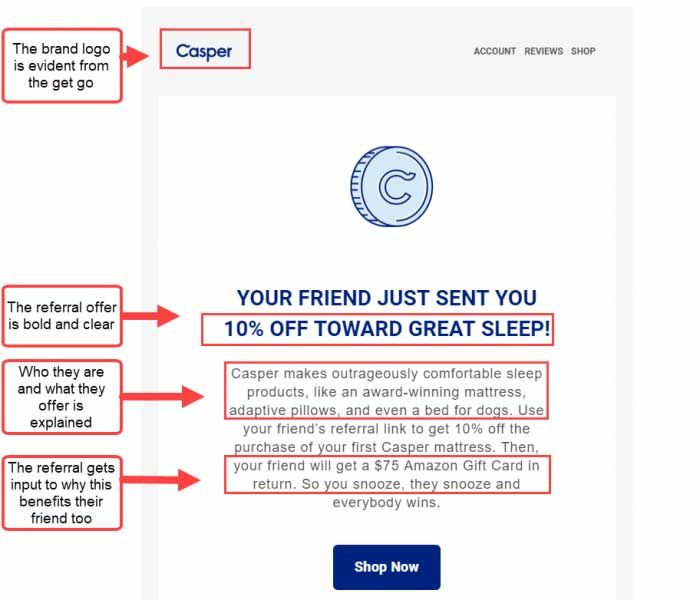
Your friend just sent you 10% off toward great sleep! Casper makes outrageously comfortable sleep products, like an award-winning mattress, adaptive pillows, and even a bed for dogs.
Use your friend’s referral link to get 10% off the purchase of your first Casper mattress. Then, your friend will get a $75 Amazon Gift Card in return. So you snooze, they snooze, and everybody wins.
With great branding and a referral discount, Casper has been on a roll. The referral message is straightforward, but also shares a little more detail than some other companies.
Worth borrowing: Casper does most of this right — clear friend reward up front, short value pitch, casual tone, one CTA.
Could be improved: The line about the friend’s $75 Amazon Gift Card pulls the friend out of “I’m getting a discount” mode and into “my friend gets paid for this.” And we wish they would have written this in first person, from the sharer’s point of view.
Where the message hands off: the friend’s landing page
The message gets the click. The friend landing page closes it.
The two should feel like one continuous handoff. When the friend lands, they should see:
- The referrer’s name on the page (“Reuben sent you this”). Without it, the page reads like a generic promo, and the trust the message carried disappears.
- The friend’s reward, recapped, with no guesswork about whether it’s been applied
- The same value pitch, expanded — what you do, why it’s worth trying
- One next step, the same kind of clear CTA the message ended on
The referrer put their relationship on the line by sharing. The friend page should honor that — make it obvious this is a personal recommendation, not a banner ad. A personalized referral page does this naturally.
If the message says “your friend sent you a gift” and the page says “Welcome to our referral program,” you’ve broken the handoff. The friend feels the seam, and the click goes nowhere.
Keep the handoff going
A great referral message isn’t one you write once and forget. It’s part of an ongoing referral program — one that runs as customers come and go, not as a one-time campaign.
Get the message right and you’ve removed the biggest friction in referrals: the moment the customer goes “wait, what am I supposed to say?” Pre-drafted message, friend’s reward up front, customer’s voice. Then make it easy for them to send it again, to someone else, next month.
Looking for more on building and running a referral program?
Check out these resources:
- Referral Program Template: Essential Elements for Your Referral Program
- 21 Absolute Best Referral Program Ideas for Every Part of Your Campaign
- Referral Program Workbook, with 15 actionable guides & 101 real-world examples
- Referral Page Examples + Strategies to Steal
- Easy Referral Email Templates: Get New Customers In a Flash
Referral Rock software makes it easy to ship pre-drafted messages, track what gets shared, and keep the handoff smooth from message to landing page.

About the author
Content Specialist (former)
Megan was with Referral Rock from 2016-2023 where she wrote many of the original referral and template guides. She also contributed to marketing videos, explainers, and mixed media for the product and support center.