
Membership businesses run on word of mouth. Members talk to people who share their interests. That’s the whole point of belonging to something. So referrals are already happening in your org, whether you’ve built a program for them or not.
The real question is whether you’ve got a system to capture those referrals, make sharing easier, and recognize the members doing the work. This guide walks through how to set one up: the readiness check, the design choices that matter, and the ongoing operations that keep referrals rolling alongside everything else you’re running.
What are membership referral programs?
A membership referral program is a system that lets your existing members invite people they know to join the organization. Members get a unique code or link to share, the system tracks who signed up because of whom, and rewards go out automatically when a referral converts.
It’s a member referral program built for orgs with a natural membership structure: clubs, gyms, professional associations, recreation centers, online communities, subscription-based services. Anywhere people sign up to belong to something ongoing.
The thing to understand up front: members are already talking about your org. They’re inviting friends to events, mentioning it in conversations, posting in group chats. The program isn’t creating that activity. It’s capturing it, making it easier, and giving you a way to thank the people doing it.
Are you ready for a membership referral program?
Most articles list the table-stakes prerequisites for starting one: have a website, have members who like you, give them a good experience. Useful in theory, but it doesn’t really tell you whether to build the program now or wait.
Here’s the readiness signal that actually matters: members are already referring people, but you have no system to make it easy, track it, or thank them for it.
If that’s where you are, you’re leaving member growth on the table. A program captures the referrals that are already happening organically and turns “random” into “reliable.”
If members aren’t referring at all, a program won’t fix that. The fix is upstream. Improve the member experience, the community, the value, the story you tell about why people belong. Once members are talking about you, you’ll know it’s time.
A few questions to gut-check readiness:
- Do members ever bring friends to events or invite people to join, without prompting?
- Would your tenured members recommend you if asked?
- Is there at least one part of the membership that members rave about (the community, the facilities, the content, the trainers, the meetups)?
- Is your operations side running cleanly enough that new members will have a good experience when they show up?
If most of those are yes, you’re ready. If they’re mostly no, build the foundation first.
Why referrals work so well for membership businesses
Member referrals work better than other acquisition channels for a few reasons baked into how memberships work:
Memberships are inherently community-based. Members are loyal and dedicated participants in something they chose to belong to. They already know other people who’d fit. That’s the whole point of joining a group built around shared interests. Most acquisition channels have to find lookalike audiences from scratch. Membership orgs don’t.
Members understand what they’re recommending. They’ve experienced the program from the inside. When they tell a friend, they’re not reciting marketing copy. They’re explaining what they actually get out of it. According to Review42, 92% of consumers trust recommendations from people they know more than any other form of advertising.
Referred members stick around longer. People who join because their friend is already a member start out with social ties to the community. They show up to events because their friend is there. They renew because leaving means leaving the group their friend is in. Referred members lift retention almost automatically.
It’s a cost-effective way to grow. You’re spending less per new member than you would on paid acquisition, and the new members you get are higher-quality on average. Better fit, longer tenure, more likely to refer others themselves.
The thread connecting all of these: the program isn’t doing the work. Your members and your community are. The program just makes it easier to participate and tracks the result.
Referral software for membership businesses [Free Tools]
These referral tools for membership businesses are a free and easy way to help you start your referral program.
Want a automated referral system for your membership business? Uncover referrals in plain sight to smooth out business lulls, without losing focus on your real day to day work helping customers.
Check out our referral program software - done right.
How to run a membership referral program well
The mechanics of running a program are simpler than most articles make them sound. The hard part is treating it the right way: not as a campaign, not as a transaction, not as a closed club. These five practices cover most of what matters.
Treat it as ongoing operations, not a campaign
Most membership orgs launch a referral program the same way they’d launch any marketing initiative. Write the announcement email, blast it to the member list, watch the spike, then move on. Two months later the program is dead.
The reframe: a referral program isn’t a campaign. It’s an operation. It runs alongside everything else your org is doing, all the time.
Think about how you already run member communications. You have onboarding emails, renewal reminders, event announcements, newsletters, signage at the front desk. Each of those is a touchpoint where a referral invitation can live. Not as a separate push, but as part of how members already hear from you.
The 3 elements of continuous promotion:
- Proactive invites. Bulk emails to your member list, triggered emails after a great moment (just renewed, just hit a milestone, just attended an event), reminders in your existing newsletter cadence.
- Discovery paths. Your website, member portal, app, social profiles, signage at the gym or clubhouse, business cards, email signatures. Anywhere members already encounter you.
- Program recruiters. Your front-desk staff, instructors, community managers, membership directors. The people who already talk to members can mention the program at natural moments. This is huge for membership orgs and underused.
A list of past contacts goes stale in 2-3 months. You can’t email-blast your way to a sustained referral program. The cadence underneath is what makes it work. Email is a channel. The program is the rhythm.
For more on this, see Promoting your membership referral program and our broader collection of proven referral ideas.
Frame the referral as a gift, not a transaction
Most rewards advice goes something like: pick a good incentive for the referrer, pick another for the friend, make them both attractive, done. Double-sided rewards are better than one-sided rewards. That’s true. But it misses the bigger frame.
Members aren’t selling subscriptions to their friends. They’re inviting them into something they love.
Frame everything around what the friend gets, not what the referrer earns. The program name, the email copy, the share message, the friend-facing landing page. The reward isn’t a payment for the work of referring. It’s the gift the member is giving their friend.
A few rules that follow from this:
- The friend’s reward goes in the headline of the message. The sharer’s reward stays in the sharer’s dashboard or thank-you email. Even one line about “your friend gets $25 when you sign up” pulls the friend out of “I’m getting a gift” mode and into “my friend is getting paid for this.” It turns the gift into a transaction.
- The message and the friend’s landing page should feel like one continuous handoff. Same referrer’s name on both (“Taylor sent you this”). Same reward, same value pitch, same tone. If the message says “your friend sent you a gift” and the page says “welcome to our referral program,” the friend feels the seam and the click goes nowhere.
- Skip the calculated incentive math when you can. Gifts work better than cash for membership orgs. A free month, a guest pass, branded swag that fits the org (a gym bag for a gym, a yearbook for an alumni association, drink tickets for a social club) all work harder than an equivalent dollar amount because they reinforce why someone joined in the first place.
The members who refer the most aren’t doing it for the reward. They’re doing it because they want their friends to share what they’ve already got. Design around that and let the offered reward incentives make it easier, not transactional.
When members want to write their own share messages, let them. The pitch in their own words from their own perspective is what makes the recommendation land. The program just gives them the link, the framing, and a friend-facing page that honors the trust they put on the line.
A share carries further when it feels personal at every step, from the invitation sharers get, to the message they send friends, to the page their friend lands on. Here’s how to personalize the share experience with Referral Rock.
Choose rewards that fit the membership
Once you’ve got the framing right (gift, not transaction), the reward selection gets simpler. The best rewards for membership programs do two things:
- Tie back to the membership itself. A free month, a discount on dues, a guest pass for the friend, branded merchandise that reinforces why someone joined. The reward should feel like an extension of belonging, not an unrelated bribe.
- Cost you less than the lifetime value of the new member. Membership LTVs are typically high (recurring revenue plus retention compounds). You can afford generous rewards because the math works on the back end.
Some examples that work for membership orgs:
- A month of free membership for the referrer; first month free for the friend
- Waived joining fee for the friend; account credit for the referrer
- Branded swag (gym bag, water bottle, mug, hoodie) tied to the org’s identity
- Guest pass for the friend; a meaningful upgrade or exclusive perk for the referrer
- Discount on next renewal for the referrer; new-member discount for the friend
Cash and gift cards work, but they tend to make the program feel transactional. Save them for situations where membership-based rewards genuinely don’t fit.
Use our referral reward calculator to determine the reward values you should offer the sharer and their friend, for the best ROI.
Keep access open: every member is already in
Most membership programs default to gating. Make members opt in. Have them fill out a form to join the referral program. Approve them as “advocates” first. Pick the most loyal members and invite them before opening it up to everyone else.
Every one of those steps loses people. The members who would have referred you don’t bother because there’s a form between them and the link.
Treat the referral program like an extension of membership itself. Every member already gets a code or link by default. No join button, no “best advocates first,” no application. The program is just there, automatically, the same way the gym is there or the community forum is there.
This sounds risky to some operators. What if people abuse it? What about quality control?
The reality: you don’t know who your most enthusiastic referrers will be until you give everyone access. The parent who’d never strike you as a power referrer might bring in twelve new members because she’s in three group chats with people who’d love your community. Gating preemptively means you never find out.
For the abuse concern, build progressively, not preemptively. Run open. If you start to see fraud signals (self-referrals, fake accounts, weird patterns), add detection rules then. Don’t preemptively kill the program out of fear of something that may never happen.
Make sharing as low-friction as possible: pre-built referral links, prewritten messages members can edit if they want, easy social and email sharing options, and a mobile referral program that works wherever members are. The fewer hoops, the more referrals.
You’ll get referrals at much higher rates through referral marketing when access is open and the friction is gone. Every step you add between “I want to refer someone” and “here’s my link” is a step where you lose people.
Tip: Briefly outline the ideal type of member you’re looking for on your member page. When sharers are clear on the type of audience you are targeting to join your organization, it’ll make referring easier.
Track what matters
You don’t need fifty metrics. Four or five tell you whether the program is working:
- How many referrals come in per month. The volume metric. Is it growing, flat, or shrinking?
- What share of members refer at all. A small percentage of members will drive most referrals. That’s normal. But if almost no one is referring, the program isn’t reaching members or the friction is too high.
- What share of referred friends actually join. This tells you whether the friend experience is working: the message, the landing page, the offer.
- How long referred members stick around vs. all members. Referred members usually retain better. If they don’t, something is broken in the matching or the friend experience.
Referral Rock software tracks all of this automatically, and saves you the manual reconciliation that kills programs run on spreadsheets.
Membership referral program examples
Two membership orgs running solid programs you can borrow ideas from.
Healthcare Financial Management Association
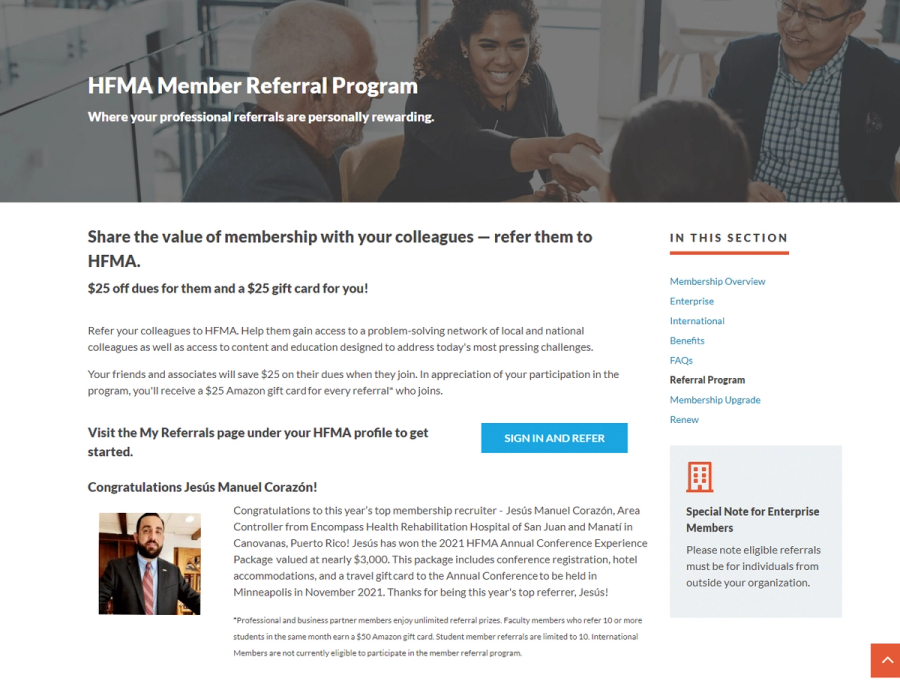
The Healthcare Financial Management Organization (HFMA) is a professional association serving the healthcare finance industry. Their referral program offers $25 to the referring member and a $25 discount on dues for the new member who joins.
What works: the call-to-action button (“Sign in and refer”) is prominent, and the program page is simple and easy to navigate. The reward structure is symmetrical, which is fine. You could imagine a stronger version that leads with what the new member gets and frames the $25 to the referrer as a thank-you rather than the headline.
Mountainside Fitness
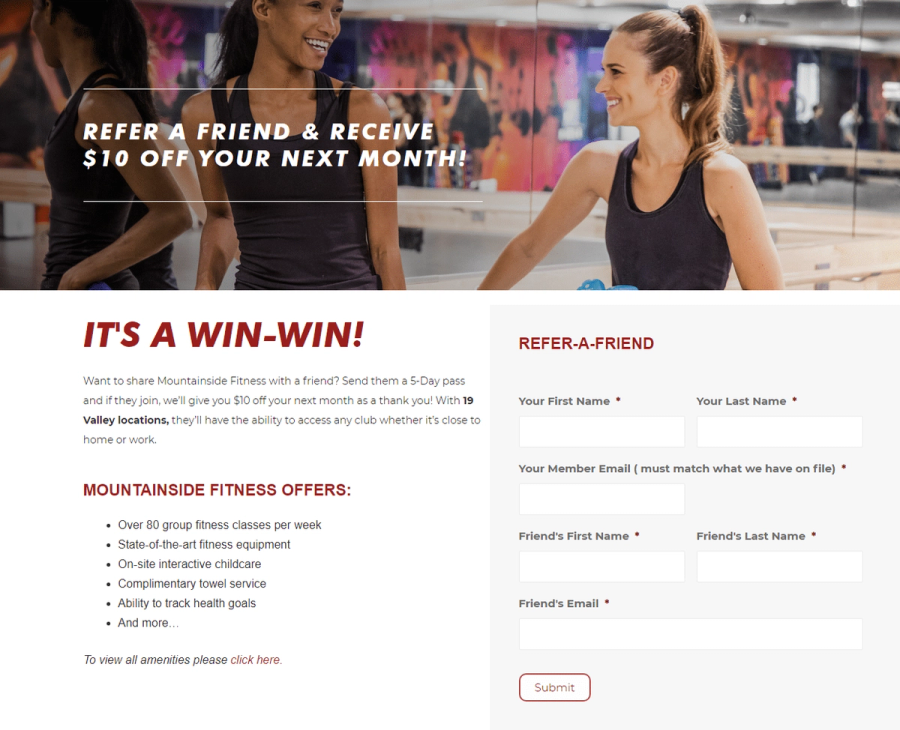
The Mountainside Fitness referral program is a great example of friend-factor framing. Members send their friends a five-day pass (the gift), and once new members join, the existing member gets $10 off their next month’s subscription.
What works: the friend’s reward (a free five-day pass) is the headline, and it ties directly to the membership. The friend gets to actually experience the gym before deciding. The referrer’s reward is real but lower-key. The page also lists what the gym offers, which gives the referring member language to use when they tell their friend about it.
Make referrals part of how your membership runs
Member referrals aren’t a campaign you launch. They’re an extension of how your membership already runs. Members are already inviting friends to events, posting in their group chats, talking up your community to people who’d fit right in. A referral program adds the structure: it makes sharing easier, tracks what’s happening, and gives you a way to thank the people doing the work.
The orgs that get this right don’t treat the program as a marketing push. They build it into onboarding, renewal cycles, member communications, and the daily rhythm of running the business. Then it just keeps rolling.
If you’re ready to capture the word of mouth your members are already generating, Referral Rock referral software is built for exactly this. Members get codes and links automatically, the messaging frames each referral as a gift to a friend, and the system runs alongside your existing operations instead of demanding a separate campaign.

About the author
Jessica Huhn is a content writer and strategist at Referral Rock. When she is not writing, there is a good chance that Jessica is singing, arranging songs, sharing and enjoying content on social media, or hanging out with her mini Goldendoodle. She believes that it's always important to cultivate gentle strength.