![How to Choose the Best Referral Rewards [24+ Examples]](https://cdn.sanity.io/images/x9q04aql/production/4be3aabbf5b86176426a4d34a204cb294408ec40-900x600.jpg?w=420&auto=format)
Referral rewards aren’t what makes customers talk about you. If people aren’t already recommending your business, a better incentive won’t change that.
What rewards do is channel word of mouth that’s already happening — making it easier for people to share, and giving their friends a reason to take action. Done right, the reward feels less like a transaction and more like a gift the sharer gives their friend.
A good referral incentive should attract customers, make sense for your business, and not take away from its bottom line. This guide covers how to choose the right rewards for your customer referral program: who to reward, when, how much, which types perform best, and which structures to use for different business models.
For a quick rundown of our best referral reward tips (+ the mistakes to avoid), check out our explainer:
Benefits of referral rewards
Referral rewards encourage people to share your business and help convince the friends they refer to become your new customers. So, they’re a key piece of any referral program.
They motivate people to share your business with friends, and create social currency for advocates: since their friends can get a deal because they know the advocate, the advocate gets a boost in their reputation.
And by rewarding the friend being referred, referral incentives create a sense of urgency and help motivate the friend to take action (make a purchase). Referred friends also appreciate that a peer sent the incentive!
Choosing a referral reward that fits your business: 4 key steps
Choose referral rewards that motivate sharing (and purchasing), and that are sustainable for your business to pay out. They must be enticing and relevant, without compromising your bottom line.
We recommend using four basic steps to choose your reward:
- Decide who gets the referral reward — the member (referrer), the new customer (friend), or both
- Choose when rewards are paid out
- Decide on the value of your rewards (how much will you spend?)
- Select the type of rewards
Step 1: Who should get the reward — the referrer, the friend, or both?
When planning your referral program, one of the first decisions is who you want to motivate. This lays the foundation for everything else: what incentive to offer, which structure to use, and how to write your program headline and messaging.
Before getting into the options, it helps to reframe how you think about rewards altogether. Most businesses design rewards around the referrer’s motivation — “what’s in it for me?” But the programs that work best flip that question. Instead of “what does my referrer earn?”, ask: “what gift can I give my friend?”
When the sharer can offer their friend something real — a meaningful discount, a free product, a gift card — the referral stops feeling like an ask and starts feeling like a favor. The sharer looks generous, not transactional. That shift changes how people talk about your business.
This is the Friend Factor: design your rewards so the sharer is giving their friend something worth having, not just collecting a payout for themselves.
Rewarding both the referrer and the friend (double-sided)
Double-sided referral programs reward both the referrer and the referred friend when a friend makes their first purchase. For any business where a purchase is made, double-sided rewards are the best approach — and through the Friend Factor lens, you can see why. When the referred friend receives something real (a discount, a free item, cash back), the sharer becomes the person who “got their friend a deal.” That’s a completely different dynamic than “I sent you this link because I get $20.”
A double-sided reward can be the same for both parties (i.e., $20 credit each), or different (i.e., a $50 gift card for the referrer, and a 15% discount for the new customer). If you aren’t already offering a double-sided reward, we strongly recommend it. It’s also best to have a good referral software tool so you can track key metrics and make the most of this structure.
Rewarding only the referrer
Rewarding only the referrer (advocate) works well for newer companies seeking to grow brand awareness — it’s an affordable way to motivate quick sharing. Free content subscriptions (like newsletters) also fit here, since they don’t earn money from purchases and can fund modest rewards through ad revenue.
The limitation: without anything for the friend, the referral can feel one-sided. The sharer has nothing to offer — they’re just asking their friend to try something.
Rewarding only the referred friend
This structure is common when regulations prevent you from rewarding referrers. It relies on pure altruism from the sharer — there’s nothing in it for them directly. While this may lead to fewer referrals overall, referred friends who receive an incentive are more likely to make a purchase.
If you aren’t bound by regulations, you should give a reward to the referrer as well.
No reward
Referral programs without any referral reward exist, but this isn’t recommended for most businesses. Some customers will refer you simply because they love what you do — and those are the most genuine referrals. But the majority of customers need a reason to act.
If you have no budget for incentives, legally can’t offer any, or already have a strong natural referral rate, a no-reward program can work. Aspirational or luxury brands may also prefer this approach.
Step 2: When and how often should you give out rewards?
Next, decide when and how often you’ll give out referral rewards.
When should rewards be paid out?
Rewards should be easy to understand at a glance and tied to the behavior you’re trying to drive — usually a purchase, sometimes a qualifying action like a demo signup or consultation.
Make sure the actions you reward are meaningful to your business and indicate a high, predictable chance of conversion. Then reward promptly. Delaying rewards creates a negative experience for your referrers and reduces motivation to keep referring.
As a general rule: reward right away when you get paid (or when a lead qualifies). As long as you’re earning more than you’re paying out in rewards, you win.
A few specific scenarios:
- Reward immediately after purchase for most businesses.
- Reward after a qualifying action (demo, consultation, signed contract) for longer sales cycles — consider a smaller reward at the qualifying stage and a larger one at purchase. See: multi-step rewards below.
- Manual approval is an option with referral software, letting you review and issue rewards in bulk before sending them.
We only recommend waiting until after a return period if there’s a known issue with early refunds or fraud. Otherwise, the delay creates a bad experience for the people referring you.
You might consider waiting briefly to reduce fraud — but fraud is less common than most people expect. Referral software with built-in fraud detection handles most edge cases. This shouldn’t be a reason to punish legitimate referrers.
Should you reward every referral, or use a milestone structure?
Rewarding customers for every single referral is the most common approach, and usually enough to motivate ongoing sharing.
If your rewards are lower in value, reward every successful referral. Don’t make people earn a payout after several referrals, or the effort-to-reward math won’t feel worth it to them.
Tiered or milestone structures work well when you want to create super-advocates who refer repeatedly over time. But make sure the first-tier reward is still meaningful on its own, or you’ll lose people before they ever hit the next milestone.
Step 3: How much should your rewards be worth?
Next, think about how much your reward should be worth. Rewards must be motivating to customers and reflect the value of referrals to your business — but they also need to be sustainable to pay out. Often, the reward value doesn’t need to be as high as you’d expect, as long as the reward itself is the right type.
When choosing your reward value, ask these questions:
What is the average value of a sale?
- The higher the value of a sale, the higher your reward value should be.
- Remember that rewards are pay for performance (you’ll only pay out rewards for qualified leads and/or sales.)
How much does it usually cost to acquire a new customer?
- What do you usually pay for quality leads/customers? Make the reward value comparable.
- Usually, rewards should be close to, but lower than, your average customer acquisition cost.
What is the lifetime value of a customer?
- The higher your average customer’s lifetime value is, the more you can afford to pay out in rewards.
- On average, rewards should be worth 10% of your customer lifetime value (or lower).
- If customers have a low average lifetime value, award less expensive incentives like swag, or consider a referral contest.
- If you have a high volume of customers with a low average lifetime value (i.e. many ecommerce companies or newsletter programs), consider using a tiered program, where you only pay out rewards for every X referrals and offer lower-value rewards to start.
Step 4: What type of reward to offer?
The right type of reward depends on your type of business and customer base. Rewards must be relevant and exciting to your audience, easy to manage and distribute, and matched to purchase frequency.
One note before you pick a type: the reward for the referred friend carries more weight than most people realize. When the sharer can say “use my link and get $20 off your first order,” that’s a concrete gift they’re giving their friend. When the only reward goes to the sharer, the referral is an ask with nothing attached. The stronger the friend’s reward, the more natural sharing feels.
The table below outlines the most commonly used referral rewards across different types of businesses:
| Infrequent or high-value purchase | Frequent or repeat purchase (including subscriptions) | |
|---|---|---|
| Common referral rewards | Cash, swag, gift cards, donations, tech items, gift boxes | Cash back, discount, gift cards, store credit, free products, free subscription service period, donations |
| Companies using these types of rewards | Casper, Hiver, SimpliSafe, Culligan Water, Provident Bank | ActiveCampaign, Dropbox, Omsom, Fiverr, GetResponse |
1. Cash / Cash back
Cash is one of the favorite referral program rewards among customers. While it doesn’t tie back to your company as much as other referral incentives, cash is more enticing as customers can spend it on whatever they want. It’s only fitting that cash is one of the best-performing rewards in referral programs.
Best for: Most businesses where a purchase is made; especially great for businesses where purchases are infrequent, or where the referrer isn’t the one making the purchase
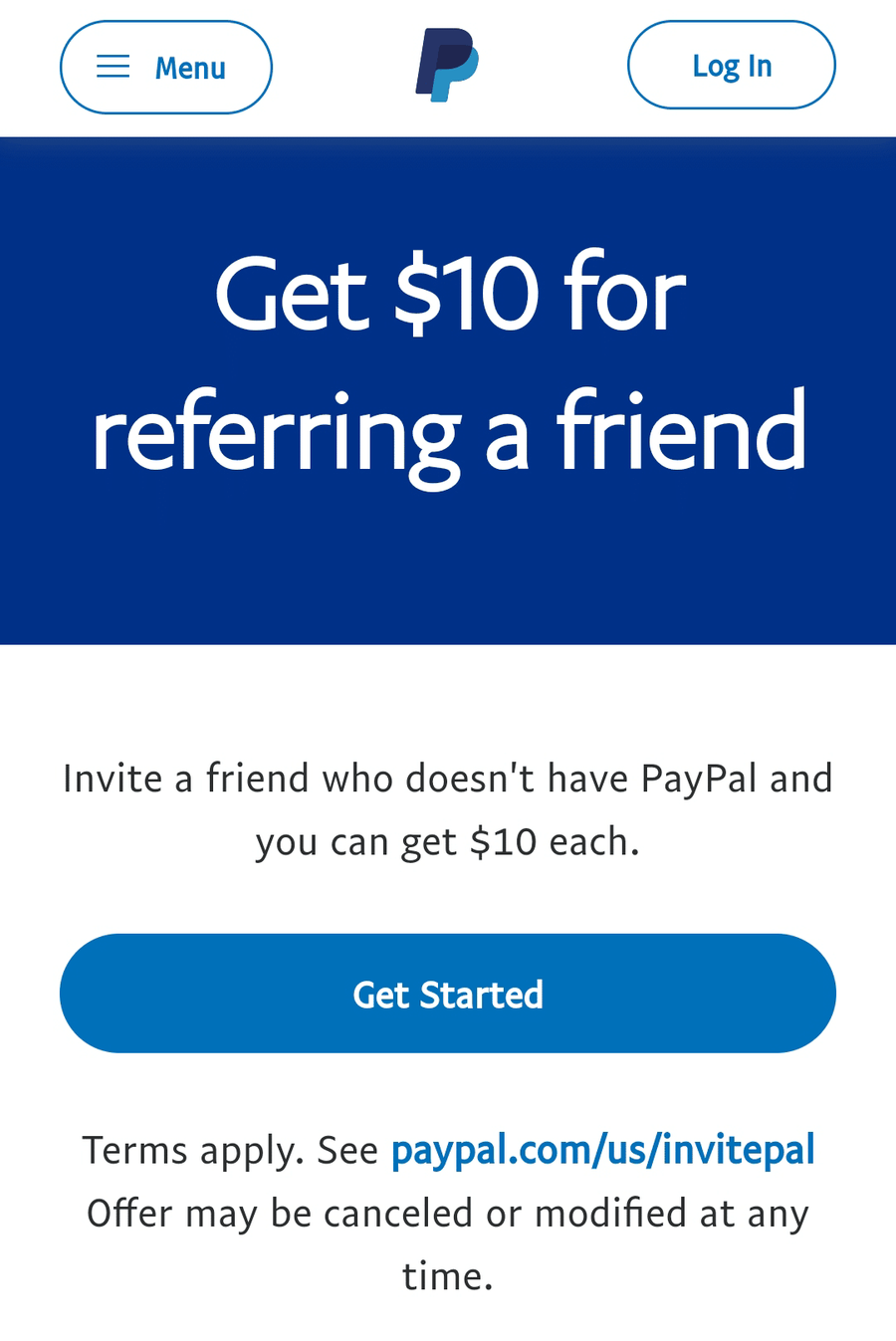
Recall Paypal’s $10 double-sided incentive: $10 for the referrer and $10 for their friend when the friend first opens an account.
Or, look at mattress brand Leesa’s offer to send $75 cash straight to the ambassador’s Paypal account for each referred friend who makes their first purchase.
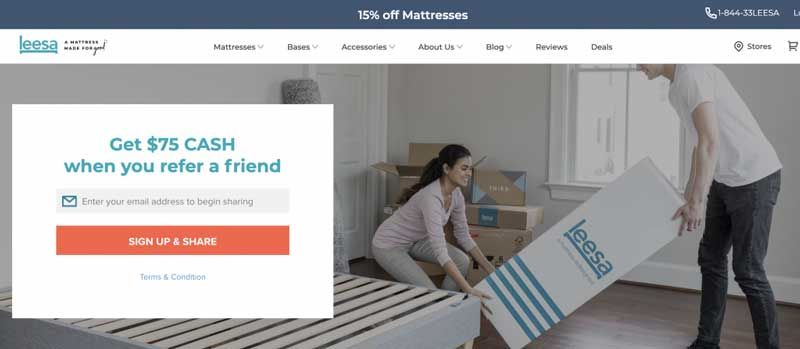
In these cases, cash is a great incentive that aligns well with the business – Paypal offers free accounts for online payment, and Leesa’s products are higher-ticket, infrequent purchases. If customers aren’t planning to make a purchase every month, discounts won’t be as alluring. They’d probably be more motivated by cash!
Cash rewards also tend to generate a lot of buzz, which are great for referral programs in a new or competitive space. Plus, when compared to other referral rewards, the amount of cash doesn’t usually have to be as much as credit or discounts for it to motivate customers.
2. Gift cards
When speaking of referral program rewards, gift cards don’t mean prepaid vouchers for your products – they refer to third-party gift cards for other companies, such as Amazon, iTunes, Starbucks, or even Visa and Mastercard.
Best for: Most businesses where a purchase is made; especially great for businesses where purchases are infrequent, or where the referrer isn’t the one making the purchase
Along with cash back, gift cards are the best-performing referral rewards, as the recipient can choose how they want to use the reward. Plus, with Referral Rock’s Tango integration, customers can choose their preferred type of gift card from Tango’s menu based on their country.
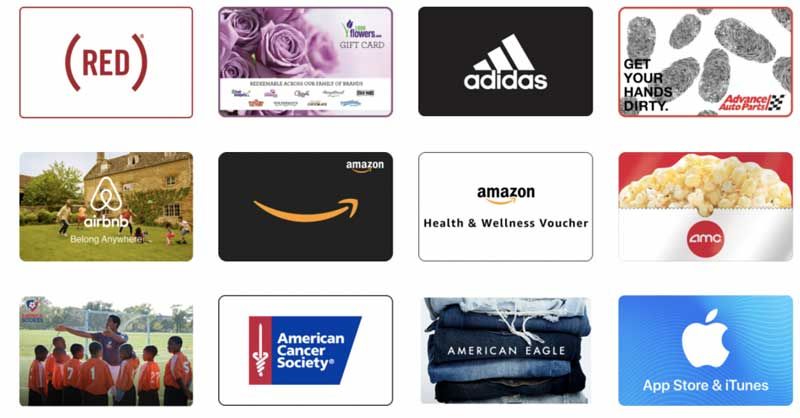
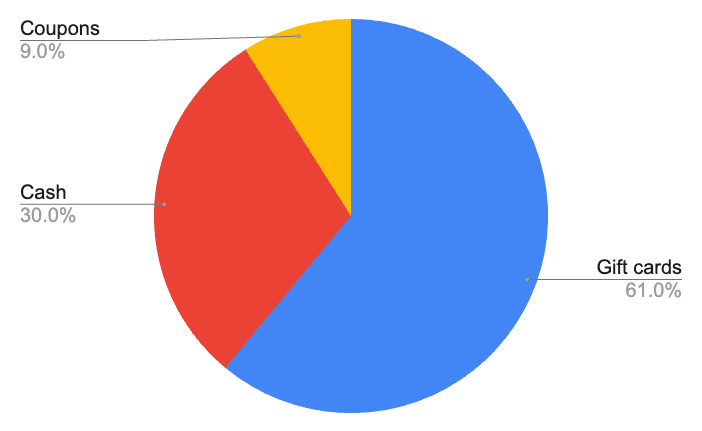
Customers love a gift card reward. Gift cards are usually spent on more memorable items (as opposed to cash), but also offer customers a lot of flexibility and control. In fact, in a recent audit of Referral Rock customers, we found that the most common type of reward for referrers/advocates was gift cards (61%), followed by PayPal and Wise transfers (30%), and coupons/discounts (9%). Gift cards was also a popular reward for referrals.
Another benefit: gift cards can be used by anyone, even if they aren’t the direct customer. Let’s say you’re a company in a B2B referral incentive program – you can easily give the gift card reward to one of your employees.
Gift card rewards are also highly customizable, and you can select a gift card that’s relevant to both you and your customers. For example, a sports company can give Adidas gift cards, while a travel agency can offer Airbnb gift cards. Most companies will also offer a range of gift card quantities and denominations to fit your budget.
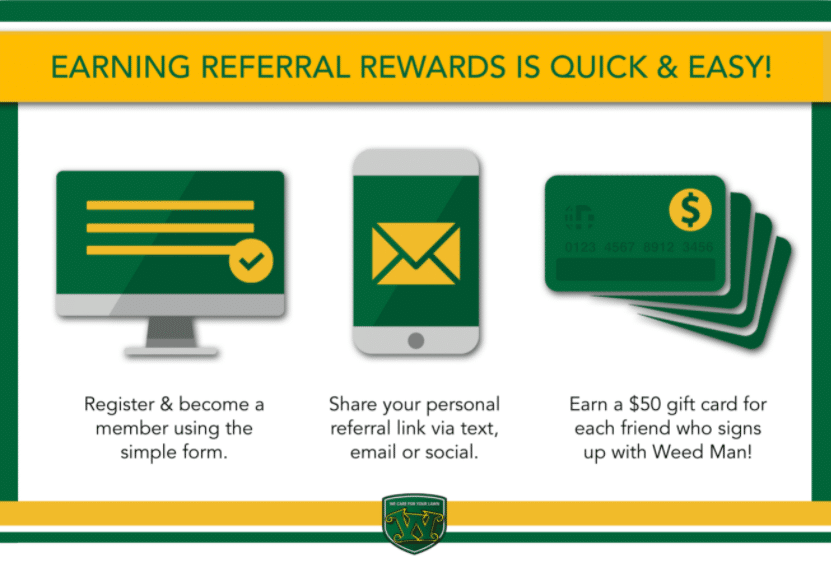
Weed Man Lexington enjoys these benefits thanks to their gift card referral program. Customers get to select their reward from a gift card menu, so the freedom of choice brings extra motivation.
3. Discounts
Discount coupons are one of the most commonly used referral program rewards. And for good reason – discounts provide benefits for both customers and businesses, alike.
Best for: Businesses where people purchase frequently; great option for convincing the referred friend to make a purchase
Usually, discounts are presented as a percentage off a purchase. But they can also be presented as a set dollar amount off of a purchase exceeding a certain value (say, $15 off a purchase of at least $50).
For repeat customers, discounts provide great value, especially if a brand offers a wide range of products or requires repeat purchases. For businesses, these repeat purchases boost sales and encourage customer loyalty.
However, for products with a relatively long lifespan, such as cars or mattresses, discounts may not seem very valuable. If customers aren’t planning to make another purchase in the near future, they likely won’t be interested in discount coupons.
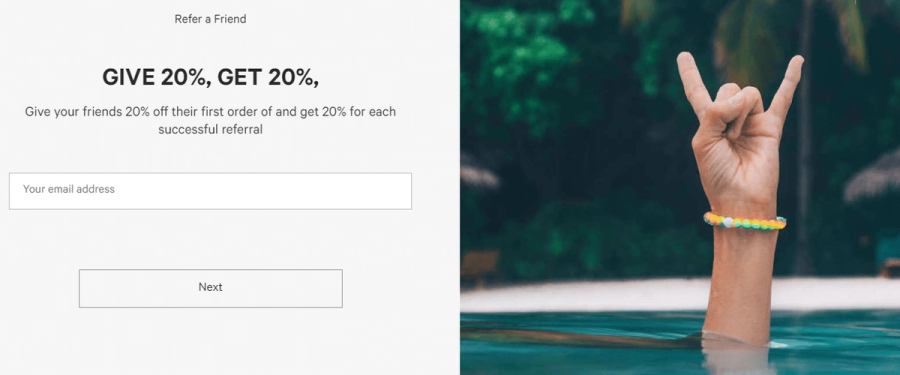
One example of a referral discount comes from jewelry brand Lokai’s referral program.
- The 20% off reward is very enticing for customers who are planning on making a purchase soon.
- A discount makes sense for Lokai’s program because they offer many different bracelets.
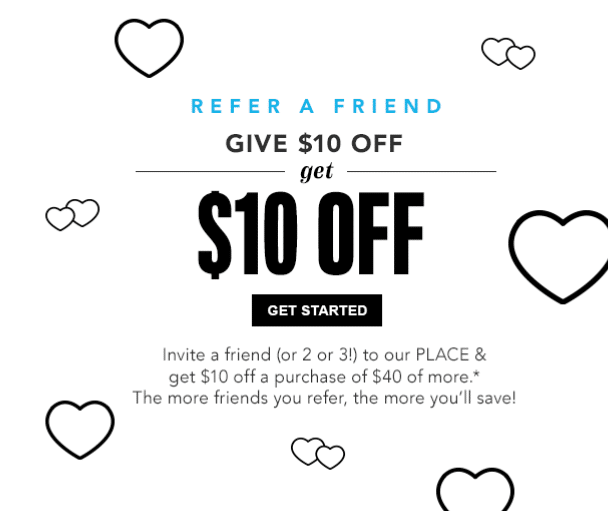
And as shown below, The Children’s Place is another good fit for a discount reward structure.
- The Children’s Place also drives frequent purchases. After all, children grow quickly, and there are plenty of wardrobe options to choose from.
- The brand gives $10 off a purchase of $40 or more, to both the referrer and friend, as its referral reward (a set cash discount).
4. Store credit/account credit
Store credit, or account credit, is the perfect middle ground between discounts and cash. Like discounts, credit can only be used to buy the same brand, keeping the value within the business. Like cash, it’s a referral program reward offered at a monetary value.
Best for: Businesses where people purchase frequently, pay-per-use business models, and subscription services
Many top referral programs use store credits as their referral rewards.
- For example, Airbnb gives $20 for every invited friend who books a stay, as well as $40 for the friend to use on their first trip.
- And Postable gives a $5 credit toward your next order for every referral that ends up placing an order – “The more friends you refer, the more money you make.”
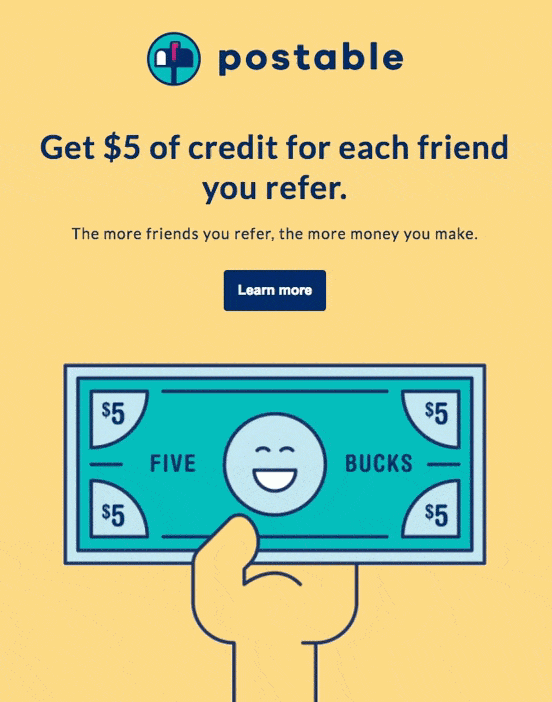
Store credits are especially useful if your product is pay-per-use or purchased on a regular basis. And by making it easier for customers to keep buying from your business, store credits are a great way to build customer loyalty.
The difference between a store credit and an “amount-off” discount is that a store credit can be used on any purchase. Also, store credits are often cumulative (i.e. they can be stacked and applied all at once to a single purchase).
5. Free products or services
People love getting something for free. When that free item is one of your products in exchange for referring a friend, this can help accelerate sharing and build more excitement around your brand (especially for new customers making their first purchase).
What if you’re a SaaS or another service business, though? You can still offer upgrades, temporary free access to premium features, or free added perks that would normally come with a higher-level service plan.
Best for: Companies where purchases are frequent; great reward for referred friends. If you’re planning to offer free products (as opposed to services), it’s best if you sell relatively inexpensive products. This will also only work if the referrer is the direct buyer of your product or service.
Free product rewards worked especially well for Harry’s. The razor brand used free products to build buzz before their official launch, and collected a staggering 100,000 emails from referrals in only a week!
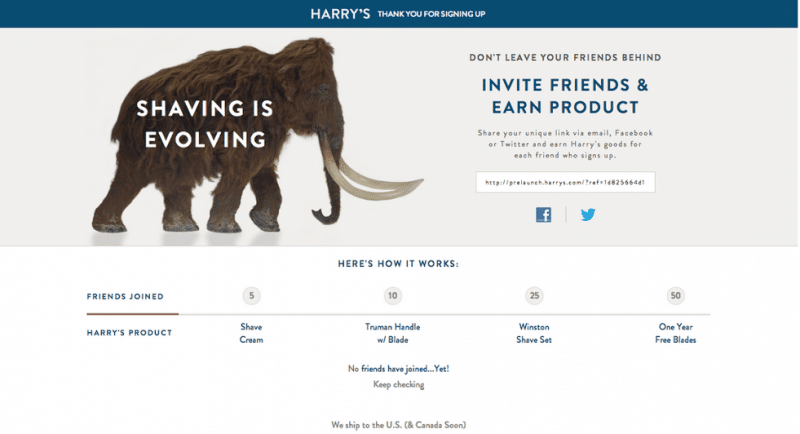
The product or service you choose must be cost-effective to offer for free, relative to your average customer acquisition cost. And of course, it must be worth a referral, from your customers’ perspective.
6. Branded swag
Swag is one of the most fun referral rewards or incentives. It can be a tote bag, a mug, a sweatshirt, a water bottle, or any number of free products outside of the standard sales cycle.
Best for: Content models where the content is offered for free; businesses with a brand strong enough that someone would be excited to wear or use something branded
Swag can also be very cost-effective when ordered in bulk. This makes it a perfect reward for newsletter referral programs (like Morning Brew’s referral program), as they offer their newsletter for free and rely on ad revenue.
Bonus: The right swag can do wonders for your business. In addition to being an attractive referral offer, branded swag also serves as advertisement for your business.
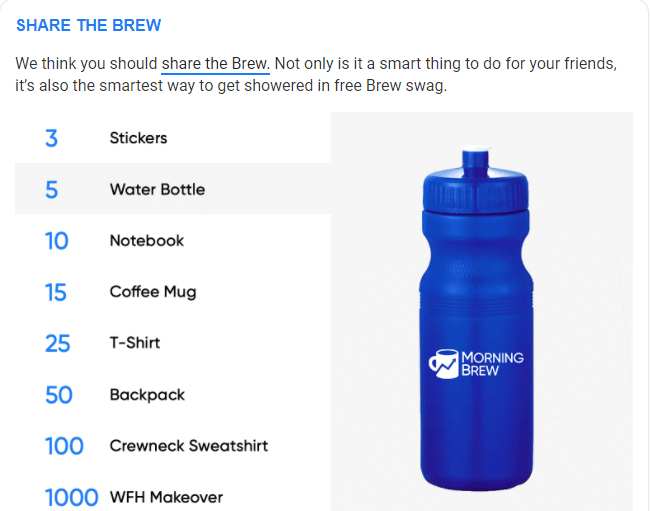
Deciding on what swag to offer can be a bit tricky, though. The item has to be something people want and even worth talking about, in itself. For example, would your customers really be excited about a coffee mug with your logo? How about if it came in a cool design or pattern? You also want to consider the weight of the item and the cost of shipping.
To see all the different swag you can offer, Swag.com has a lot of fun options for every type of customer. They can also handle logistics and shipping for your company (in branded packaging, of course!).
7. Free subscription period
If your business offers subscriptions, as well you might want to consider offering a free subscription period in your referral rewards program. Not only does this encourage existing customers to stay with your business, it also gives interested individuals a free taste of what you have to offer – and this may be just the nudge that turns them into a long-term customer.
Best for: Subscription-based businesses, including meal delivery services, content subscriptions, online courses/classes, and SaaS companies
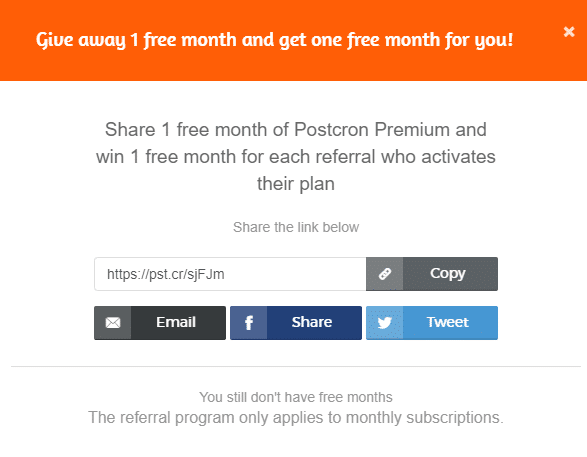
Social scheduling SaaS Postcron offers a free month of their premium subscription – for both the referring customer and new customer – in their referral program. This encourages loyalty and referrals from existing customers, and whets new customers’ appetites.
8. Donations
Donations are an unconventional, but very meaningful, referral reward. Offering customers the opportunity to turn their referral reward into a donation turns the standard program into a win-win-win situation.
Best for: Businesses with a social good mission; businesses that can’t offer traditional rewards due to laws or industry regulations
As so well-described in a Forbes article, “the business gets referrals, the charity gets donations, and the client gets to feel good.”
- The donation could be made to a non-profit organization or a foundation.
- It could go toward a community project sponsored by your company (a popular example of this is TOMS, the original One for One giving model).
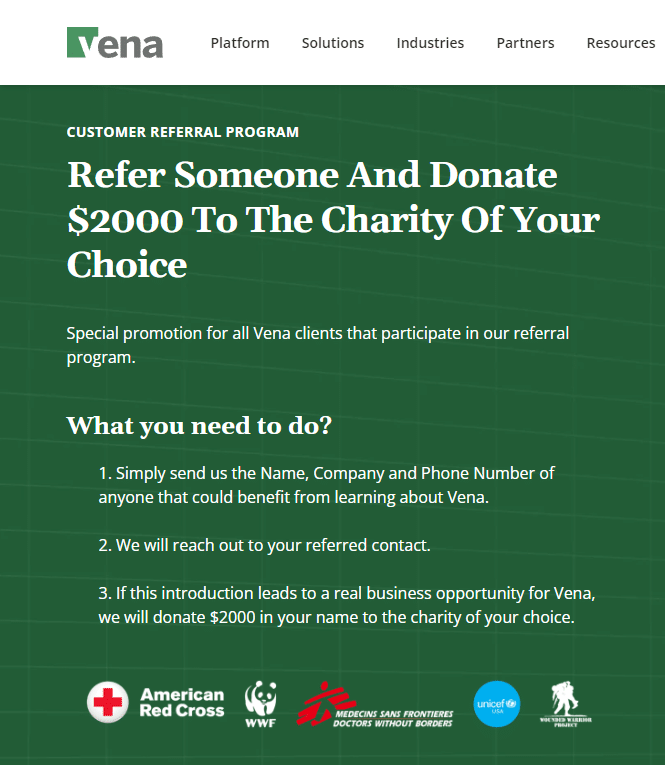
- You could donate to any approved charity that the customer selects, as Vena Solutions offers as a reward.
Donations can even run alongside other rewards.
For example, customers can have the choice between getting $45 in cash back or donating the same amount to charity. You may find your customers actually prefer to give back when it’s something they’re interested in and easy to do.
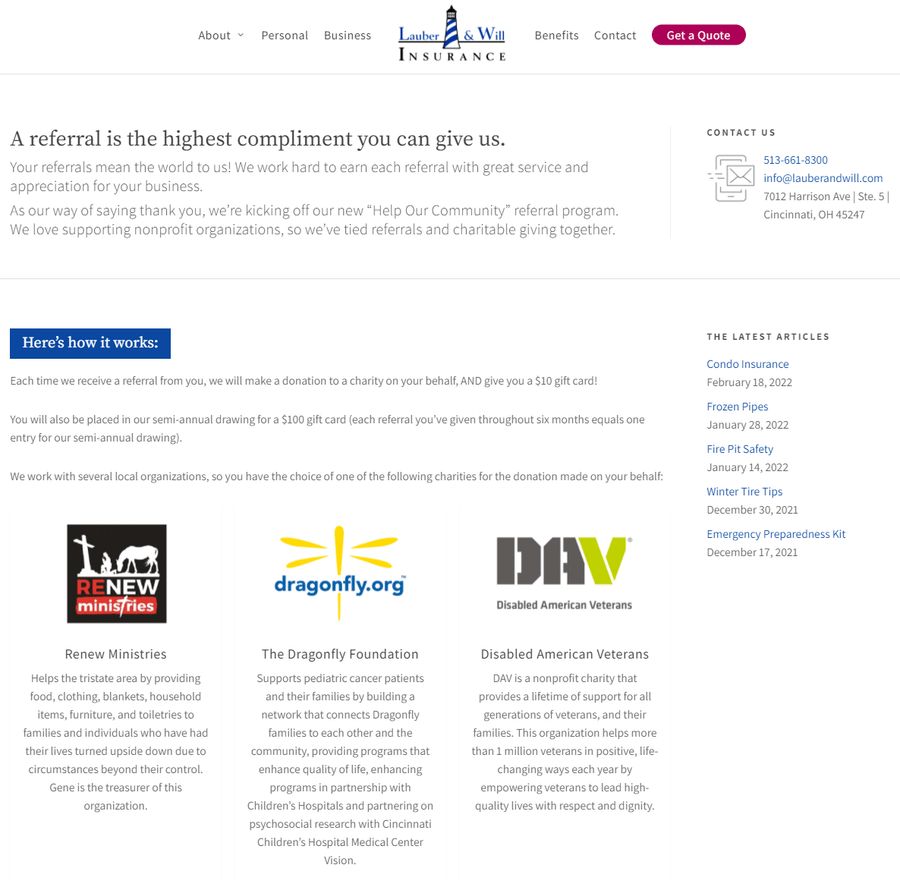
Or, you could offer a reward for the customer in addition to a donation, as Lauber & Will Insurance does.
9. High-value items
For especially valuable referrals, you might decide to offer big-ticket items, such as electronics. Travel experiences, dinners out, event tickets, and other VIP events also make great rewards. Of course, this assumes the value of an individual purchase, and a customer’s average lifetime value, is high enough that you can afford to pay out these rewards consistently.
Best for: Higher tiers of rewards (after multiple referrals), contest rewards for winners, businesses where purchases are expensive, but the referrer isn’t always the one making the purchase
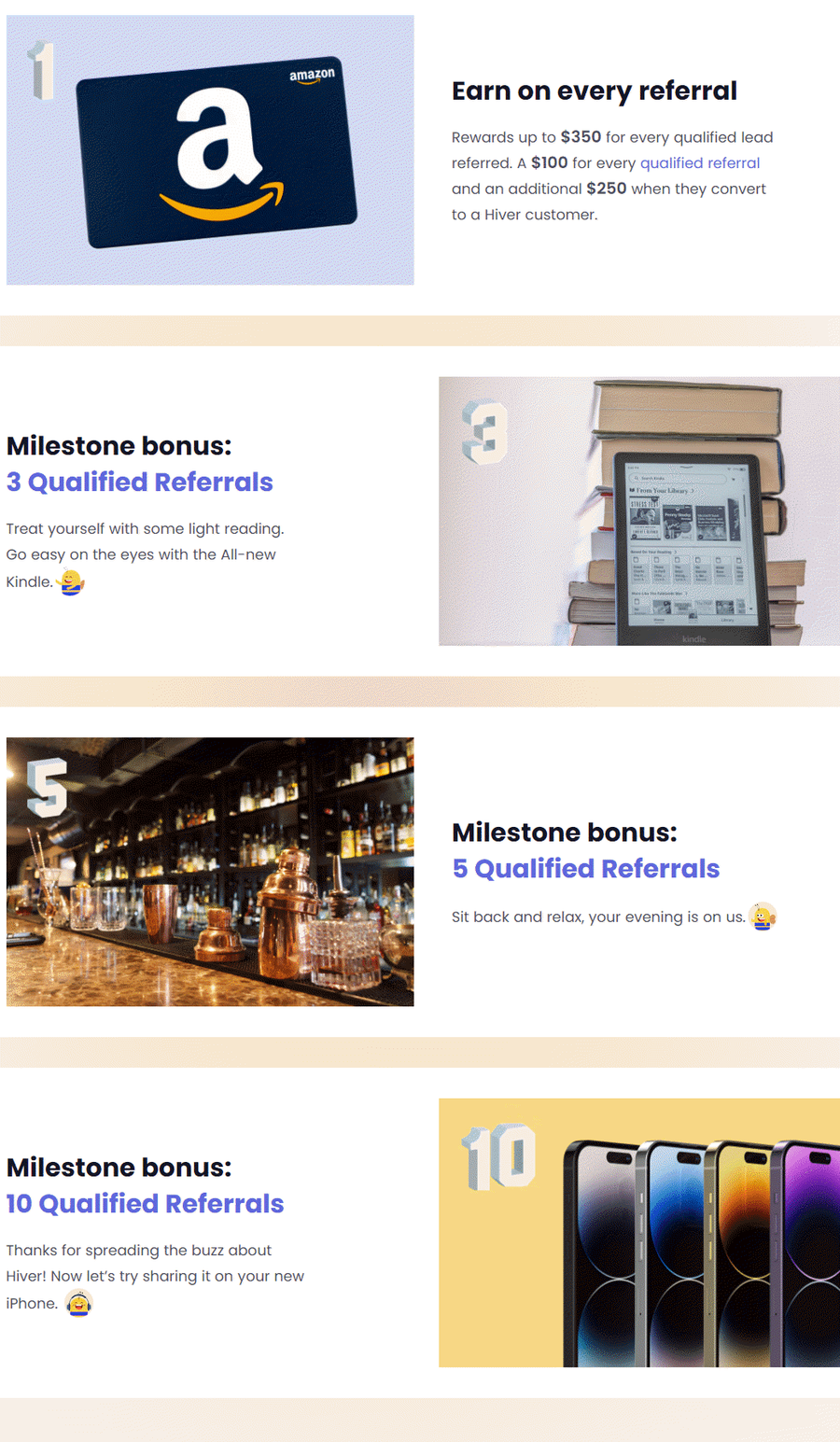
Email management and help desk software Hiver uses high-value items as part of their tiered rewards. Three qualified referrals earns someone a Kindle reader, five referrals earns a high-end dinner out, and 10 referrals earns the latest iPhone. As a B2B SaaS, the average customers are worth a lot more than the value of these rewards, so they’re still sustainable for Hiver to give advocates.
10. Referral gifts
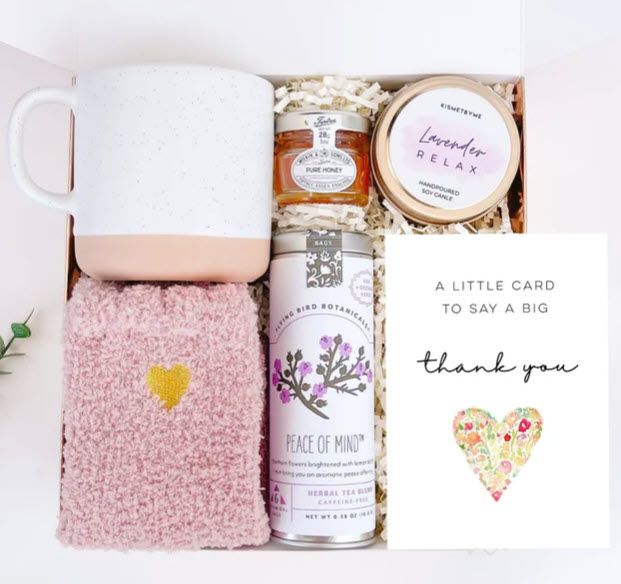
Sometimes, companies will choose to offer a referral gift box or gift basket for successful referrals, containing several tangible rewards at once. This opens up the opportunity to personalize the gift for each referral, which can be a great incentive for the most faithful advocates.
Best for: Brands that don’t want to offer a reward that ties back to their business (say, luxury brands and businesses where purchases are infrequent).
No matter what referral reward or incentive you end up choosing, always provide a good customer experience. If customers are happy, then word of mouth is bound to happen, with incentives being more like an added referral bonus (much like a finder’s fee).
8 referral reward structures (and when to use each)
Now that you’ve decided who will receive your referral rewards and what rewards to give, it’s time to take a look at the finer details of different reward structures you could use.
Double-sided rewards (“give and get”)
With this reward structure, you’ll reward both referrers and their friends when a friend makes their first purchase. A double-sided reward can be the same for both parties (i.e., $20 credit each), or different (i.e., a $50 gift card for the advocate, and a 15% discount for the new customer).
Best for: All business types where a purchase is made, as long as they have enough resources to give referral rewards or incentives to both parties. It’s also best for businesses to have a good referral software tool so they can track key metrics and make the most of this referral program.
| Pros | Cons |
|---|---|
|
|
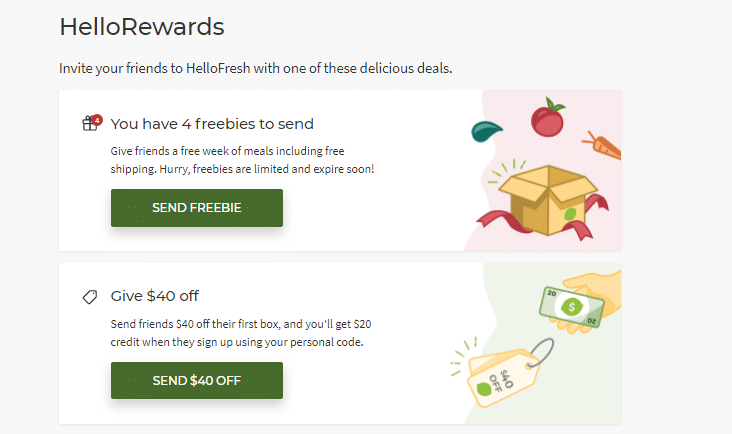
HelloFresh includes multiple reward schemes in their refer-a-friend program. Their HelloRewards referral code offers a double-sided incentive, giving a $20 credit to the referring customer and $40 to their referred friends.
(HelloFresh also offers a one-sided incentive to send new customers: a Freebie box with a free week of meals.)
Source
Rewards only for the referrer (“get only”)
In this structure, the referrer gets a “thank you”reward after their friend makes their first purchase, but they don’t give their friend a reward. These rewards encourage customers to bring more people to your company. And with the strong recommendation in mind – plus, a reasonably priced product offer – the referred friend is likely to make a purchase, even without a discount incentive.
Best for: Companies that are new and need to grow their brand awareness, as well as those selling more affordable products. Also, free content subsciptions like newsletters that don’t involve a purchase.
| Pros | Cons |
|---|---|
|
|
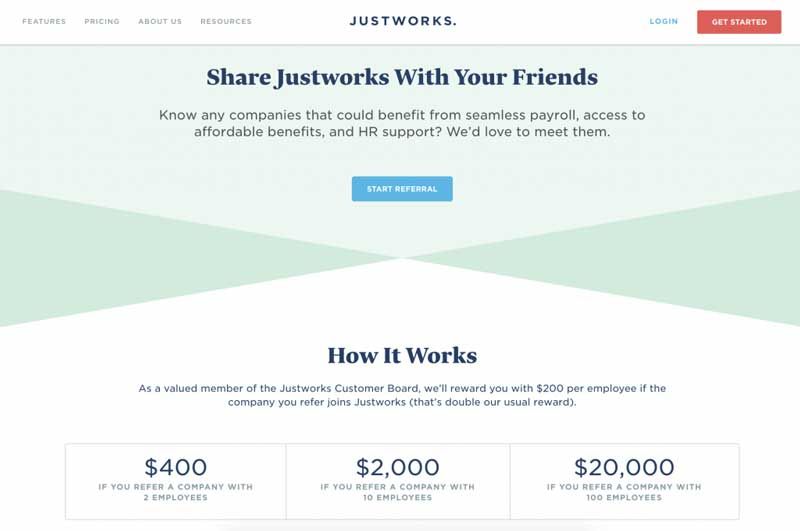
With their clients being companies instead of individuals, Justworks rewards referrers $200 for every employee in a referred company that signs up. This means $400 for referring companies with two employees, and $20,000 for referring companies with 100 employees.
Plus, you don’t have to be an existing customer to join their referral program – Justworks invites everyone to participate.
Source
Rewards only for the referred friend (“give only”)
Offering an incentive for the referred friend will encourage them to move toward a purchase, and hopefully end up as long-term customers. In this case, the program relies on pure altruism from referrers, though, as there’s nothing in it for them. While one-sided incentives for new customers may lead to a smaller amount of referrals, they may still lead to a greater customer base.
Best for: Businesses that operate using subscription models or frequent purchases, or that are considered a luxury purchase. Also, businesses where regulations prohibit rewarding referrers, but that aren’t restricted from incentivizing new customers.
| Pros | Cons |
|---|---|
|
|
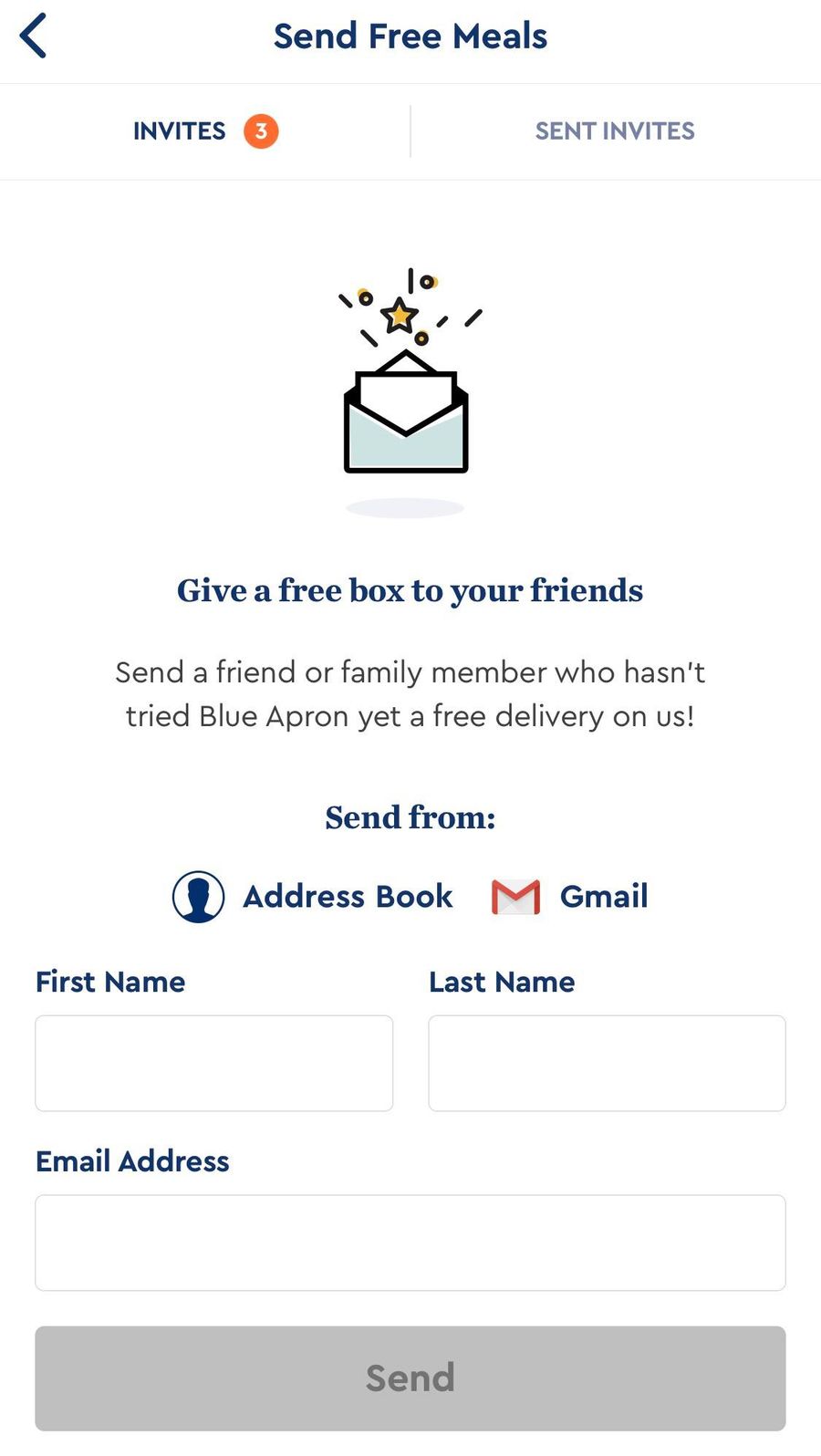
Meal subscription box Blue Apron gives customers the opportunity to send a free meal box to friends who haven’t yet tried the service. Since there isn’t a reward on offer for the existing customer, this referral program is all about performing an altruistic act for a friend.
Tiered rewards (milestone rewards)
Some programs include various levels of referral rewards and incentives, usually based on the number of actual referrals. While this is more complicated, a tiered program structure does create an opportunity for customers to become dedicated members of your referral marketing program.
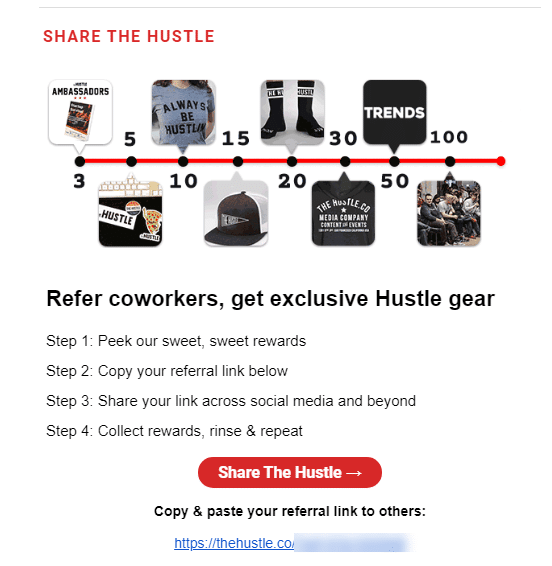
With tiered rewards, you start off by giving the advocate a smaller reward, and then offer larger rewards as they bring in higher numbers of referrals (like The Hustle does with its tiers of swag).
For instance, you might offer a 20% discount for one referral, a free product after three successful referrals, and a $50 gift card for five referrals. This is a great way to motivate repeat referrals and create super-advocates.
Best for: Content subscriptions, SaaS businesses, travel agencies, ecommerce; any industry can reap the benefits, though, as long as you set rewards strategically
| Pros | Cons |
|---|---|
|
|
Not all referral program software can handle tiered programs. Referral Rock can help you set up a tiered program with ease.
Bump rewards
Bump rewards (also called gateway rewards) are the opposite of tiered rewards: they jumpstart your campaign by giving higher rewards for the very first referral.
So rather than $15 for every referral, a business can offer $30 for the first referral and then a smaller amount, like $10, for every following referral.
If margins are tight or you can’t afford a higher reward, offering a larger reward for the first referral is a great way to get people engaged without overpaying.
Best for: Businesses that want to launch their first program and drive initial sign-ups; newer businesses and those with tight budgets
| Pros | Cons |
|---|---|
|
|
Multi-step rewards
Sometimes, a business has a drawn-out purchasing process. It may require an initial consultation, demo, or trial period before an actual sale is made. But if a customer has to wait too long before they can see their rewards, they may no longer be motivated to make any referrals. In this case, it makes sense to break down the entire referral process into steps.
A multi-step rewards structure gives the advocate (referrer) different rewards for each key step in the sales process their referral completes.
The rewards are cumulative, and will usually increase in value with every step the referred friend completes. For example, you might give a referring customer a smaller reward when a lead is qualified (say, they request a demo or sign up for a trial) and then a larger reward when that lead makes their first purchase.
Best for: Sales-led B2Bs and SaaS companies; other businesses with longer sales processes and/or multiple stakeholders involved in the purchasing decision; staffing agencies; higher ticket-value services that require a more “consultative” approach (i.e. HVAC installation, landscaping, plumbing, construction contracting)
| Pros | Cons |
|---|---|
|
|
Here are some examples:
- A customer might earn $10 if their referral signs up for a trial period, and then $30 when the referral signs up for a paid account.
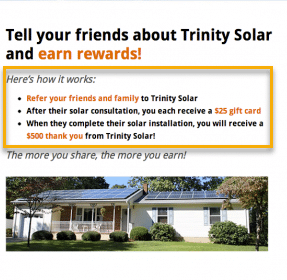
- If your business is installation-based like Trinity Solar, your referral program might offer $25 after a referred friend completes a consultation and $500 when the installation is complete.
Only select referral program software options can help you set up multi-step reward structures. Referral Rock handles multi-step reward structures, so it’s great for businesses that want to use complex rewards.
Multiplier rewards
Instead of offering flat rewards no matter how valuable a purchase was, multiplier rewards set reward values based on the purchase amount. This means a referrer will receive a larger reward when someone buys a more expensive product or service.
Best for: Brands with several different levels of pricing plans, or brands where purchase amounts vary widely. If you’re a service-based business that offers services with different price, time, and complexity levels (say, repairs vs. installations), then multiplier rewards are also a good fit.
| Pros | Cons |
|---|---|
|
|
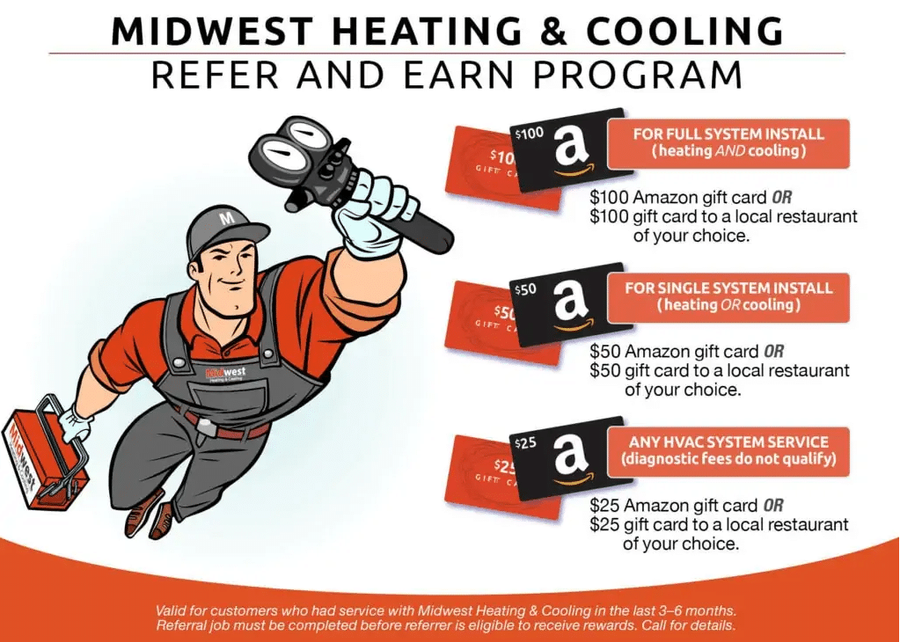
Service businesses, like HVAC and plumbing companies, often use multiplier rewards. In this example from Midwest Heating and Cooling, referrers receive higher-value gift cards when their friends have HVAC systems installed, as an installation costs more and is more labor-intensive than a repair.
Contest or drawing
People like to be appreciated (which is a main reason referral programs work so well). But they also like a bit of competition. A contest or drawing can help drum up excitement and even viral growth for your referral program, especially when a higher-ticket reward is at stake for the winner.
The rules are up to you.
- Will you give rewards to the people who make the highest number of customer referrals in a month or quarter?
- Or, will you give people a drawing entry for every referral they make, and then select the winner purely at random?
Best for: Businesses that want to increase engagement and excitement around their referral program
| Pros | Cons |
|---|---|
|
|
Contests work best in a shorter time frame, such as during a seasonal or holiday promotion. And of course, the grand prize has to be something that really motivates your customers.
Even better, though, you could run a referral contest alongside your regular referral program.
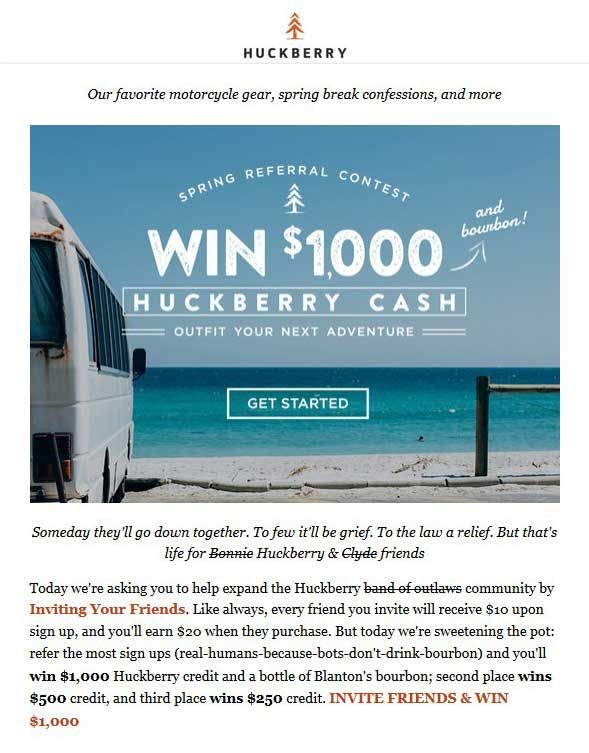
Independent retailer Huckberry uses seasonal contests to boost their regular ongoing referral rewards program. Instead of their usual referral program reward ($20 for referring customers, $10 for referred friends), they offered $1,000 in Huckberry credit, as well as second and third place rewards.
Referral reward examples: 4 programs worth studying
When putting together your referral program, it’s always good to have a little inspiration. Of course, most of us are already familiar with programs that offer cash as a referral reward.
We’ve pooled together some examples of more unique referral programs to give you an idea of how creative you can get with your referral rewards and incentives.
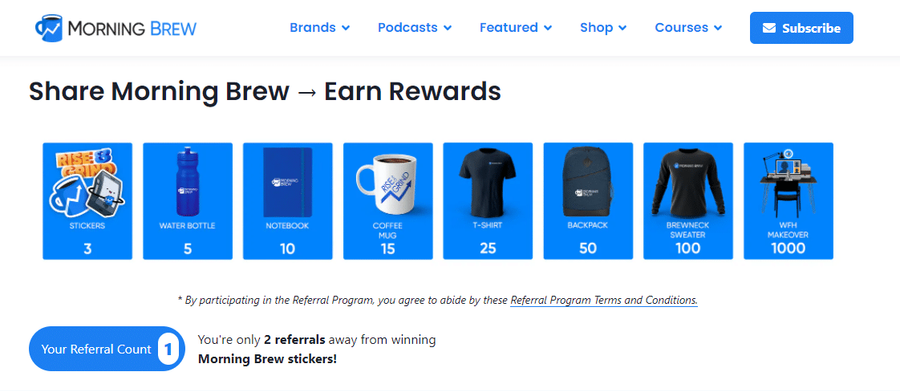
Morning Brew
“Share the Brew” is the catchy referral phrase used by Morning Brew, a free newsletter geared toward young professionals.
Who gets the referral reward? The current subscriber, using a one-sided referral incentive
What type of referral reward? Mostly swag, but the highest-level reward is a work-from-home makeover, complete with tech
How is the reward structured? Tier-based reward structure, with customers getting greater rewards for more referrals
Shutterfly
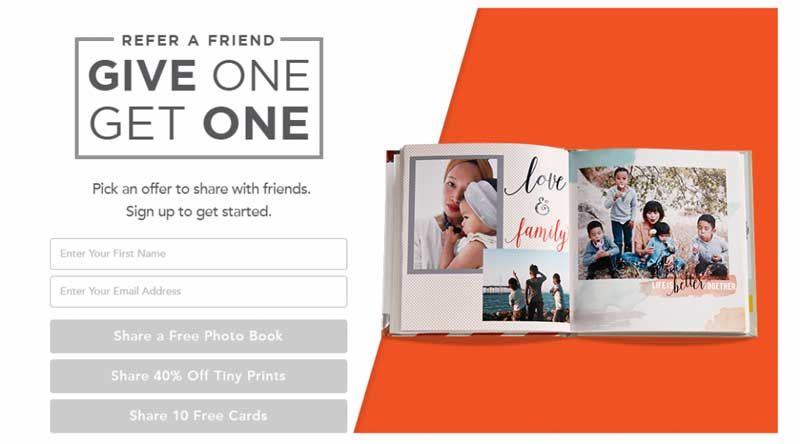
Shutterfly specializes in print-to-order photos, calendars, and other paper products. With so much in store, they use many of their own products as referral rewards.
Who gets the referral reward? Both the current and new customers are rewarded, using double-sided incentives
What type of referral reward? A variety of the company’s products (while customers are offered a free photo book, they can choose to send their friends free products or discounts)
How is the reward structured? Customers get the same reward for every successful referral, with a limit of 10 rewards per year
Courtesy Chevrolet
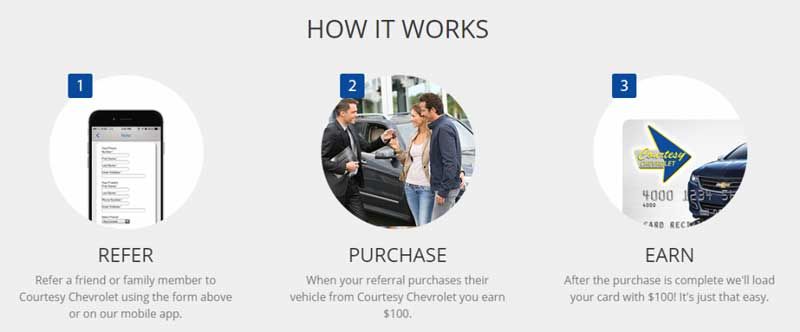
Car dealerships operate in a competitive industry. To separate itself from the pack, Courtesy Chevrolet offers a very generous gift card for every successful referral.
Who gets the referral reward? Anyone (customer or not) whose referral results in a car purchase at the dealership
What type of referral reward? $100 Courtesy Chevrolet Visa prepaid card
How is the reward structured? One-sided, only the referrer gets the reward – they get the same reward for every successful referral, with no limit to how many they refer
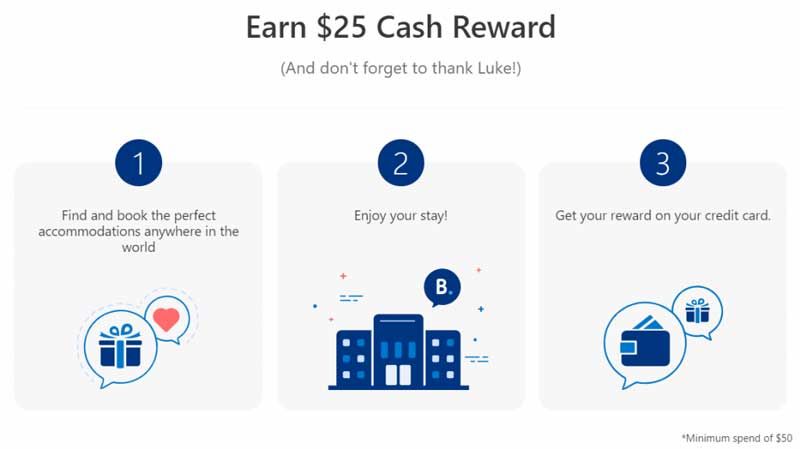
Booking.com
Booking.com offer cash as its referral reward. But instead of the amount being added to your Booking.com account, it goes straight toward your credit card.
Who gets the referral reward? Both the existing customer and their friend, in a double-sided structure
What type of referral reward? The current customer gets $25 in cash back, while the referred customer gets $25 in Booking.com credit
How is the reward structured? Customers get the same reward for every successful referral, with no limit to how many friends they can refer
What are the most common types of rewards?
To give you an idea of the most popular types of rewards, we looked at anonymized data from 500+ programs run on Referral Rock — here’s what we found.
Reward types for members
The most common rewards for members (aka customers or affiliate partners referring customers) were gift cards (61%), followed by cash (30%), and coupons (9%).
Gift card and cash rewards for members make a lot of sense for both customer referral and affiliate programs. While discounts are more common for lower-cost consumer products like clothing or cosmetics, many companies will reward cash or gift cards for items that are less likely to be repeat purchases (e.g. home services, air conditioners, bank accounts). Cash payouts are common for affiliate marketing programs, where affiliates are incentivized by ongoing monetary rewards.
Reward types for referrals
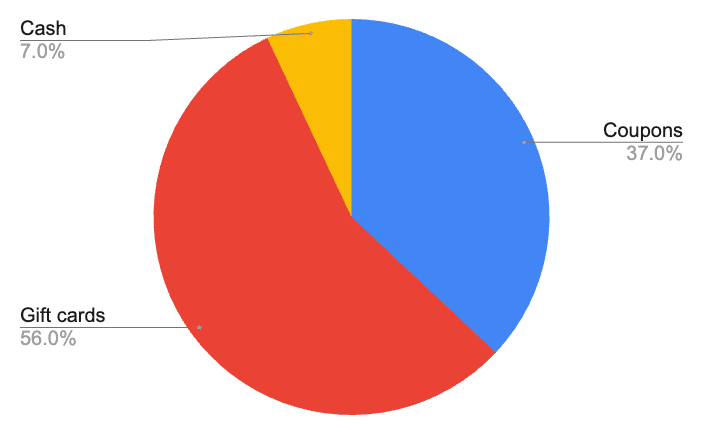
The most common rewards for referrals (someone who purchased after they received a share from a friend) were gift cards (56%), followed by coupons (37%) and cash (7%).
Coupons are a more popular choice when rewarding referrals, which makes sense — you’re trying to incentivize a purchase from someone new. An exclusive offer, like a percentage or dollar amount off (e.g. 25% off, $20 off) is compelling, especially after someone has received a product or service recommendation from a friend.
Fixed reward amount vs. percentage of sale amounts
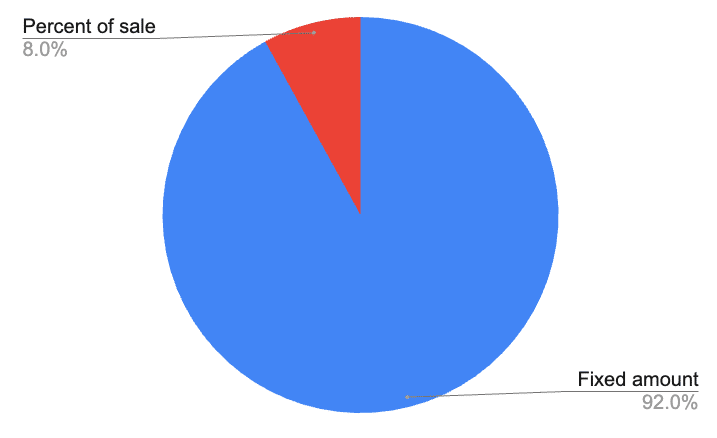
The majority of programs in the data offered a fixed-amount reward (92%) vs. a percentage of sale (8%).
Percentage-of-sale rewards are more common for affiliate programs and less common for customer referral programs. It can also be harder to come up with a percentage-of-sale amount that makes sense across products and services, so many companies start with a fixed amount to make it easier to predict payout costs.
Insider reward tips and best practices
Looking for even more advice on choosing the best referral rewards? Check out these insider tips:
✅ Ask your customers what rewards they’d like to receive by running a poll with a few options. This way, you’ll pick incentives that truly motivate your clients.
✅ It may also help to look at competitors’ referral rewards programs. This will give you an idea of the referral rewards patterns in your niche and industry, and assist you in finding out ways to make your own program unique.
✅ Make the referral reward truly valuable. If you offer the same type of discounts elsewhere, or offer store credits when purchases are infrequent, the reward likely won’t be worth it. Choose a reward that customers will want to earn and use.
✅ If you’re giving a reward to the new customer (referred friend), it’s best to give a reward that’s directly connected to your business, to motivate that first purchase.
✅ Don’t be afraid to change up your incentives to boost engagement with your program. For instance, you might increase the amount of store credits you offer, or add a free gift to the cash referral reward, during slower business periods. Try changing up rewards based on seasons; this lets you experiment until you find a good reward value and type.
✅ Notify people when they get rewards, or when they’re getting closer to a reward, for added motivation.
✅ Think about what your referrer is giving their friend, not just what they’re earning. If the reward for the referred friend is strong enough, the referrer becomes the person who got their friend a great deal — not someone who submitted a link. That dynamic makes sharing feel natural rather than transactional.
Discover more best practices by downloading our Referral Program Workbook, with 15 actionable guides & 101 real-world examples.
Optimizing referral rewards
If your program isn’t getting the results you want, rewards are often the place to start. Three adjustments worth making:
- Increase the reward value — especially if you have a high average customer value. A higher reward motivates more people to share. (Learn more about calculating referral program ROI.)
- Change the reward type — if the value seems right but sharing is still low, the type may be the issue. Try gift cards or cash if you’re currently offering store credit for infrequent purchases.
- Add a reward for the referred friend — if you’re only rewarding the referrer, you’re leaving the Friend Factor on the table. Give the friend something real and the referral becomes a gift, not an ask.
Common referral reward concerns, answered
Even with all the reasons to offer a referral reward or incentive, a few concerns may come to mind. Here are the most common ones we’ve come across over the years:
How much will offering referral rewards cost?
One of the main benefits of referral programs is that you only give rewards for successful sales. Unlike other forms of marketing that require initial payments, referral programs are pay-for-performance. So while you’re offering something of value, you’re getting much more in return.
Plus, your rewards don’t have to cost much or even be monetary at all. Many companies get more creative with their rewards – offering swag, free upgrades, donations, etc. – which can even be more effective than offering cash.
To ensure you’re not losing money on your referral program, it’s important to determine your average customer value and — if you’re offering cash, rewards, or discounts — figure out a reward value that makes sense for your user base and your bottom line (learn more about calculating referral program ROI).
What if someone tries to game the system?
To be honest, yes, there are people out there who will want to get rewards without doing the work. This includes spamming a referral code or using multiple accounts (also called self-referral).
However, referral fraud can usually be detected with the proper tracking (i.e., high activity coming from one IP address). It can also be prevented in the first place with a referral software tool, which safely collects and tracks all your data.
How to get started with referral rewards?
For the most successful referral rewards scheme, you need referral program software. Once you’ve decided on your referral rewards, software automates the approval and sending of referral rewards once they’re earned, to keep your existing and new customers happy.
But you’ll need the right referral software for the most flexibility in issuing and managing rewards, because many types of referral software only handle simple “give one, get one” rewards. With Referral Rock, you can:
- Offer incentives that motivate your target audience: This includes more advanced referral reward structures, including tiered, multi-step, referral contests and more
- Trigger rewards based on status updates in your CRM, e-commerce platform, or other system of record: This is especially useful if you want to reward for qualified leads as well as converted referrals!
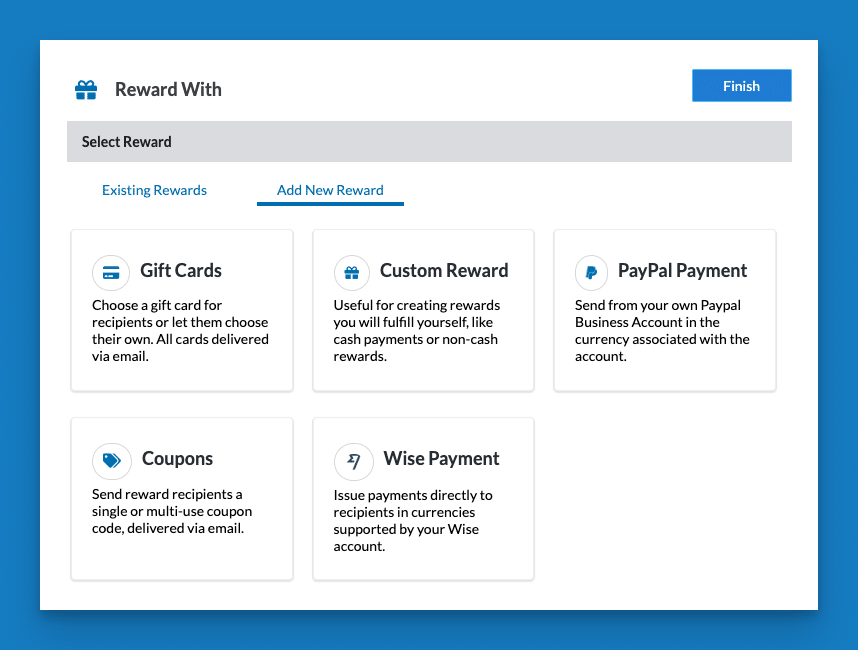
- Automate reward fulfillment with a variety of payout options: This includes cash, gift cards, discounts, donations, and custom rewards.
Learn more about how our software can help you set up and manage rewards to grow your business!
Launch your referral program with the right rewards
Start by getting the frame right: you’re not designing an incentive for your sharer — you’re designing a gift for their friend. When that shift happens, the rest of the decisions (type, structure, value) fall into place more easily.
Follow the four steps in this guide and you’ll have a reward structure that motivates sharing, gives referred friends a real reason to buy, and keeps your program sustainable long-term.
Want help setting up and managing rewards? Book a demo with a referral program expert.
Searching for the best referral program ideas for all parts of your program (beyond just rewards)? We’ve got you covered.

About the author
Content Specialist (former)
Megan was with Referral Rock from 2016-2023 where she wrote many of the original referral and template guides. She also contributed to marketing videos, explainers, and mixed media for the product and support center.

![What Is a Referral Link? How to Create & Track One [with Examples]](https://cdn.sanity.io/images/x9q04aql/production/0b09aaf011a5c0e7a3974c4951e5fab75effd68b-900x600.jpg?w=400&auto=format)
![How to Set Up Referral Tracking [+ Free Tools & Spreadsheet]](https://cdn.sanity.io/images/x9q04aql/production/15188e26f1554362b7fb44e91b59c7e77f700d14-900x600.jpg?w=400&auto=format)