
Credit unions are built on word of mouth. Members join because a coworker, neighbor, or family member told them they’d be treated better than at a big bank, and they were right. That trust is your acquisition engine, whether you’ve systematized it or not.
A referral program doesn’t create that word of mouth. It captures and amplifies what’s already happening, so referrals stop being random and start being reliable. The best programs feel less like a marketing campaign and more like an extension of how the credit union already operates.
Here’s how to build one that fits, what to reward, how to promote it, and four credit unions doing it well.
Why credit unions are built for referrals
Credit unions have a structural advantage in referral marketing that big banks don’t. You’re member-owned. You share profits with the people you serve. Most members are local or regional, and the relationships are personal. That’s the soil word of mouth grows in.
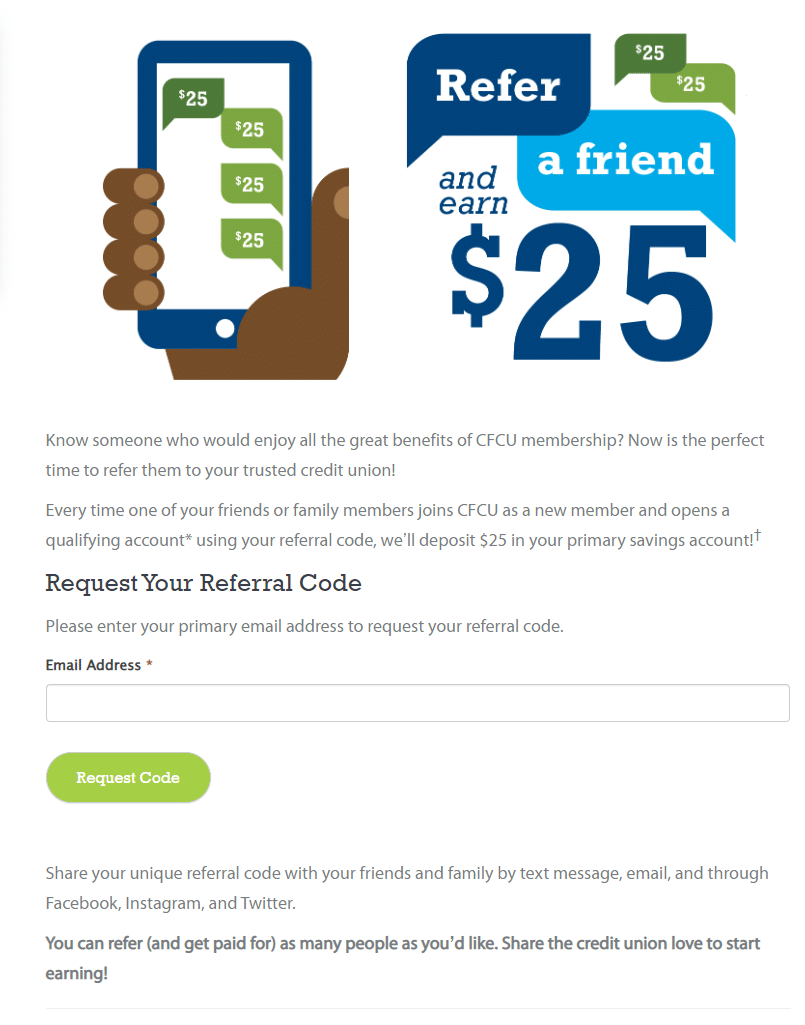
When a member recommends you, they’re not just passing along a coupon. They’re staking their reputation on the idea that their friend will be treated like a person, not an account number. A referral program operationalizes that recommendation, so when it happens, you can capture, attribute, and thank the member for it instead of letting it disappear into the noise.
The other reason this matters: member acquisition costs are climbing across financial services. Paid ads compete with national banks who outspend you ten to one. A program that turns existing members into a reliable acquisition channel doesn’t just lower your member acquisition costs, it brings in better-fit members, because peer recommendations filter for people who already share the values your members do.
Referral software for credit unions [Free Tools]
These referral tools for credit unions are a free and easy way to help you start your referral program.
Want a automated referral system for your credit union business? Uncover referrals in plain sight to smooth out business lulls, without losing focus on your real day to day work helping customers.
Check out our referral program software - done right.
Are you ready to launch a referral program?
Not every credit union is ready for a formal program. A program captures word of mouth that’s already happening, so the prerequisite is that members are already talking about you. If they aren’t, no incentive structure will fix that.
Before launching, check that you have these in place:
Members are already referring informally. You hear “my coworker told me to come here” at the teller window. New checking accounts trace back to existing members through casual conversation. The referrals exist; they’re just untracked.
Strong member service that earns the recommendation. Branch staff who know members by name. Quick response times on calls and applications. Loan officers who follow through. The reason people recommend you is the experience itself, the program just captures it.
Capacity to handle new members without dropping the ball. A successful program will bring in new accounts steadily. If your onboarding process or member service team is already stretched, the influx will erode the experience that earned the referrals in the first place.
A clear picture of who your best members are. What demographics they fit, why they chose you over a bank or competing credit union, and what kinds of friends they’re likely to refer. This shapes everything from reward design to messaging.
A definition of a “qualifying” referral. Does the friend need to open a checking account? Make a direct deposit within 90 days? Maintain a minimum balance? Without this, you can’t structure rewards or measure the program.
If most of these aren’t in place, focus on the foundation first. A program built on shaky operations or weak word of mouth doesn’t grow, it leaks.
How to run a credit union referral program that lasts
The credit unions that succeed with referral programs aren’t running clever marketing campaigns. They’re running disciplined operations. Here’s what that looks like in practice.
1. Frame the reward as a gift, not a payout
The default approach to referral rewards is to obsess over what the referring member earns. Bigger reward, more referrals, right? Not really. The transactional framing is exactly why most programs feel awkward to share. Members don’t want to feel like they’re monetizing their friendships.
Flip the focus. The reward isn’t a payout for the referrer, it’s a gift the member is giving to their friend. The friend gets cash in their new account, a waived fee, or a competitive rate they wouldn’t have found on their own. The member gets to feel like they did their friend a favor, which is exactly what made them want to recommend you in the first place.
Practical guidance:
Cash deposits to the new account are the strongest gift. They tie directly to the credit union and start the new member’s relationship with money in the door. Other options like gift cards or event tickets work, but they pull the focus away from the financial relationship.
Reward both sides. The friend gets a deposit when they open and qualify. The referring member gets a deposit (or comparable thank-you) once the friend is active. Both signals matter — the friend feels welcomed, the member feels appreciated.
Make terms clear and pay out fast. What does the friend need to do? Open a checking account? Set up direct deposit? Maintain a minimum balance? Spell it out, then pay out as soon as conditions are met. Slow or unclear payouts kill trust.
Don’t cap rewards. A member who refers ten friends should be rewarded for ten friends. Capping signals that you don’t actually want more referrals.
Use our referral reward calculator to determine how much to offer the sharer and their friend, for the best ROI.
2. Keep access open — every member is already in
Most programs die at the signup form. Members have to opt in, fill out a form, get approved, then they get a link they forget about a week later. Every step between “I want to recommend you to my sister” and “here’s my link” is a step where you lose people.
The better approach: every member is already enrolled. The credit union generates a unique referral link or code for every member by default and surfaces it where they already are. Members log into online banking and see their link. They open their statement and see a “share with a friend” prompt. They walk into a branch and a teller hands them a card with their code. No signup, no form, no opt-in.
Get more of your customers into your program, instantly, with our automatic enrollment tools and discovery paths.
What this looks like in practice:
Pre-generate codes for every member. No application form, no enrollment process. Members access their link the same way they access their account balance.
Make sharing simple from the link itself. One-click options for email, text, and social. Members shouldn’t have to copy and paste a URL into a separate app.
Keep members in the loop proactively. When a friend they referred opens an account, send them a notification automatically. Don’t make them log in to check status.
Trust members by default; handle abuse progressively. Worried about fraud? Build detection rules, not enrollment hurdles. Self-referrals and fake accounts are real, but locking the program down preemptively kills the 99% of legitimate sharing to prevent the 1% of bad behavior.
You’ll also catch referrers you’d never have predicted. Some of the strongest sharers won’t be your most active members, they’ll be quiet ones who happen to know everyone in their neighborhood. Open access is how you find them. Gating means you never do.
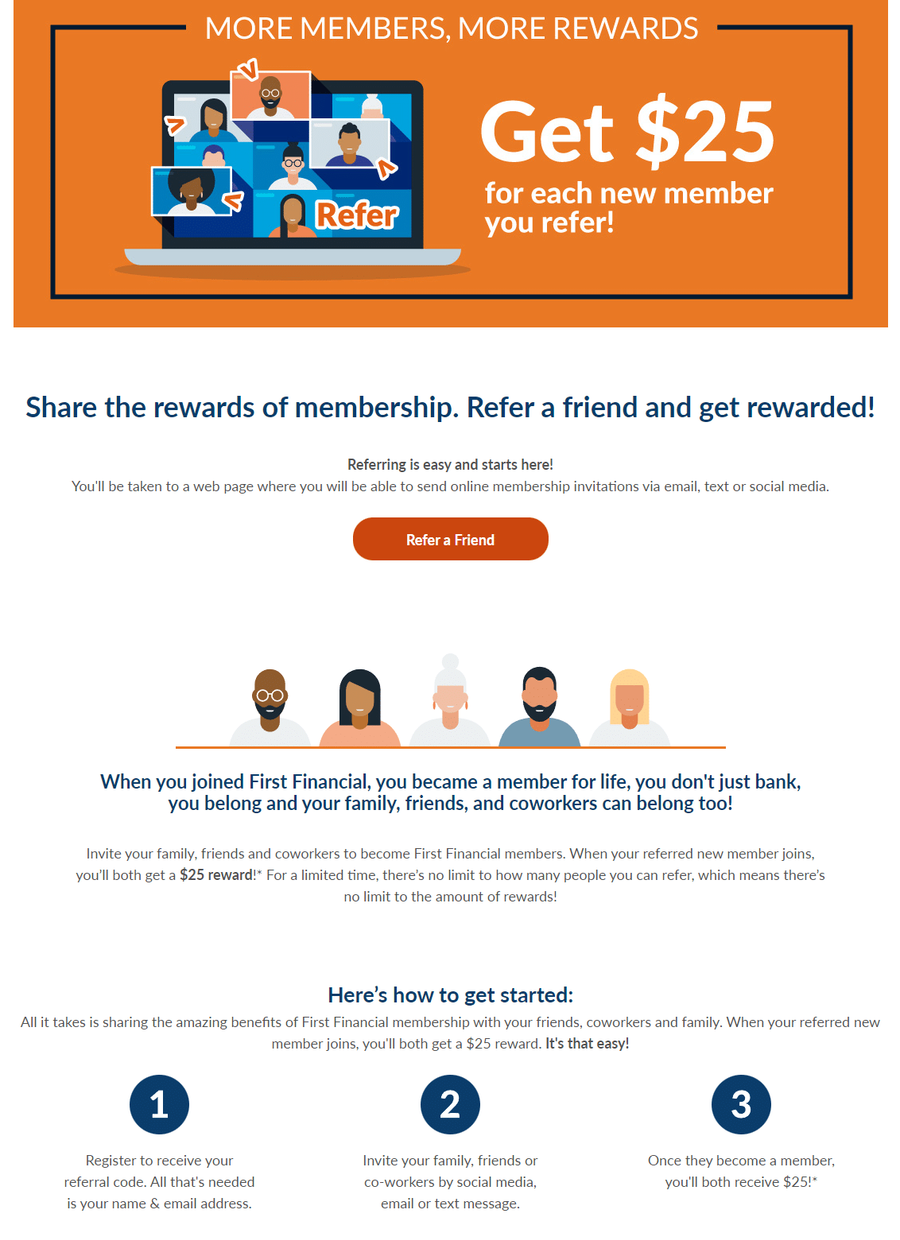
First Financial offers multiple sharing options in their referral program, explains how it works in a few simple steps, and includes a clear call to action.
The same principle applies if you’re building an app referral program inside your mobile banking app, the share button should live next to the features members already use, not behind a separate signup.
3. Treat promotion as continuous operations
This is where most credit union referral programs fail. They launch with a big email blast, get a spike, then the program fades. A list of past contacts goes stale in two to three months. Without continuous promotion, the program dies quietly.
The fix is to stop treating promotion as a campaign and start treating it as part of how the credit union runs. The program needs to be visible everywhere members already interact with you, all the time.
A useful frame is what we call continuous promotion:
Proactive invites — bulk emails, but also event-triggered invitations. New member just opened an account? Send them an invitation to refer a friend. Member just got a great rate on a loan? Trigger a “share this with someone who might need it” prompt.
Run your program emails without bolting on another tool. The invite emails, reminders, reward alerts, and monthly nudges that keep a referral program alive are built in, ready to send from inside Referral Rock.
Discovery paths — places members can discover the program on their own. Online banking dashboard. Website homepage. Branch signage. Receipts. Newsletter. Email signatures. The footer of every transactional email. Members shouldn’t have to search for it.
Make continuous promotion easy with our built-in discovery paths.
Recruiters — your team. Branch staff and loan officers who mention the program during routine conversations. “By the way, if you know anyone who’d appreciate the rate you just got, here’s how to send them our way.” Make it part of their script, not a special moment.
Turn your reps into program recruiters with Referral Rock. Give all your reps a way to enroll customers in your referral program in seconds, right at key conversation moments. Staff and loan officers each get their own recruiter portal and link.

Concrete promotion checklist:
- Post on social channels at the credit union and branch level
- Display a banner and link on the homepage
- Add a referral section to the online banking portal
- Place “refer a friend” links in website headers and footers
- Hang signage in branches
- Include the program in newsletters and transactional emails
- Send personal invitations to long-tenured members
- Direct members to the program after they leave a high-rated satisfaction survey
Run the program continuously. Members refer more when they know there’s always a reward, not a deadline. Tracking referrals through referral software lets you see what’s working, where members are coming from, and which channels deserve more energy.
4. Lean into community — service and story are why members talk
Credit unions don’t compete with big banks on rates and features alone. You compete on service and story, the local roots, the member-first model, the sense of being treated like a person. That’s also what gets talked about. Rates don’t go viral. Stories about how the credit union helped someone through a tough month do.
Your referral messaging should lean into this:
Show the friend they’re being invited into a community. “Taylor sent you here” personalization on the friend’s landing page. Photos of real members. Language that sounds like a neighbor recommending a neighbor, not a corporate offer.
Make the story part of the share. Members who refer aren’t just saying “this place gives good rates,” they’re saying “this place takes care of people I know.” Give them language that reflects that.
Reflect community in your reward design. Some credit unions add monthly drawings on top of the standard reward, others tie rewards to community milestones. The mechanics matter less than the signal: this is a community thing, not a transactional one.
The principle: members refer because of how you make them feel, not how much you pay them. Match the program’s tone to the relationship they have with you.
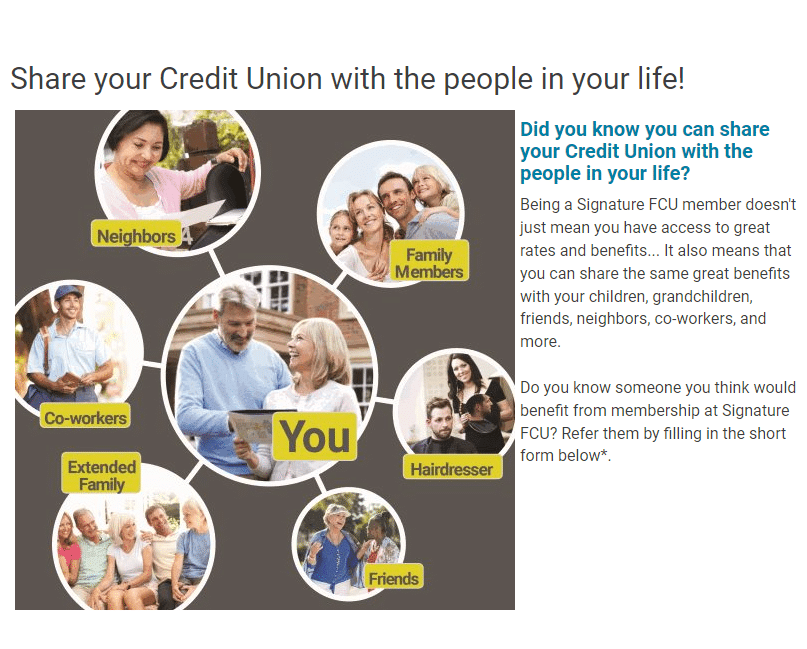
Signature Federal Credit Union emphasizes the web of connections existing members have, and how they can share the credit union’s benefits with this community.
The best credit union referral programs
Looking for more inspiration as you start your credit union referral program? Here are four examples worth studying.
A+ Federal Credit Union
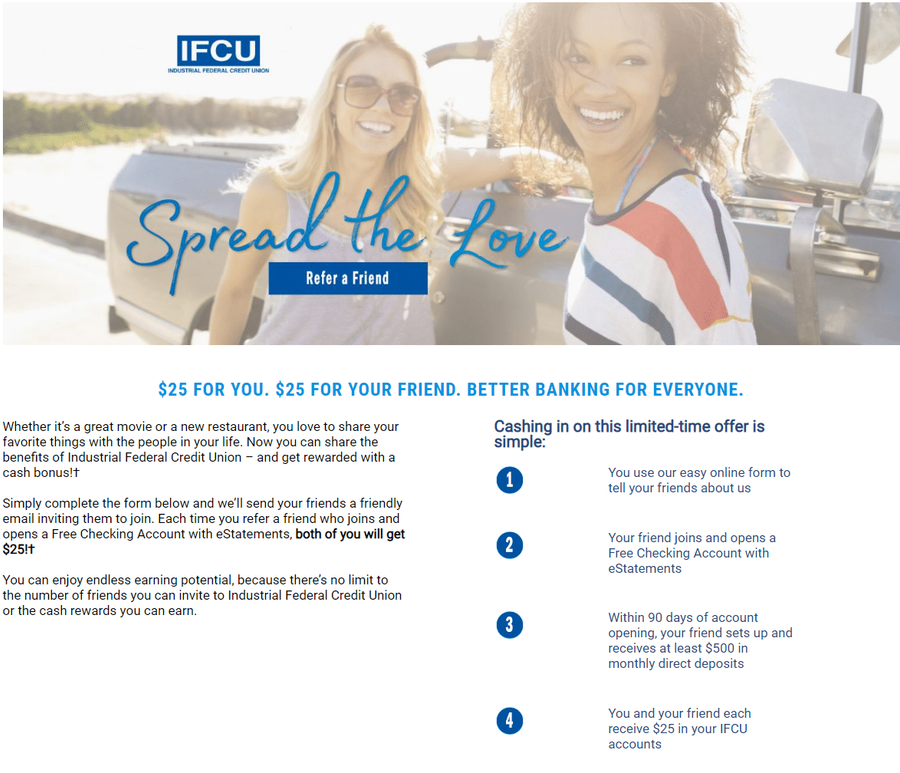
Started for educators and focused on giving back to the community, A+ Federal Credit Union now offers checking, savings, investment and loan options for members from all walks of life. Their referral program is strategically designed to appeal to the many types of people who might open accounts.

What we love about their referral program:
- Strong community focus: “Share the love” language and images of members having fun with friends and family
- Multiple types of referral rewards for different types of members, including one for youth and one for businesses
- Reviews and testimonials show why members love the credit union, as inspiration for referring
- Double-sided rewards mean both the referrer and friend earn cash when the friend joins the credit union
- Engaging video about the referral program
- Members can access their referral code from their accounts
Could be improved:
The page has a lot of links and it’s not always clear how to access the program page directly.
OnPoint Community Credit Union
OnPoint serves Oregon with personal and business accounts and loans. Their referral program is straightforward and easy to understand.
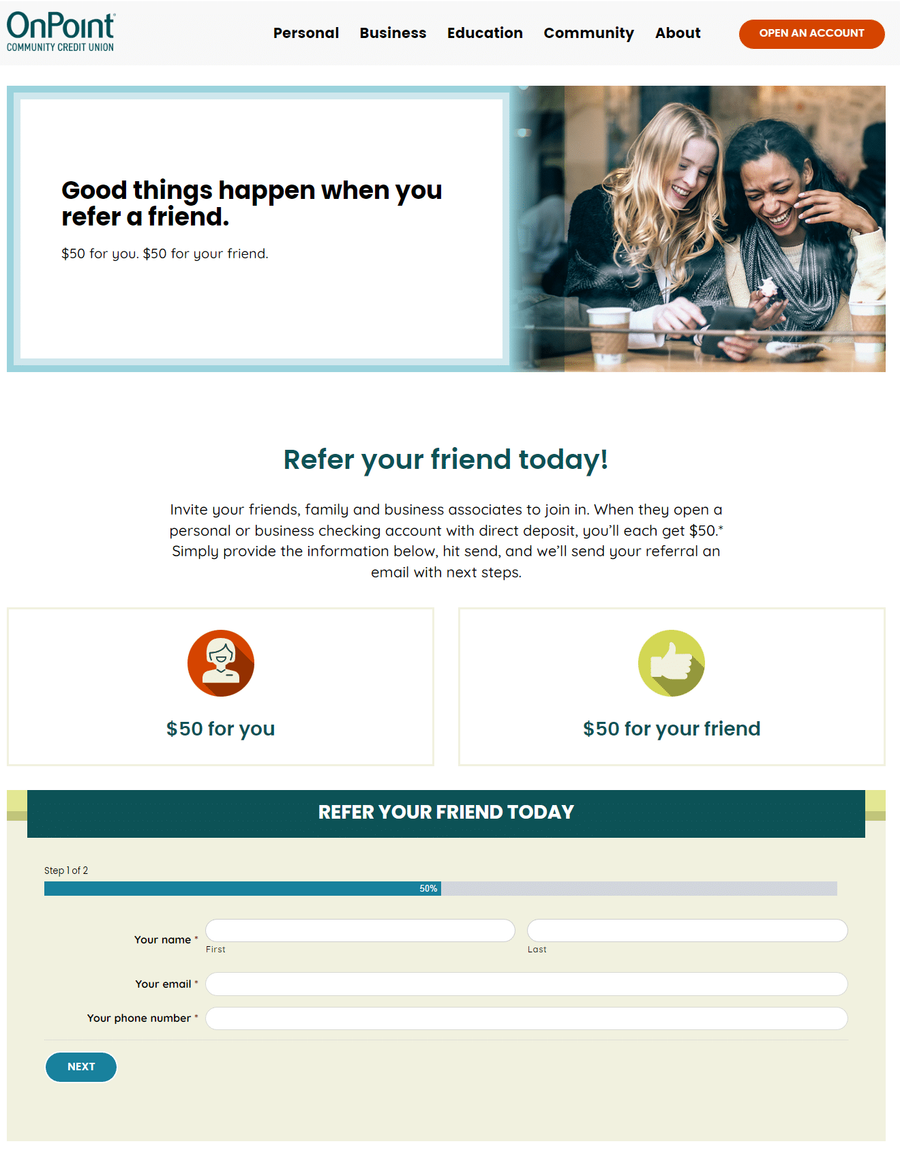
What we love about their referral program:
- OnPoint leads with a meaningful headline and then explains the reward right away
- Double-sided rewards mean both the referrer and friend earn cash when the friend joins the credit union
- Easy to understand how the program works, including the terms
- Short referral form removes friction
Could be improved:
OnPoint offers both a digital and a paper referral form. Paper referrals don’t track automatically and add operational overhead. The digital form is enough.
Eagle Community Credit Union
Eagle Community Credit Union serves Orange County, California with six branches and 11 ATMs. We appreciate how their referral program blends a standard structure with an exciting contest layer.

What we love about their referral program:
- Members earn set rewards with each successful referral, but also get entered into a monthly drawing for a larger gift card
- Eye-catching image advertises the reward and explains the program in a few simple steps
- Double-sided rewards mean both the referrer and friend earn cash when the friend joins the credit union
- Members can use the QR code to access the program
- Members can submit multiple referrals at once
- There’s no limit to the number of referrals someone can submit
Could be improved:
The page text could be tightened, as the image already explains the program well. An FAQ would cover more info without crowding the page. The expiry date creates urgency but it’s unclear if the program continues past that date.
NIH Federal Credit Union
NIH Federal Credit Union offers $50 Visa gift cards when members get their friends to open a new checking account. Referred friends must also meet certain deposit requirements within 90 days, meaning NIH only pays when they truly see results from their referral program.
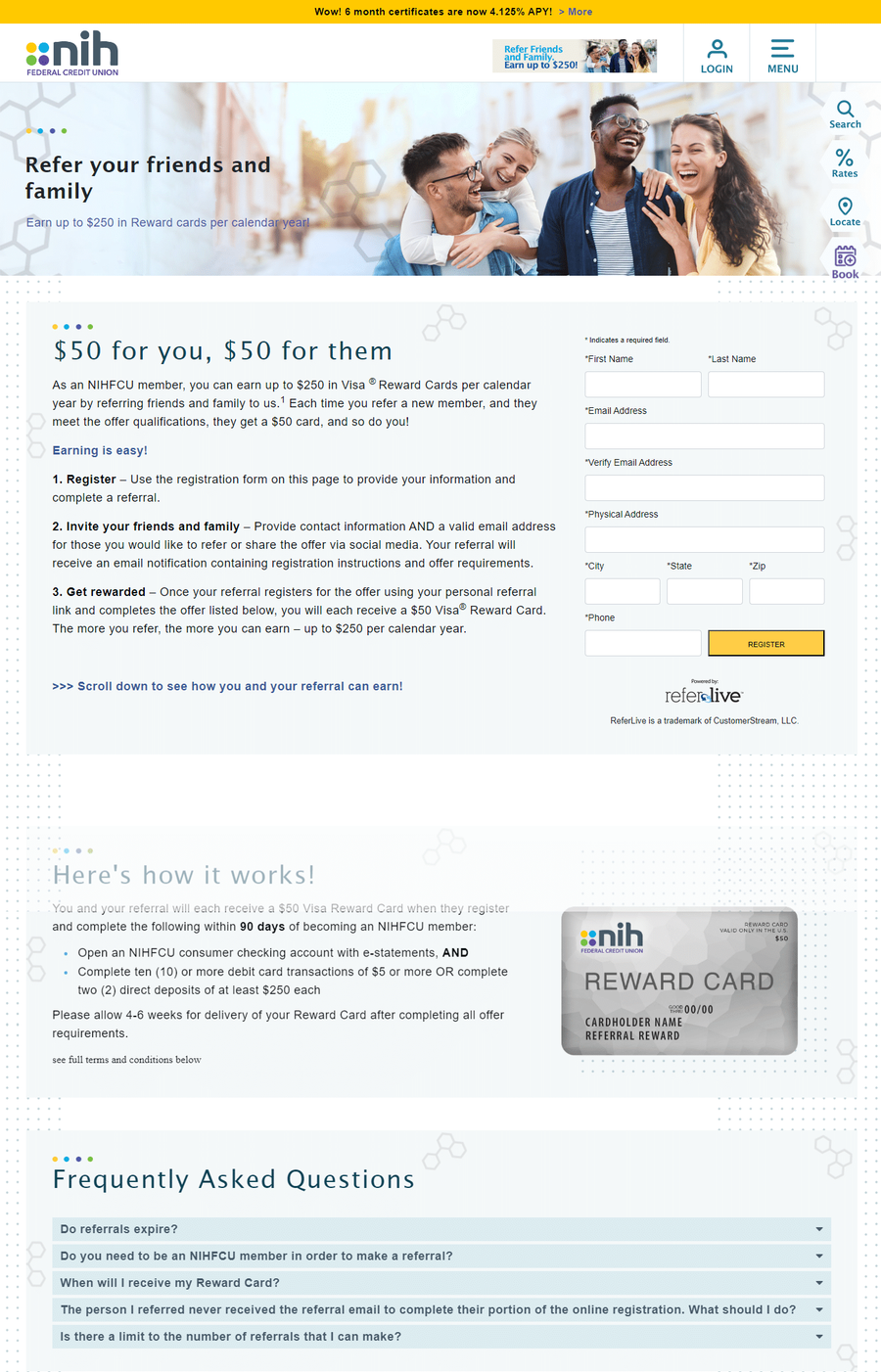
What we love about their referral program:
- NIH explains the program in three easy steps
- Double-sided rewards mean both the referrer and friend earn cash when the friend joins the credit union
- Expandable FAQ answers questions in a less cluttered way
- Eye-catching referral image in the top menu directs members to share, and makes the program easy to find from other pages
Could be improved:
Even with the three-step explanation, there are ways to cut down some text on the page. The referral form is a little long, asking for the friend’s home address and phone number is probably more than necessary.
Bring referrals into your operations
Credit unions don’t need to manufacture word of mouth — your members already trust you, and they already talk. The job is to make it easy for them to bring a friend, frame the offer as a gift instead of a transaction, and keep the program rolling alongside everything else you do.
If you’re not sure whether your credit union is ready, start by asking how often you hear “my friend told me about you.” If the answer is “all the time,” you’re leaving growth on the table without a program to capture it.
A program that lives inside your operations — branches, online banking, member touchpoints, and the conversations your team has every day — turns the referrals you’re already earning into reliable growth. That’s what Referral Rock is built for: referral program software – done right, shaped around how credit unions actually run. Find out how our referral software is designed for financial services, including your credit union.

About the author
Jessica Huhn is a content writer and strategist at Referral Rock. When she is not writing, there is a good chance that Jessica is singing, arranging songs, sharing and enjoying content on social media, or hanging out with her mini Goldendoodle. She believes that it's always important to cultivate gentle strength.