Most real estate referral advice boils down to “ask happy clients and offer a reward.” That’s not wrong, but it’s incomplete. The agents who get a steady stream of referrals don’t treat their program like a marketing campaign they launch once. They build it into how they run their business. This guide covers how to set up a real estate referral program that keeps working, from earning the kind of experience people talk about, to making it effortless for clients to share you with friends.
Benefits of a real estate referral program
Real estate referral programs work by engaging your existing clients, as well as relevant professionals. You’ll build a stronger customer base through trust, and won’t have to run pricey campaigns. Here are the top benefits:
Increased trust in your services: People trust referrals from peers far more than ads. A study by Nielsen revealed that 84% of people see referrals as the most trusted form of advertising.
Warm leads, not cold ones: When clients promote you, they refer friends and family who are already interested in buying or selling. A personal recommendation can be up to 50 times more effective in driving a purchase than a standard ad.
Lower customer acquisition costs: Referral programs bring in clients at a lower cost than traditional ads. If you can’t (or don’t) offer rewards, that lowers your CAC even further.
Easy referral tracking: Starting a referral program, with or without rewards, makes clients’ sharing trackable. With the right referral program software and the unique links it creates, you can attribute every referral to the person who sent it.
Referral software for real estate agents [Free Tools]
These referral tools for real estate agents are a free and easy way to help you start your referral program.
Want a automated referral system for your real estate business? Uncover referrals in plain sight to smooth out business lulls, without losing focus on your real day to day work helping customers.
Check out our referral program software - done right.
Be worth recommending first
A referral program captures word of mouth that’s already happening. It doesn’t create it. Before you set up a program, ask yourself: are people already recommending me?
What makes a real estate agent worth talking about comes down to a few things:
- Your service: Do you respond quickly? Do clients feel taken care of at every step, from the first showing to closing day? When something goes sideways (and it will), do you handle it in a way that builds trust instead of breaking it?
- Your value: Do clients feel like they got more than they paid for? Not just in the transaction, but in the guidance, the attention, the extras you didn’t have to provide?
- Your story: What’s the thing that makes you, you? Maybe it’s your deep knowledge of a specific neighborhood, your background, or the way you make first-time buyers feel less overwhelmed. People recommend agents who have a personality, not just a license.
Are people leaving five-star reviews, sending stellar feedback, sharing testimonials, or recommending you even before you’ve launched a referral program? Those are signs you’re ready. If that’s not happening yet, focus on the experience first. A program built on top of a weak experience just amplifies the wrong thing.
Follow the rules for referral fees
In many areas, state and federal laws prohibit real estate agents from paying referral fees to individuals who don’t have a real estate license. If that’s the case in your area, you can’t give out traditional rewards to people who make referrals. Even non-cash rewards (like gifts for the referrer) may be illegal to give. Be sure to check the laws regarding referral fees before planning your program’s structure.
Even if you can’t legally give rewards to referrers, don’t despair. Non-incentivized referrals are the most authentic form of recommendation. They signal that clients are genuinely sharing your services because they had a great experience and want their friends to have the same one. Here’s more on creating a referral program without rewards.
Consider giving back as a reward alternative
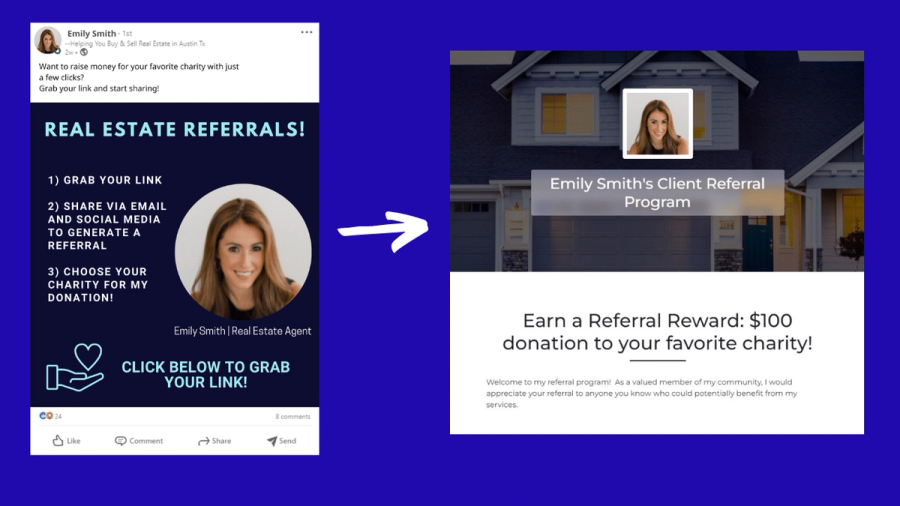
If you can’t offer incentives, consider making a donation to charity for every referral. This could be a charity you’ve chosen, or one the referring client selects from a list of options. Go local, national, or global with your charity choices. Your referrers will appreciate the opportunity to give back to a worthy cause.
Frame the referral as a gift for the friend
Most referral programs put all the focus on the referrer. But think about it from the other side, especially given that those tangible rewards may not be an option.
When a past client recommends you to a friend who’s about to buy their first home, they’re doing it because they trust you and want their friend in good hands. That’s the dynamic worth designing around.
Instead of leading with “here’s what you get,” lead with “here’s what your friend gets:” a trusted agent who will guide them through the process, answer their questions, and look out for their interests.
When your program messaging centers on the friend’s experience, sharing feels like a favor, not a sales pitch. The referrer is doing something generous because they care about their peer. That’s the difference between a program people use once and one they keep coming back to.
Build referral promotion into your operations
The biggest mistake agents make with referral programs is treating them like a campaign. They announce the program, send one email blast, and wait. When nothing happens after a few weeks, they assume referral programs don’t work.
They work. But only if you keep them running.
Instead of a one-time launch, build referral touchpoints into how your business already operates:
- Send dedicated program emails to current and past clients. Not once, but monthly to quarterly. A contact list goes stale in 2-3 months, so consistency matters more than any single blast.
- Include a short mention in every newsletter and regular communication. One line is enough to keep it visible.
- Put it in transactional moments. Invoice emails, closing documents, post-sale follow-ups. These are natural touchpoints where clients are already engaged.
- Feature it on your website. A prominent banner on your homepage, a link in the footer or menu, a dedicated landing page. If clients can find it without searching, more of them will participate. Promote your program wherever clients already look.
- Mention it on social media and offline materials. Business cards with a QR code, social posts, signage at open houses.
- Make your team part of it. If you work with a team, transaction coordinators, assistants, or showing agents, they can mention the program during handoffs and follow-ups. They become recruiters for the program without it being their main job.
- Stay connected with past clients. Send holiday cards, personal notes, or a small gesture on the anniversary of a home purchase. Even if you can’t reward referrals, you can send gifts to clients “just because.” A small food gift with a tag asking for referrals is a creative way to keep your program top of mind.

Take advantage of Referral Rock’s Monthly Summary emails to follow up with existing program members. These provide a personalized recap of each member’s referral activities every month.
Don’t overthink the timing. Some guides will tell you to ask previous and current clients only at the “perfect moment,” like right after closing or right after a glowing review. Those are fine moments, but waiting for the perfect one means you miss all the good-enough ones. The right time to promote your program is all the time, in multiple ways.
Make sharing a breeze
To get maximum participation in your referral program, prioritize ease of use and sharing.
- Break down the program into three to four straightforward steps for better understanding.
- Emphasize the advantages of sharing. Even if you can’t offer rewards, you can still list intrinsic advantages, like the chance to help a friend – and if applicable, the chance to help a charity.
- Remind clients of the benefits your real estate agency provides – benefits their friends stand to enjoy if they become new clients.
- Keep your program page organized – don’t clutter it up with too much text.
- Ensure there’s a clear call to action (CTA) that encourages sharing.
Additionally, strive to minimize the effort required to make a referral.
- Offer various sharing options that fit how people usually communicate, like email, social media, and text messages.
- Provide a referral link that clients can easily copy and share anywhere—referral software can create these links with ease.
- Craft a friendly pre-written message for clients to send to their friends. Make it feel personal and engaging.
- Make sure the program is easy to access and use on mobile, as most clients share things with friends via their phones.
A share carries further when it feels personal at every step, from the invitation sharers get, to the message they send friends, to the page their friend lands on. Here’s how to personalize the share experience with Referral Rock.
Remove the barriers to joining
Here’s a principle that trips up a lot of referral programs: don’t make people sign up to participate. Every form, every login, every extra step between “I want to refer someone” and “here’s my link” is a step where you lose people.
The best approach is to treat every past client as a program member by default. No signup form, no join button. They already did business with you. They’re already in.
With Referral Rock’s auto-enrollment features and One Click Access links, your clients can immediately start sharing your real estate services. They’re instantly part of your program without needing to sign up or complete a form.
Include One Click Access links in all your promotional emails, not just the ones specifically about the referral program. Newsletters, transaction emails, follow-ups. Every email is an entry point.
Referral Rock also allows members to access their referral portal using popular social logins like Google and Facebook, eliminating the need to remember a password.
You might worry about opening up the program to everyone. What about abuse? The answer is to prepare for it progressively, not preemptively. Keep access open, and use detection rules to flag the rare bad actor. You never know who your most enthusiastic referrer will be, and gating access means you’ll never find out.
Get referrals from other sources, not just clients
Previous clients aren’t your only possible source of referrals. Homebuilders, loan lenders, architects, designers, home service providers, movers and other people at related, non-competing local businesses could send referrals your way. You might even get referrals from other real estate agents who are based in different states or countries – they might know previous clients who are thinking of moving to your area! So, you’ve potentially got a whole referral network at your disposal if you form the right partnerships.
You might offer separate referral programs for current and past clients vs. for professionals, or you can have everyone funnel their referrals into the same program.
Show your appreciation
Even if you can’t (or don’t) send rewards for referrals, it’s still vital to show your appreciation. When referrers feel valued, they’re more likely to continue spreading the word, and a simple thank-you note is a powerful gesture that costs nothing. Whether you opt for a handwritten message or an email, include the person’s name and convey your sincere appreciation for their referral.
You can also make it public. Shout out your top referrers on social media, your website, or your blog. A public thank-you might be the nudge that drives others to make their own referrals. And like the personal notes, this costs nothing to offer.
Track what matters: shares and reach
It’s essential to monitor and refine your program, but focus on the right metrics. The most useful leading indicators are shares (are people actually sharing?) and reach (how many people see those shares?). If shares aren’t happening, you have a promotion problem. If shares are happening but referrals aren’t converting, it’s a messaging or friend experience problem. Diagnose upstream before tweaking downstream.
Track converted referrals and compare your costs with your revenue. If the revenue from referrals exceeds your customer acquisition cost, you’re seeing a positive return. This information should guide your next moves.
Select the right software
Referral software lets you track the number of referrals people generate, pinpoint where those referrals are coming from, and distribute rewards. You’ll gain insights into your program’s performance, enabling you to make data-driven adjustments.
Referral Rock software streamlines the creation, tracking, rewarding, and marketing of your program:
- Track referrals effortlessly: Each participant gets a unique referral link, and customers can monitor their own referrals through personalized dashboards.
- Automate marketing: Engage customers with automated promotional emails and passwordless sharing links.
- Automate reward distribution: If you’re offering rewards, Referral Rock distributes them as soon as someone makes a successful referral.
- Integrate with essential tools: Connect with over 50 tools, including your CRM.
- Gather program insights: Assess performance and make data-driven enhancements.
- Set up in no time: Launch in just days, with expert assistance available at every stage.
Set up your own real estate referral program
The best real estate referral programs don’t feel like programs at all. They feel like how you do business. Earn the recommendation first, make it easy for clients to share you with friends, and keep it running as part of your daily operations. Start with the experience, and the referrals will follow.

About the author
Jessica Huhn is a content writer and strategist at Referral Rock. When she is not writing, there is a good chance that Jessica is singing, arranging songs, sharing and enjoying content on social media, or hanging out with her mini Goldendoodle. She believes that it's always important to cultivate gentle strength.