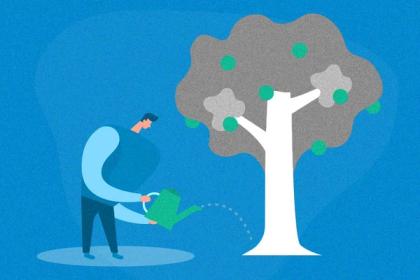
A lot of people don’t have the time, equipment, or know-how to care for their own lawns and trees. So homeowners and businesses hand that work to landscaping and tree care companies like yours. The hard part is standing out, and your best advantage isn’t an ad. It’s the customers already recommending you to their neighbors.
A landscaping referral program turns those recommendations into a system you can see, track, and reward. This guide walks through how to set one up, when your business is actually ready for one, exactly how a single referral plays out in the field, and the practices that keep referrals coming in all year.
What is a landscaping referral program?
A landscaping referral program lets you leverage your existing customer relationships and turn them into a source of acquiring new clients. It involves rewarding your existing customers for successfully referring a friend or family member to your landscaping, mowing, tree services, or lawn care business.
Setting up a formal referral program (with referral software) lets you monitor the client referrals your customers make. Tracking that data shows you which customers send the most business and how well the program is working, so you can improve it over time.
Why do you need a landscaping referral program?
Landscaping and tree services projects often require a considerable investment. Potential customers spend a lot of time researching and comparing providers in their area before they commit. But people trust a brand recommended by a friend far more than one they found in an ad. When a neighbor recommends your services, the person who hears it is much more likely to hire you. A referral program is how you capture that trust at scale.
Unlike paid options such as Google Ads, referral programs are low-risk and require minimal upfront spend. You pay once for referral software, and after that you only pay out when a referral turns into a sale. You aren’t spending blindly the way you would with traditional ads.
54% of marketers report that a referral program significantly reduces their cost-per-lead. And most marketers rank referral-generated leads among their top three sources for lead quality.
Referral software for landscapers [Free Tools]
These referral tools for landscapers are a free and easy way to help you start your referral program.
Want a automated referral system for your landscaping business? Uncover referrals in plain sight to smooth out business lulls, without losing focus on your real day to day work helping customers.
Check out our referral program software - done right.
Are you ready for a landscaping referral program?
Here’s the thing most guides skip: a referral program doesn’t create word of mouth. It captures and amplifies what’s already happening. If no one’s recommending you yet, a program won’t manufacture it for you. But if customers are already telling their neighbors about you, you’re leaving money on the table without a system to capture it.
That’s the real signal you’re ready: people refer you sometimes, but you have no easy way to track those referrals, reward them, or make them happen more often.
Before you launch, make sure you have these essentials in place:
- A pool of existing customers who love your work. Ideally, some are already recommending your services without being asked.
- A customer experience worth recommending, from the first phone call to the last finishing touches.
- A high level of customer satisfaction, including strong ratings from customer reviews.
- A website to send referred leads to.
If those are solid, a program takes the referrals you’re already earning and makes them reliable instead of random.
What a landscaping referral actually looks like, step by step
Most guides stop at “ask happy customers.” Here’s what the whole flow looks like in the field, from the moment you finish a job to the moment that customer’s neighbor becomes your next client. We’ll follow one example: Sarah, a customer whose yard you just finished, and Dave, her neighbor.
This is also where landscaping has an edge most industries don’t: your work is on display at the curb, your truck sits in the driveway all morning, and the neighbors are watching. The flow below is built to take advantage of exactly that.
Step 1: You finish the job and make the ask
You’re loading the mower when Sarah comes out to look at the yard. She’s happy, and the work speaks for itself. That’s your moment, and it only takes a sentence or two:
“Glad you love it. I’m running a referral program right now, so here’s a card or two you can pass along. Whoever you send gets 15% off their first visit, and you get $30 off your next bill for anyone who books.”
You hand Sarah two or three referral cards. Each one carries her unique QR code (tied to her account in your system), the friend’s offer, and your contact info. The ask lands here because the proof is all around you: her fresh-cut yard, the neighbors’ lawns in plain view, and your branded truck right there in the driveway.
Step 2: Sarah shares, online or offline
Sarah now has one tool she can use whichever way feels natural:
- Offline: she hands a card to her neighbor Dave when he leans over the fence to ask who did the lawn.
- Online: she scans or screenshots the QR code and texts it, or drops it into the neighborhood Facebook group or Nextdoor: “This is who does my lawn, they’re great, and you get a discount on your first visit.”
The QR code and the referral link point to the same place, so it works in any format. Sarah never has to memorize a code or spell your business name over the phone. The card and the code do the work for her.
Step 3: Dave redeems the offer
Dave scans the code and lands on your booking page. The system automatically tags him as Sarah’s referral, shows his 15% discount already applied, and lets him book a visit in a few taps. He sees real value before he’s even met you, so he books.
Step 4: You do the job, already knowing the backstory
You show up for Dave already knowing he came from Sarah, because your system flagged it. A small line goes a long way: “Sarah mentioned you might reach out, glad you did. We’ll take good care of you.” Referred customers arrive pre-sold. They tend to trust your quote, accept your recommendations, and be easier to work with, because someone they trust already vouched for you.
Step 5: The rewards trigger themselves
After Dave’s first completed visit, the rewards take care of themselves:
- Dave already got his 15% off at booking, so it’s done. No coupon to remember, no awkward conversation.
- Sarah gets an automatic text or email: “Your referral just completed their first visit. We’ve added $30 to your account, and it’ll come off your next invoice automatically.”
Sarah didn’t have to follow up, remind you, or fill anything out. It just appeared, and that frictionless experience is exactly what makes her want to refer again. Rewarding her only after Dave’s job is paid also protects you, because you only pay out on real revenue, not on a name.
Step 6: The flywheel starts turning
Here’s where it compounds. After Dave’s visit:
- Dave is in the program now too, with his own QR code to share.
- Dave’s neighbors have spent the morning watching your truck in his driveway and his yard transform.
- Sarah sees her $30 credit on the next invoice and remembers how easy it was.
One job created two advocates, each with a reason to talk about you, and the next referral is already in motion. That loop, running quietly in the background after every job, is the whole point of a referral program.
Landscaping referral program best practices
Once you decide to roll out a landscaping or tree services referral program, the right steps will get it off to a strong start. Here are the practices that make a referral program work.
Choose rewards that feel like a gift
Most landscaping programs treat the reward as a transaction: refer a friend, get $50. The problem is that this makes your customer feel like they’re selling out a neighbor for cash. People don’t want to feel like they’re monetizing their relationships. They want to feel like they’re doing a friend a favor.
So flip the focus. The best referral isn’t an ask, it’s a gift your customer gives a friend. Lead with what the friend gets, not what the referrer earns. The same reward can feel like a sales commission or a generous gift depending entirely on how you frame it.
That said, reward design still matters, and it depends on whether you did a one-time project or you maintain the property on a recurring basis:
- Credits toward future services are a good choice if the advocate pays for recurring landscaping, tree, or lawn care services.
- Cash, Visa gift cards, gift cards to other businesses, referral gift baskets, and travel- or event-based rewards are great options for the advocate if they aren’t receiving recurring services.
For the referred friend, the reward should always tie directly back to your services, to encourage them to book:
- Discount coupons, credits toward the project, cash back after the project is paid for, and free or discounted added services are great friend rewards.
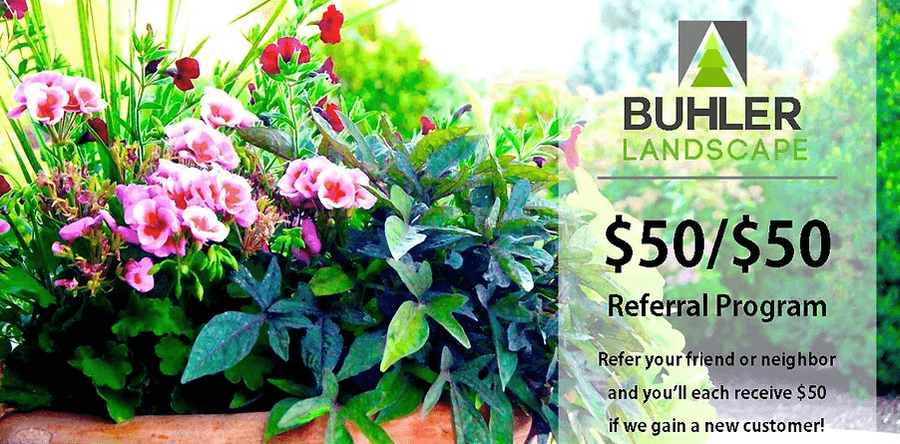
A double-sided reward (something for both the referrer and the friend) works well here, because it gives your customer a real gift to hand over. Also consider bigger rewards for higher-value referrals. If you serve both home and business clients, larger commercial referrals are worth more to you, so reward them accordingly.
Use our referral reward calculator to determine the reward values you should offer the sharer and their friend, for the best ROI.
Start a referral contest to motivate more sharing
Adding an element of competition through referral contests can significantly boost engagement. Contests motivate participants to make as many referrals as possible for a tempting prize.
In a referral contest, you enter referrers into a drawing for a larger reward, like season passes or a tech item, where one referral equals one entry. Or you give an added reward to whoever brings in the most successful referrals in a year.
If you run a contest, still give a set reward for every referral. Everyone who brings in new business should win something.
Choose the right referral software
Efficient software is vital when setting up a referral program. The right referral software streamlines program creation and automates the management work.
Thanks to the referral links it generates, referral software lets you track exactly where every referral came from and instantly issue rewards for successful referrals. It also collects program data you can use to measure success and refine your program over time.
Referral Rock software offers best-in-class referral tracking, sharing, and engagement experiences, with concierge onboarding and no developers required. Check out how our referral software is designed for field and home services businesses.
Ensure easy sharing
Make sharing effortless for your existing customers. They should be able to access the program and share with friends in as few clicks or taps as possible.
And once they’re on the referral page, it should be easy to understand what to do:
- Create an enticing headline that states exactly what customers should do (share) and what’s in it for their friend (the reward).
- Concisely explain the program (and what must happen for the rewards to be earned) in a few steps.
- Include an easy-to-find call-to-action button to get customers sharing.
- Give multiple options for sharing, based on how customers naturally share things they love with friends (including email, social media, and a unique referral link they can copy and share anywhere).
- Direct customers to an FAQ page if they have other questions.
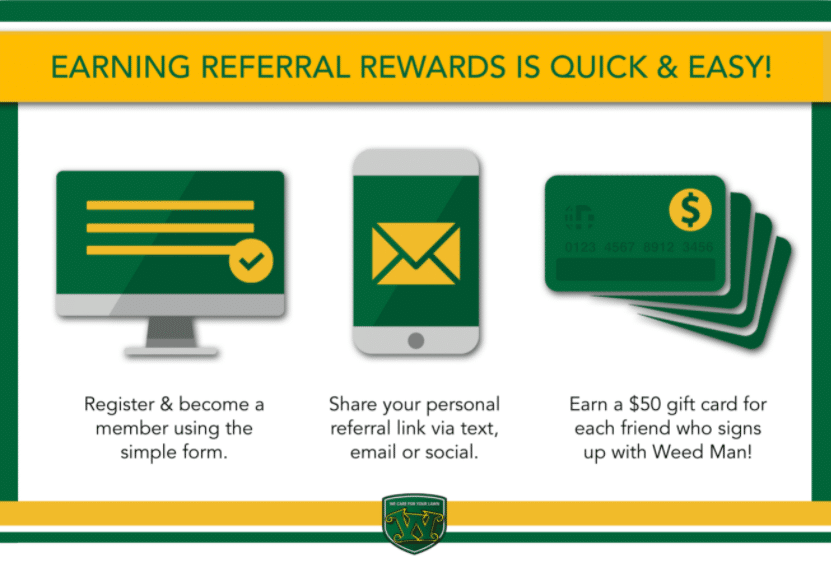
Bridge offline and online with a QR-coded card
Landscaping referrals happen in two very different places: at the fence in person, and in neighborhood Facebook groups and Nextdoor threads online. A referral card with a unique QR code is the one tool that works in both. Your customer can hand it across the yard or screenshot the code and post it, and it routes to the same trackable link either way.
That small square is what separates a nice gesture from a system:
- Share it anywhere. A physical card only travels as far as the hand holding it. A QR code can be texted, posted to Nextdoor, or dropped into a Facebook group, turning one happy customer into a one-person marketing channel.
- Frictionless booking. The friend lands on your page with the discount already applied, with no code to type and no phone call required.
- Automatic attribution and enrollment. The software ties every scan back to the right customer, and the friend who books gets their own code, so your network grows without you lifting a finger.
Whatever you print, make sure every card connects back to the digital program, so offline shares get tracked just as cleanly as online ones.
Keep access open (skip the signup hoops)
Here’s a mistake that quietly kills landscaping referral programs: making customers sign up to participate. Every form, login, or “join now” step is a place where you lose people, and you never know which customer would have been your best referrer until you give them the chance.
So don’t gate the program. Treat every customer as a member by default and give each of them a referral link automatically, no application required. The fewer hoops between “I’d recommend you” and “here’s my link,” the more referrals you’ll get.
Get more of your customers into your program with our automatic enrollment tools and discovery paths.
The one place a form belongs is on the friend’s end, to capture the new lead. Landscaping and tree care programs tend to ask for a lot of information here, but too many required fields make things overwhelming. Only ask for what you need to contact the new lead (your referral software will already track who the referral came from).
Promote your program continuously
You’ve put effort into designing your program, but it won’t generate a single sale if customers don’t know it exists. The mistake is treating promotion like a one-time announcement. A referral program isn’t a campaign you launch and forget. It’s an ongoing part of operations, so promote your program in lots of places, continuously:
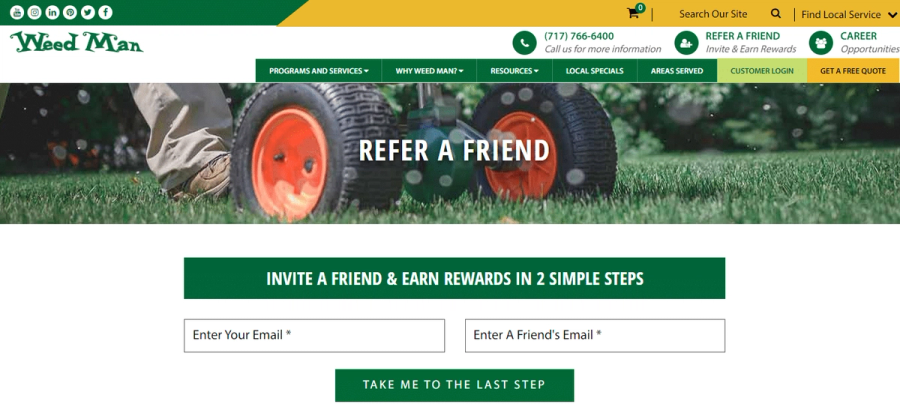
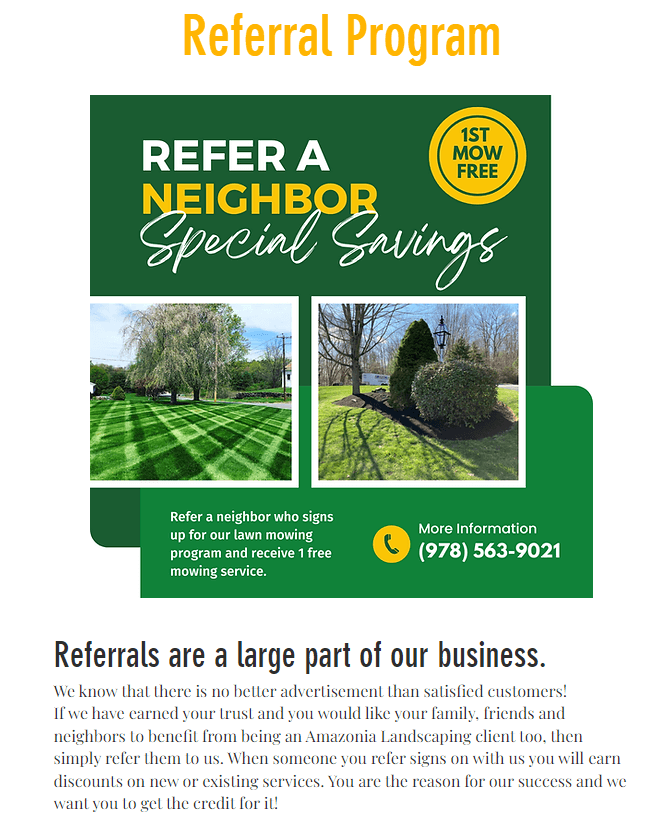
- On your website (place a hero image or banner where it’s easy to find, and/or buttons in the top and bottom menus).
- In mass emails focused on your program, sent to all clients (one is plenty, don’t spam).
- In conversations with clients, when you know a client is satisfied.
- In personal referral emails sent to your most satisfied clients.
- In news/update emails, confirmation emails, invoices, and other emails unrelated to your referral program.
- In email signatures and social media bios.
The goal is for your program to be in front of every customer at every relevant moment, not blasted once and forgotten.
Run your program promotional emails without bolting on another tool. The invite emails, reminders, reward alerts, and monthly nudges that keep a referral program alive are built in, ready to send from inside Referral Rock.
Train your staff to share your program
Your crew can play a big role in promoting your program. They’re closer to the customer than anyone in marketing, and they’re already in the conversations where a referral request fits naturally, like right after a job they know went well. Train them to bring up the program in those moments. In doing so, your staff become trusted sources of information, which strengthens your customer relationships.
Also consider giving your staff referral cards to hand out at touchpoints like home shows, community events, or door-to-door. This keeps your program top of mind for both your staff and customers. Just be sure to connect those cards to the digital side of the program.
Or, use Referral Rock’s recruiter features to make your team’s referral program conversations even easier. This gives all your reps a way to enroll customers in your referral program in seconds, right at key conversation moments. Each of your reps gets their own recruiter portal and link, and can register your clients for the program on their phone, right in the field. The customers then get their own share links, accessible right from their inboxes. Plus, they get that all-important, personal QR code to share with friends.
Beyond mentioning the program, your staff should understand how it works so they can answer questions accurately and confidently.
Know the best time to ask is all the time
One of the best ways to get referrals is simply to ask, since you’re talking with clients throughout the project and have built a relationship. It’s tempting to hunt for the one “perfect” moment to ask for referrals, but that kind of over-optimization leads to paralysis. The better approach is to build the ask into the moments that come up naturally, again and again.
That said, some moments land especially well. Ask when you know a client is happiest and you’re top of mind, such as when:
- You’ve just finished a job and the client comes out to admire the yard (as in the walkthrough above, this is the single best moment, because the proof is right in front of both of you).
- A neighbor wanders over while you’re working to ask who you are. Have a card ready to hand them on the spot.
- You’ve received a positive review from them.
- You’ve received a positive social media comment from them.
- They give you great in-person feedback.
- You know they were satisfied, and you’re sending an invoice.
- You know they’ve already recommended you outside of your referral program.
Send the lead a personal note from the referrer
It’s just as important to optimize the experience on the referred friend’s end. The message the friend receives is often their first impression of your business, and a referral message is a handoff, not an ad.
It’s best to have the referrer write the message and explain why they’re recommending you. You can also prompt the referrer with ideas to include, or provide an editable message (written from their perspective) they can send as-is.
However you format it, make sure the message shows the reward the friend has been given, available once they book services with you. Keep the focus on what the friend gets, and include an eye-catching CTA above the fold to entice them to take action. The message and the page they land on should feel like one continuous handoff: same referrer’s name, same reward, same tone.
A share carries further when it feels personal at every step, from the invitation sharers get, to the message they send friends, to the page their friend lands on. Here’s how to personalize the share experience with Referral Rock.
Thank customers for referrals
Thanking customers for referrals encourages them to make more, because they feel appreciated. Send a personal thank-you note (preferably handwritten) whenever someone’s referral results in a purchase. You might also post a public thank-you on your social media page.
As customers keep referring, showing appreciation builds goodwill and retains their loyalty. Beyond the rewards they earn, a simple thank-you goes a long way toward motivating them to keep recommending you. This is also a natural moment to ask a top referrer for a testimonial, since you already know they’re eager to recommend you. A heartfelt customer testimonial reinforces trust and can sway an undecided prospect, and you can display it on your website for an added word-of-mouth boost.
Keep your landscaping referrals rolling
The landscaping, lawn care, and tree care industries keep growing, which means more competition for the same neighborhoods. A referral program is one of the most cost-efficient ways to win that competition, because it runs on trust you’ve already earned instead of ad spend. The businesses that get the most out of it treat it as an ongoing part of operations, not a one-time campaign. Keep it in front of every happy customer, keep the rewards feeling like a gift, and keep access open.
It really does start at the curb, right after you’ve done work you’re proud of. The ask takes thirty seconds, the card costs pennies, and the QR code and your software handle the tracking and rewards from there. Do that after enough good jobs and the referrals stop being random.
For more tactics you can apply across service businesses, check out our field services referral program guide.