Construction and home improvement run on trust. People don’t pick a contractor from an ad — they ask someone who’s had work done. If your clients are already recommending you, a referral program turns that into a system: easier for them to share, easier for you to track, and a reliable way to keep new leads coming in. Here’s how to build one that actually works.
What is a contractor referral program?
A contractor referral program motivates your existing clients to recommend your construction or home improvement services to people they know. Clients share through a unique referral link or code, and when their recommendation turns into a new customer, both parties are rewarded.
A referral tracking system handles the tracking and reward fulfillment automatically, so you’re not managing spreadsheets or trying to remember who sent whom. The referral system monitors every recommendation so you can see exactly how the program contributes to revenue.
Note: The advice in this article applies whether you’re in the construction, home improvement, or home renovation business.
Why contractor referral programs work
Construction and home improvement projects are significant investments. People spend time researching their options, and when it comes to choosing a contractor, they trust what their friends recommend. People are four times more likely to make a purchase when referred by a friend.
A referral program lets you channel that trust into a system. Instead of spending blindly on traditional ads and hoping for results, you only pay for referrals that convert into actual business. Every referral is tracked, so you always know how the program is performing and can adjust accordingly.
Referral software for contractors [Free Tools]
These referral tools for contractors are a free and easy way to help you start your referral program.
Want a automated referral system for your contracting business? Uncover referrals in plain sight to smooth out business lulls, without losing focus on your real day to day work helping customers.
Check out our referral program software - done right.
Are you ready for a referral program?
Not every contractor is ready for a referral program. A program captures and amplifies word of mouth that’s already happening. It doesn’t create it from scratch. Before you launch, you need two things in place:
- Strong operations. You run a tight ship. You’re responsive when clients call, you follow through on timelines and budgets, and your crew shows up and delivers. Consistency is your reputation. When every project goes off without a hitch (or you recover quickly when something doesn’t), clients remember that. They don’t just hire you again. They tell their neighbors.
- Word of mouth worth capturing. Some of your clients are already recommending you informally. Maybe they’ve left positive reviews, mentioned you on social media, or you hear “my friend told me about you” on a first call. That’s the signal. A referral program takes those organic recommendations and makes them easy to share, easy to track, and easy to reward.
If you don’t have these yet, focus there first. No program structure or incentive will compensate for inconsistent work or a reputation that isn’t generating conversation. But if clients are already sending people your way and there’s no system to capture it, you’re leaving money on the table.
How to run your contractor referral program
With the foundation in place, here’s how to build a program that generates referrals and keeps them coming.
Frame the reward as a gift for their friend
The rewards you offer shape how the whole program feels. Most programs focus on what the referrer earns. Flip that. Frame the referral as a gift the referrer is giving their friend.
For the referred friend: Tie the reward directly to your services to encourage them to hire you. Discounts, credits toward the project, cash back after the project is paid for, and free or discounted add-on services all work well. This is the gift. When a client says “I know a great contractor, and they’ll give you 10% off,” that’s a generous recommendation, not a sales pitch.
For the referring customer: Since they probably won’t need another contracting job soon, the reward should be unrelated to your services but should reflect the value of the project they drove. Cash, gift cards to other businesses, gift baskets, and experience-based rewards are great options. Consider cumulative incentives that increase with each successful referral.
The key is that the messaging, the program title, and the offer all center on what the friend gets. When the referrer feels like they’re doing their friend a favor (not earning a commission), the whole dynamic changes. People don’t want to feel like they’re monetizing their relationships. They want to feel like they’re helping a friend.
Show your gratitude to referrers too. A personalized thank you note for the referral goes a long way toward keeping them engaged and referring again.
Use our referral reward calculator to determine how much to offer the sharer and their friend, for the best ROI.
Decide when to give rewards
In most contractor referral programs, you give referral rewards when the referred lead signs the contract and/or pays. But since the sales process for selecting a contractor can be longer, you might also give the referrer a smaller reward when a lead is qualified. This keeps referrers in the loop and motivated while the deal progresses.
Start a referral contest to motivate more sharing
You could also motivate referrers with drawing entries for a big-ticket item (each referral equals one entry chance), or offer bonus prizes to those who bring in the most successful referrals within a calendar year.
But the contest should be in addition to the fixed rewards for the member and referral (programs are meant to be ongoing, not short campaigns).
Don’t be afraid to ask
Ask for referrals when your clients are happiest and the relationship is strong. Good moments to ask:
- You’ve completed a project
- You’ve received a positive review from them
- You’ve received a positive social media comment from them
- They give you great in-person feedback
- You know they were satisfied, and you’re sending the invoice for the completed project
- It’s the one-year or two-year anniversary of a project completion you know went well
- You’re calling for a warranty check in (or other post-project check-in) and the customer says the project is holding up well
- You know they’ve already recommended you outside of your referral program
Here’s an example from Fletcher Home:
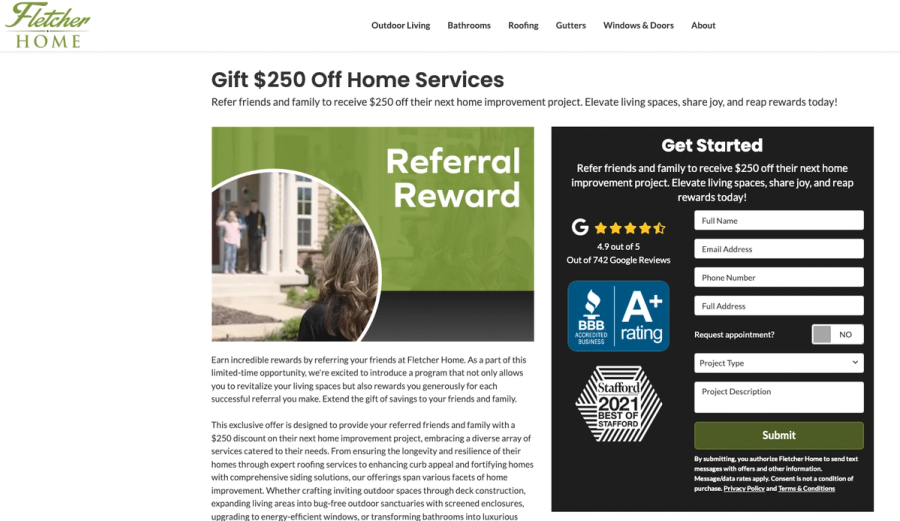
When you know someone is happy with your work, asking is natural. Done right, it’s not pushy. You’re giving them an easy way to do something they might already be doing informally.
Make sharing seamless
The fewer steps between “I want to refer someone” and “here’s my link,” the more referrals you’ll get. Every extra click or form field is a place where you lose people.
- Customers should be able to access the program and share with friends in as few clicks or taps as possible.
- Create an enticing headline that states exactly what customers should do (share) and what’s in it for them (the reward).
- Concisely explain the program (and what must be done for the rewards to be earned) in a few steps.
- Include an easy-to-find call to action button to get customers sharing.
- Direct customers to an FAQ page if they have other questions.
- Give multiple options for sharing, based on the ways that customers naturally share things they love with friends (including email, social media, and a referral link that customers can copy and share anywhere).
A share carries further when it feels personal at every step, from the invitation sharers get, to the message they send friends, to the page their friend lands on. Here’s how to personalize the share experience with Referral Rock.
Keep access open
Rather than making customers sign up or fill out a form to join your referral program, treat everyone as a member from the start. Give every client a link or code by default. No hoops, no join button.
With Referral Rock, you can automatically enroll customers as sharers, and send One Click Access links that let customers into the program right away via an email — no passwords or logins needed.
You never know who your most enthusiastic referrers will be. Gating access means you might never find out. Keep it open, assume good intent, and handle exceptions as they come rather than building barriers upfront that slow everyone down.
If you do need to collect information, ask for only the essentials: the referrer’s name and email, along with the lead’s name, phone number, and email.
Build referral touchpoints into your operations
Don’t treat your referral program like a one-time launch. Build it into the way your business already runs, so it’s always visible and always rolling.
Start with setting up proactive invites. This means inviting all your recent previous clients, then adding and inviting all your new clients to the program as they come in.
The invite emails, reminders, and monthly nudges that keep a referral program alive are built in, ready to send from inside Referral Rock.
Then, set up as many discovery paths as you can (promotion touchpoints in places you already connect with clients):
- On your website (place a hero image or banner where it’s easy to find, and/or buttons in the top and bottom menus)
- In conversations with clients, when you know a customer is satisfied
- In personal referral emails sent to your most satisfied customers
- In mass emails focused on your program, sent to all customers
- In news/update emails, confirmation emails, invoices, and other emails unrelated to your referral program
- Through social media posts
- In email signatures and social media bios
And turn your team into your best recruiters. After every successful project, a team member who mentions the program is more effective than any email. Equip them with referral cards that link to the program via QR codes, so customers don’t have to remember anything — they can join right away.
Easily turn your reps into program recruiters with Referral Rock. Give all your reps a way to enroll customers in your referral program in seconds, right at key conversation moments. Sales reps, field teams, and location staff each get their own recruiter portal and link.
The key is consistency. A contact list goes stale in a few months. New clients are always coming through the door. When referral touchpoints are built into your process (not just your launch plan), the program keeps producing. To promote your referral program effectively, think of it as operations, not a campaign.
Choose the right referral software
The right referral software makes running a program significantly easier. With referral links generated by the software, you can track exactly where every referral came from and issue rewards automatically for successful referrals. The software also collects program data you can use to measure success and refine your program over time.
Referral Rock offers referral tracking, sharing, and engagement tools with concierge onboarding that doesn’t require developers. You can create a program tailored to your contracting business and have it running quickly.
Check out how our referral software is designed for field and home services businesses like yours.
Send a personal note from the referrer
Sending a personal note from the referrer to the referred friend can create a positive first impression of the business and increase the likelihood of a successful referral
Ideally, the message should be written by the referrer, and explain why the referrer is recommending you to their peer. But you can also prompt the referrer with ideas to include in the message, or even include an editable message as a starting point that they could send as is. Be sure to show the rewards that their peer has sent them, and include an eye-catching CTA above the fold to entice the friend to take action.
Make referrals part of how you run your business
A referral program isn’t a marketing campaign you launch and hope works. It’s an operational system that rolls alongside your business. New clients come in, you deliver great work, and the people you’ve helped bring you more. The foundation is the work you’re already doing. The program just makes it visible and repeatable.
Check out how to start a customer referral program with software — it’s easier than you think. And for more tips specific to your industry, see our field services referral program guide.

About the author
Jessica Huhn is a content writer and strategist at Referral Rock. When she is not writing, there is a good chance that Jessica is singing, arranging songs, sharing and enjoying content on social media, or hanging out with her mini Goldendoodle. She believes that it's always important to cultivate gentle strength.