
Brand ambassadors and affiliates often get lumped together, and the terms get confused with customer referral programs too. They’re related, but they’re not interchangeable. Each one defines a different relationship between you and the people sharing your business, and that relationship shapes how the program runs, who fits, and what results you can expect.
This breakdown covers how each works, where they differ, and how to choose the right one for your business (including when the answer is actually a third option).
Three sharer types: affiliates, ambassadors, and customer referrals
A lot of search terms get used interchangeably here. They shouldn’t.
Each of these is a different relationship between you and the person sharing your business, and that relationship changes how the program runs.
The tactics that work in one don’t fully apply to the others. The reward structures are different. The trust dynamics are different. The operational system that supports each is different. Picking the right program type starts with naming what you’re actually building.
This article focuses on the first two, but we’ll come back to customer referrals later because it’s the option most readers comparing affiliates and ambassadors are accidentally skipping over.
| Type | Who shares | Relationship | What they want |
|---|---|---|---|
| Affiliates | Bloggers, content creators, publishers | Commission-based partner | Earn money on sales they drive |
| Ambassadors | Curated fans, often with an audience | Long-term arrangement, brand-aligned | Represent a brand they love |
| Customer referrals | Your actual customers | Existing fan, no formal arrangement | Help a friend, get thanked |
How brand ambassador programs work
Brand ambassadors are people you handpick to represent your brand. They already use your product. They understand what you stand for, and they’re a good fit to promote it. By choosing the right people to be your brand ambassadors and bringing them on with a formal agreement, you build a long-term promotional relationship.
Ambassadors influence people both online (social media, blogs) and offline (events, product launches). They focus on relationships more than direct sales. Anything they engage in reflects on your brand image, so the curation matters.
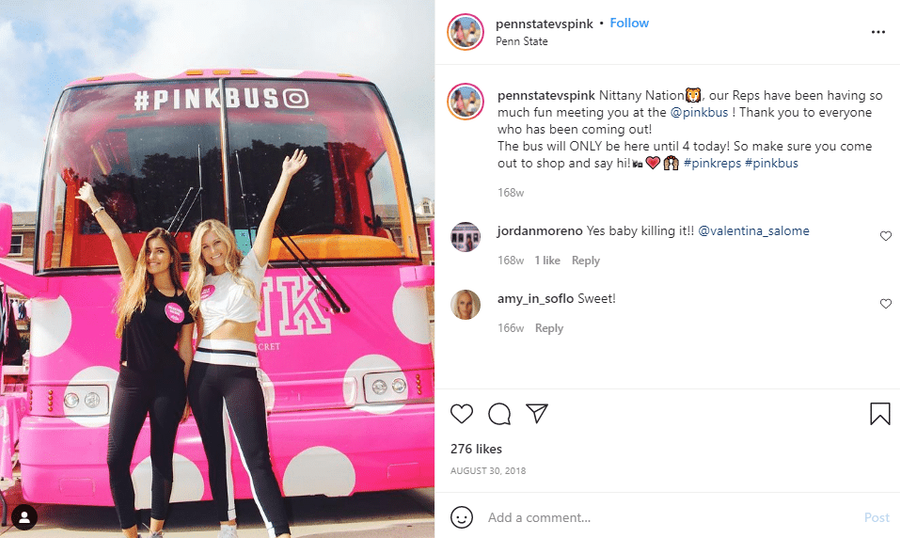
PINK campus brand ambassadors host an in-person event at Penn State University, where students can shop on the PINK brand bus.
Brand ambassadors don’t have to have a large follower count. Some brands work with celebrities or large-audience creators, but others work with smaller creators who have a tight, trusted audience.
What matters most is they love your brand, have the skills to promote it online and offline, and are highly trusted by their audience. Fit and trust are much more important than follower count.
How affiliate marketing programs work
Affiliates are website owners, blog owners, or social media creators who produce content to promote your brand and drive sales. They include affiliate links in their content, and when a sale comes through one of those links, the affiliate earns affiliate commission.
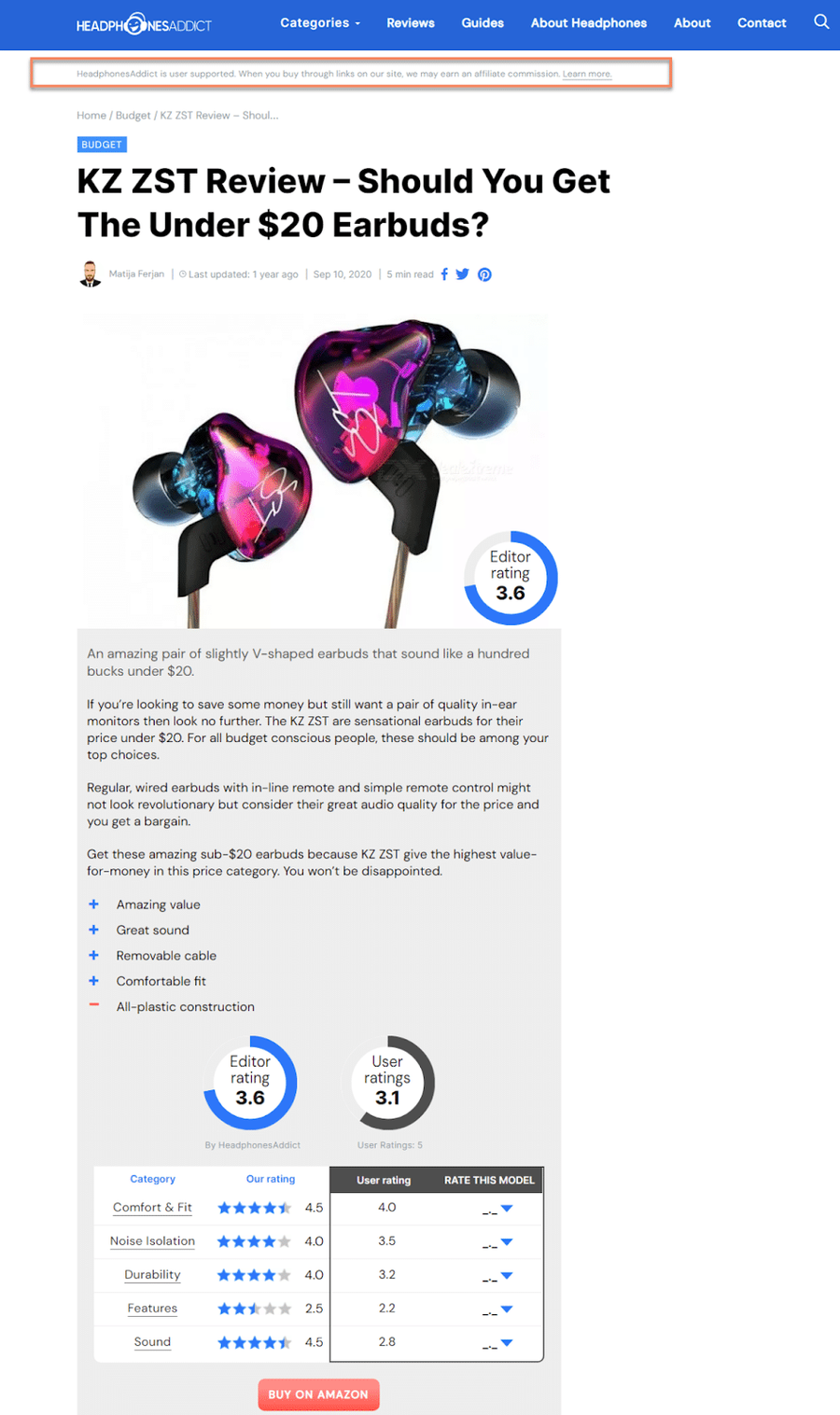
The HeadphonesAddict website includes an affiliate link to Amazon in this review of earbuds.
Affiliates don’t have to know or love your product before they promote it. They often choose to promote a brand based on audience overlap and commission potential. Their relationship with you is transactional by design: they drive traffic, they earn commission, the math works for both sides.
Differences between affiliates and brand ambassadors
The brand ambassador vs. affiliate debate has been going on for a while now. In fact, many people still don’t understand the difference between the two.
Here are the distinctions you should know:
Mediums used to share your brand
Affiliates work in digital spaces only. They share affiliate links through their blogs, websites, and social media. Every share is trackable through the link.
Ambassadors share online too, but they can also promote offline at events, product launches, or in-person community moments. Some of what they do isn’t easily tracked back to a single conversion.
Compensation and rewards
Affiliates get paid in cash, calculated as either a percentage of each sale or a flat amount per sale. The more sales through their link, the more they earn. No sales, no payout.
Ambassador compensation is more flexible. It might be a flat retainer or per-task payment. It might be free products, brand credits, or other incentives. Occasionally it’s a sales commission, but usually not.
For ambassador rewards, framing matters more than the format. The same dollar amount can feel like two completely different things depending on how you talk about it. A gift card framed as “you earned $X by referring sales” is a sales comp plan, and the sharer behaves like a salesperson. The same gift card framed as “thanks for sharing something your friends will love” is a gift, and the sharer behaves like a fan. This isn’t just semantics. It shapes how people share, what they say, and whether their friends trust the recommendation.
Motivations to refer
Affiliates are motivated by commission. They earn nothing up front, so the focus is volume: drive as many sales as possible.
Ambassadors are motivated by the relationship. The job is to build trust between the brand and its current and potential customers. Authentic representation matters more than sales volume. Both still ultimately help generate revenue, but the day-to-day motivation is different.
What ambassadors and affiliates have in common
Both affiliates and ambassadors are advocates representing your business to people who trust them. Both work better when you train them on what they can and can’t say while leaving room for their own voice. And both need a system to track what’s working. The right word-of-mouth software can run both kinds of programs, plus customer referrals and partner programs, from one place. Referral Rock software handles all of these without code, so the operational side of running multiple programs doesn’t double your workload.
What about customer referrals?
This article exists because the affiliate-vs-ambassador comparison shows up everywhere. But many businesses comparing these two would be better off running neither. They’d be better off running a customer referral program.
The difference: ambassadors and affiliates require an audience to recruit from (creators, influencers, publishers, communities). A customer referral program runs on people who are already buying from you. You’re not building an external network. You’re capturing word of mouth that’s already happening between your customers and their friends.
If you’re a local service business, a B2B company with a satisfied client base, or any business where customers occasionally refer you without being asked, a referral program is usually a better starting point than either ambassadors or affiliates. It’s lower lift to launch, it doesn’t require recruiting strangers, and the trust signal is stronger because friends are recommending friends, not creators recommending products to their audience.
This doesn’t mean ambassadors and affiliates are wrong. It means the right answer depends on who you have available to share your business. Read on for how to tell which fits.
How to choose the program that fits
Goals like “grow my brand” or “drive sales” don’t pick a program for you. All three of these do those things. The real question is which sharer relationship matches your business.
| Brand ambassadors | Affiliates | |
| Medium of promotion | Online: Social media or blogs Offline: Trade shows, events, guerrilla marketing | Online: On their website, social media or blogs |
| Method of promotion | Authentically talk about how they use your products | Place affiliate links in their content |
| Type of compensation | Could be cash, free products, branded swag, store credits, tangible rewards… whatever your brand chooses | Always cash |
| Structure of compensation | Flexible; based on an agreement your brand makes with the ambassador | Paid on every sale |
| Main motivation | Build relationships with your audience | Generate sales |
Choose ambassadors when…
- You can identify and curate a small group of fans, creators, or community members who genuinely love your product
- Offline presence matters (events, in-person communities, retail moments)
- You want long-term brand-aligned voices, not transactional partners
- You’re comfortable with rewards that aren’t tied directly to sales (free product, retainer, brand credits)
- The relationship is the goal, with sales as a downstream outcome
The main focus of ambassador marketing isn’t on direct sales. Brand ambassadors also help you build strong relationships with your current and potential customers. And of course, brand ambassadors also still help increase your revenue.
The right brand ambassador program gets paired with brand ambassador software so you can track activity even when conversions aren’t tied to a single click.
Choose affiliates when…
- You’re focused on online sales and want to attribute conversions to links
- You don’t need creators with prior product affinity, you need reach into audiences that match yours
- You’re comfortable paying commission on every sale (and not paying anything until a sale happens)
- The economics of pay-per-sale work for your margins
- You have content and assets to support affiliates
You’ll only pay an affiliate when you sell a product through their affiliate link – you won’t make an up-front payment. But you’ll need to be okay with paying commissions every time an affiliate makes a sale, in cash, for the strategy to suit your business.
Starting an affiliate program with the right affiliate software gives you the tracking and data control that makes the model work.
Choose customer referrals when…
- You already have customers, and at least some of them are happy enough to mention you to a friend
- You’re not in a position to recruit creators or curate an ambassador roster
- You’d rather capture word of mouth that’s already happening than build an audience from scratch
- You want the lowest-friction option to launch and the highest-trust signal between sharers and friends
Many businesses end up running more than one program type (referrals plus affiliates is common). The point is to start with the one that matches the sharers you actually have access to, not the one with the most search volume.
Wrap-up
Affiliates, ambassadors, and customer referrals all rely on the same underlying idea: someone you trust is recommending you. What changes is who that someone is and the relationship you have with them. Pick the one that fits the kind of business you run and the operational system you can actually maintain. And if more than one fits, the right software will let you run them together without doubling your effort. Contact us to learn more or schedule a demo.

About the author
Content Specialist & Referral Program Advisor
Jess has been with Referral Rock since 2019. She has been a critical part of our content team and has been responsible for writing, reviewing, and maintaining our content library as well as our product support documentation. She is meticulous in her research, writing, and review process. More recently she has helped review and draft referral program messaging for our customers. This has helped her create a unique feedback loop where she sees referral programs in action, helps launch them, and also contributes to our articles.