
Partnership management is a sustained operational job, not a campaign role. The work is integrated into how your business runs day to day: keeping partners enabled, in the loop, and aligned with everything else moving in the company. That’s why the skills and strategies that actually move partner programs forward look different from generic “be a good communicator” advice.
Below are the partnership management skills that matter most, plus the strategies that turn a partner program from a stop-and-start effort into something that keeps rolling.
What is a partnership manager?
A partnership manager is a person responsible for managing all aspects of a partnership (an agreement between two businesses – or a business and individual – to promote each other through sales, distribution, or marketing efforts).
The partnership manager is essentially the liaison between both parties, and is your brand’s representative within the partnership. They’re the point of contact for the partnership at your business – the person your partner can come to with any questions.
The role of a partnership manager is to ensure that both partners are aware of their responsibilities and rights, as well as any changes that might arise within the partner relationship. They’ll oversee the partnership’s progress and consult with the partner on how to proceed based on data. Managing the partnership isn’t necessarily their only role at the company, but it’s one of their key responsibilities within marketing and/or sales.
What does partnership management involve?
Strategic partnership management involves various tasks. Here are some of the main ones:
- Setting goals and responsibilities. Partnership managers work with the partner to set goals and outline the responsibilities of each party. This ensures everyone understands their respective duties and avoids confusion or conflicts.
- Training partners. They train partners on how to promote their brands effectively. This consists of providing marketing materials, training on products or services, and guidance on how to communicate with potential customers.
- Communicating across the partnership. They convey information between their business and partners to maintain a successful partnership. Partnership managers act as a liaison, ensuring everyone is up-to-date on vital information such as product changes, marketing campaigns, and other updates.
- Managing incentives and payouts. They are responsible for paying partnership incentives and ensuring partners receive other partnership benefits, including commissions, bonuses, and other rewards.
- Tracking performance. Partnership management also involves checking in with the partner regularly and examining collective progress on mutual goals. Partnership managers analyze performance data, evaluate the effectiveness of partnership strategies, and identify areas for improvement.
Partnership management is operations, not a campaign
What separates partner programs that take off from programs that fizzle isn’t the partner manager’s hustle. It’s whether the whole organization treats partnerships as part of how the business runs.
When partnership management is operational:
- Partner check-ins are scheduled, not improvised
- Partner status updates flow automatically, not when someone remembers
- Performance data is visible to partners on demand, not pieced together by request
- Partner enablement is continuous, not a one-time onboarding push
There’s a prerequisite for any of this to work. Your business has to run a tight ship internally before you can run partners well. If your team is firefighting, missing internal handoffs, or unclear on who owns what, partner relationships are the first thing to suffer. Partners are watching how reliably you deliver, and they’ll quietly stop promoting you if the answer is “not very.” Strong internal operations are what make the partnership management role survivable.
The good news: most of the operational scaffolding can live in software, not in a partnership manager’s calendar. That’s where the skills and strategies below come in.
Key partnership management skills
For partnership management to actually work, the partnership manager needs the following skills.
Communication and negotiation
Partnership managers spend most of their time communicating: negotiating contracts, sending performance updates, fielding partner questions, handling escalations. The communication that matters is specific. Can you write a clear partner-facing brief? Can you negotiate a commission structure without the relationship turning sour? Can you have an empathetic conversation when a partner is unhappy and stay focused on the resolution? Interpersonal and active listening skills are doing more work in those conversations than most people realize.
Organizational thinking and adaptability
A partnership manager usually has many partners running in parallel, each with their own goals, timelines, and quirks. The job rewards people who can keep multiple relationships moving forward, prioritize without losing track, and adapt when a partner’s situation shifts. New requests, unexpected market changes, partner team turnover — all routine. The skill is staying flexible without losing the thread on what each partnership needs.
Analytical thinking
Data analysis matters at two stages. Up front: gathering information about a partner’s structure, history, and current strategies before you commit to working together — a SWOT analysis is a useful tool here. After launch: tracking sales, conversions, and the metrics you and your partner agreed on, so you know what’s working and what needs attention. Strong partnership managers don’t wait until something goes wrong to look at the numbers; they pull data into every check-in.
Essential partnership management strategies
Partnerships grow business revenue. They fail when there’s no operational system underneath them. Below are five strategies to make partnership management run reliably.
1. Set mutual goals together (and discuss how you’ll hit them)
Successful partnerships start with goals neither side could hit alone. That requires understanding what each partner brings to the table — a market they reach, a distribution channel they own, an audience that trusts them — and choosing goals that genuinely require both parties.
Once goals are set, walk through the how:
- What are the partner’s core duties and expectations?
- What will you accomplish for the partner, and how?
- What distribution channels will the partners use?
- How will your and your partner’s offerings (products, services, expertise, audience relationships) add value to each other?
Then make the goals measurable. Time-bound KPIs — sales, leads, conversion rates, or other metrics relevant to the partnership — turn vague intentions into something you can track and adjust against.
2. Make partner enablement continuous
Most partnership managers think about partner enablement as something that happens at the start: kickoff call, onboarding email, training session, then on to the next partner. That’s how programs go cold. Partners who haven’t heard from you in two months stop prioritizing your link. New product features go unused. Performance plateaus.
The fix is to treat enablement as continuous operations, not a one-time push. That means:
- Scheduled check-ins (monthly, quarterly — pick a cadence and hold it)
- Proactive status updates partners don’t have to ask for
- Ongoing access to the latest collateral, product info, and incentive details through a partner portal
- A dedicated point of contact (usually the partnership manager) partners can reach without friction
The key shift: don’t make partners hunt for information or chase you for updates. Make the system push it to them. Tools like Slack shared channels, partner portals, and automated CRM workflows all sit underneath this — the goal is information that flows to partners, not information they have to dig for.
The strongest partner relationships pair both: human-level attention from their main contact, plus the operational reliability of a system that keeps them informed regardless of who’s in the room.
3. Use PRM software to make partnership management easier
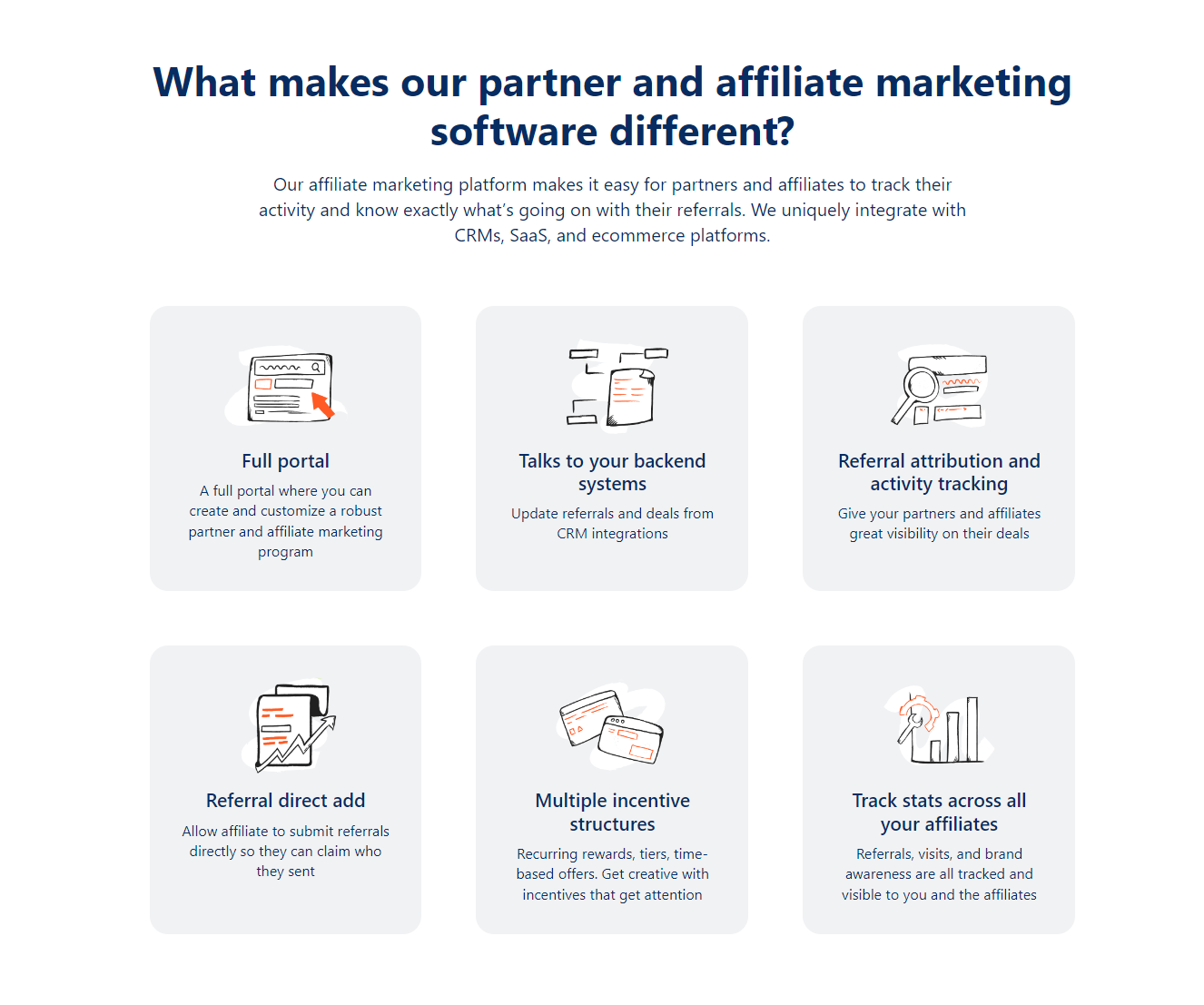
Partner relationship management (PRM) software is the operational backbone for everything above. It tracks partner sales through unique links, aggregates performance data in real time, automates payouts when partners hit reward thresholds, and gives partners self-serve access to a portal where they can find collateral and check on their own performance.
PRM software also gives your team a uniform way to manage every partner relationship. Instead of spreadsheets and inboxes, every partner’s history, communications, and rewards live in one place. That’s what makes the operational model above possible without burning out your partnership manager.
Referral Rock offers PRM software flexible enough to track and manage partnership types across affiliates, B2B partners, and resellers.
4. Onboard and train partners
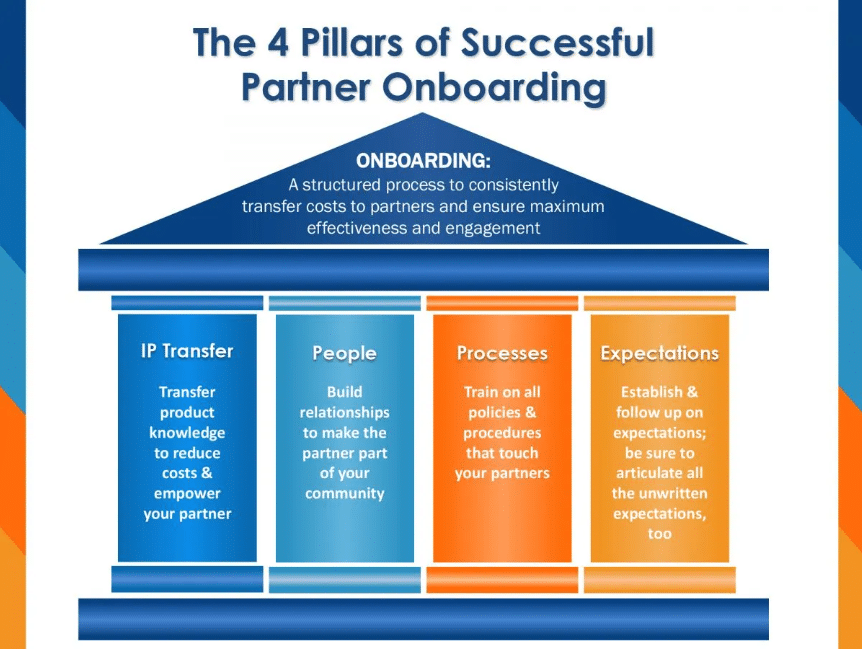
Onboarding sets partners up to actually drive results. Done well, it’s the first instance of the continuous enablement model, not a separate event.
For effective onboarding and training, consider the following:
- Identify the channels you’ll use for onboarding. You might use Zoom, asynchronous videos, or your partner portal.
- Single out the key info that partners need to market and sell your products, including unique selling points and how to use the product.
- Establish standards for how your brand should be represented — how partners should and shouldn’t market and sell your products or services. Include guidelines on messaging and rules for promotion.
- Provide partners with tools, assets, and resources for success: product information, images, videos, whitepapers. Your partner portal is the place to keep these assets easily accessible.
- Provide information on how partners can use the portal and share their partner links.
- Make payment terms clear. Specify the incentives and what must be done to earn them.
- Once these terms are established, have yourself and your partners sign a written partnership agreement that captures all terms.
5. Regularly analyze partnership data
Regular performance review is what keeps partner programs from drifting. Set a cadence (monthly or quarterly works for most programs) and hold it. Use every review to identify what’s working, what’s not, and what needs adjustment.
Track the metrics that matter for the partnership: sales generated, leads, customer base growth, conversion rates within agreed time frames. Whatever you and your partner agreed to as KPIs at the start, those are the numbers you’re tracking now.
Make this data visible to partners too. Through your partner portal, they should be able to see their own performance anytime they want — no manual reports, no email requests. The same data that informs your decisions should inform theirs.
Wrapping up
Partnership management isn’t about pulling off the perfect launch or finding the magic message. It’s about putting the operational scaffolding in place so partner relationships keep rolling — communication systems, tracking, enablement, payouts, all running quietly in the background.
If you’re building or scaling a partner program, Referral Rock gives you the PRM infrastructure to manage partners across types — affiliates, B2B partners, resellers — without the overhead of building it yourself. Check out how we’re built for affiliates and partners.