
“Referral agreement” is one of those terms that gets used loosely, and whether you need one depends on what kind of program you’re running.
- A simple customer referral program (where customers tell friends in exchange for a small reward) doesn’t need a formal contract.
- A partner program (where you’re paying real estate agents, B2B partners, or affiliates a commission for every closed deal) absolutely does.
This guide is for the second kind. Below, you’ll get a free referral agreement template plus a section-by-section walkthrough of what belongs inside. First, a quick check on whether you actually need one.
Do you actually need a referral agreement?
Before you draft anything, figure out which kind of program you’re running. The word “referral” gets used to describe two very different setups, and only one of them needs a formal contract.
Customer referral programs. Existing customers tell friends and family about you. You give them a small thank-you (a discount, a gift card, account credit). There’s no commission, no negotiated commercial relationship, no shared confidential information. These programs run on light terms and conditions, not a signed contract. Here’s how to set up a terms and conditions page in Referral Rock.
Partner / affiliate / channel referral programs. A formal third party — a real estate agent, an insurance broker, a B2B partner, an affiliate publisher — sends qualified business your way and gets paid a commission for it. Money changes hands. Sometimes confidential information does too. This is a channel partner relationship, and it should be governed by a written agreement.
Three quick questions to figure out which side you’re on:
- Are you paying cash commissions, or just rewarding customers? Cash commissions to non-customers means partner program. Discounts, credits, or small gifts to your own customers means customer referral program.
- Is the referrer an independent business, contractor, or professional? A real estate agent referring clients is a partner. A happy customer recommending you to a friend isn’t.
- Are you sharing branded materials, training, or confidential information with the referrer? If yes, you’re in partner territory. If you’re just giving them a share link, you’re not.
If you answered “yes” to any of these, you need a formal referral agreement. Read on. If you didn’t, save yourself the legal scaffolding — a clear set of program terms and conditions is enough, and you can spend your energy on the program design instead. (For more on building that side, see our guides on referral partnerships and building a referral network.)
Download our free referral agreement template
The best way to get a referral fee agreement that fits your needs is to write up the terms yourself. Of course, you don’t have to start from scratch. Download our free referral agreement template and tailor it to your program.
What is a referral agreement?
A referral agreement (sometimes called a referral partner agreement, referral fee agreement, or referral marketing agreement) is a written legal contract between a business and a third-party referrer. It establishes that the referrer will send qualified prospects to the business in exchange for a commission, lays out exactly what each side is responsible for, and protects both parties if something goes wrong.
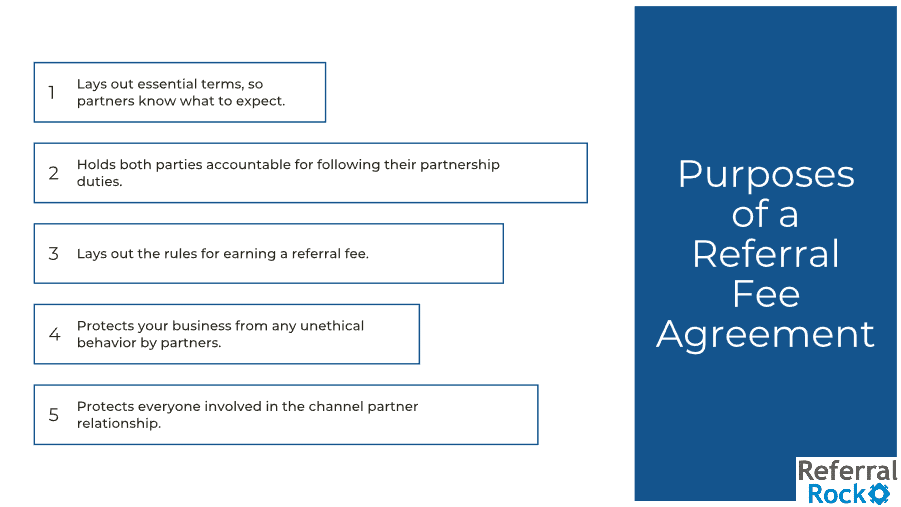
These contracts show up most often in real estate, insurance, and B2B / SaaS, where deal sizes are large enough to justify formal commissions and the relationship runs through a named professional rather than a casual customer. The agreement does three jobs at once: it sets expectations, holds both sides accountable for what they signed up for, and protects against bad actors who might misrepresent your business or try to game the commission structure.
Below, we’ll walk through every section that belongs in a strong referral fee agreement (we’ve included all these in our template), and then close with a few tips for making the contract actually work in practice.
How to structure a referral agreement
A complete referral agreement should cover the following 12 sections.
1. Definitions
Start by defining the key terms used throughout the document. Spell out what “referral partner,” “referral fee,” “qualified referral,” and any other terms specific to your program mean. Two parties reading the same word and assuming different things is the most preventable source of disputes.
2. Relationship between parties
State clearly why the two parties are entering into the agreement: whenever the partner successfully refers someone to your business, your business pays the partner a referral fee.
Just as importantly, state that the partner is an independent contractor, not an employee. Even if you pay them regularly for years, the relationship doesn’t convert to employment. This protects both sides.
3. Responsibilities
Spell out what each side is responsible for.
On your end: whether you’ll provide training on your brand, what branded assets or marketing materials you’ll offer, what support partners can expect, and what compensation or rewards you’ll deliver in return for their work.
On the partner’s end: how they’re expected to refer your business, how much effort or time they’re expected to put into promoting it, and any other obligations specific to your relationship.
4. Referral fee terms
This is the section partners read most carefully. Cover:
- Form of payment. Cash is most common, but you can pay in store credits, products, or other compensation.
- Amount. Flat fee, percentage of sale, or tiered fee based on product value?
- What qualifies as a successful referral. Usually, this is when a referred prospect makes a purchase. B2B businesses sometimes pay smaller fees on qualified leads given the longer sales cycle, with a larger fee on the closed deal.
- Payment timing. Immediately, monthly, after a return window closes, or after a minimum sales threshold?
- Bonuses or tiers. Whether commissions increase after performance milestones, or whether top monthly referrers earn additional rewards.
Pro tip: How to calculate a referral fee that’s motivating but consistently affordable for your company? Consider the following:
- How much you spend to make a sale
- The length of your sales process
- Your pricing structure
- When and how often your business receives money for sales
- The schedule and bonuses you want to implement
Determine the best referral fee, for all parties involved, using our free finder’s fee calculator.
And for a full breakdown on calculating fees that motivate partners without breaking your unit economics, see our complete guide to paying referral fees to individuals.
5. Promotional expectations
You and your partners need to be aligned on how your brand should be represented, so partners don’t accidentally misrepresent you or share inaccurate information.
In your agreement, outline:
- What messaging and positioning partners should use when referring others.
- Which audiences partners should focus on (and which they shouldn’t).
- Which promotional channels and methods are off-limits (cold outreach, paid search bidding on your branded keywords, etc.).
- Whether partners should only refer people they personally know — this is the expectation in most referral fee agreements, and worth stating explicitly.
6. Referral process and tracking
The biggest source of partner frustration is confusion about how to refer or not getting credit when they do. Make the process as easy as possible and document it clearly.
Spell out:
- How partners should submit referrals (typically through a referral form or partner portal)
- How they should invite peers (email, direct message, etc.)
- What pieces of contact information they need to capture for each referral
Then explain how the partner can track the status of their referrals through your software, and how they’ll be notified when a referral converts and a reward is earned. Visibility is what keeps partners referring again — without it, they assume nothing is happening and stop.
7. Non-exclusivity clause
A referral agreement should include a non-exclusivity clause stating that the partner is independent and free to enter referral relationships with other businesses. This protects both sides from being locked in if the partnership stops being beneficial.
Many businesses do add a narrower exemption: partners can’t work with direct competitors during the partnership (and sometimes for a defined period afterward). If that’s important to you, write it in clearly.
8. Non-disclosure and confidentiality
If you’re sharing trade secrets, customer data, pricing, strategy documents, or any other confidential information with your partner, both sides need to agree to keep that information protected. This section binds both parties to non-disclosure: neither side can share confidential information outside the relationship without consent.
9. Cancellation of the contract by the partner
Most referral agreements run indefinitely, meaning they last until one side decides to end them. You don’t want something unexpected to come up and leave your partner confused about how to end their obligation. But you also can’t just let partners end the relationship immediately, on any grounds. Spell out exactly how cancellation works so neither side is caught off guard.
Cover:
- Legitimate reasons for canceling
- Required notice period (30 days is typical)
- What happens to pending referrals or unpaid commissions when the contract ends
10. Termination
The termination section (sometimes called severability) sets the rules for ending the relationship in less amicable circumstances: breach of contract, ethical violations, or behavior that puts your brand at risk.
Spell out which actions are grounds for immediate termination. Common examples:
- Spreading false claims about your business
- Creating fake referrals to fraudulently earn commissions
- Violating intellectual property rights
- Outside legal trouble that could damage your reputation
Think through worst-case scenarios going in, decide how you’d handle each one, and write the consequences into the contract.
11. Other legal terms
Several additional legal provisions should appear in any complete agreement:
- Conflict and dispute resolution. Usually arbitration for routine disputes, with a path to court for serious breaches.
- Tax and reporting terms. For example, partners earning over $600 in a year in the U.S. must be reported to the IRS — call this out so partners know to expect a 1099.
- Indemnification. Sets up how legal costs and damages are handled if the partner’s activities create liability.
- Warranties. Confirms both parties are legally able to enter the agreement and aren’t violating other contracts or third-party rights by doing so.
Also note any state and national laws that apply to your industry. Real estate, finance, automotive, and insurance businesses often face specific rules around referral fees, so make sure your agreement reflects them.
12. Signatures
End with space for both parties to sign and date the agreement. Once signed, the contract is binding and the partner is eligible to start earning commissions on successful referrals. Include the effective date so the start of the relationship is unambiguous.
If you’re using Referral Rock, anyone who joins your program automatically agrees to its terms — no chasing signatures required. Get our free referral agreement templates to use as your starting point.
How partner agreements fit into your wider referral system
A signed agreement gets the paperwork right. It doesn’t get you referrals. The contract is the floor, not the ceiling — what actually drives volume in a partner program is the operational layer underneath it: how you find partners, how often you stay in touch, and how easy you make it for them to refer.
Two things to keep in mind once the ink is dry:
Partner programs run on relationships, not lists. The partners who actually refer are the ones with named-relationship access to your prospects — account managers at agencies, brokers in their local markets, professional services firms in adjacent industries. They sit closer to the prospect than your marketing team ever will, and they’re already in conversations where a referral fits naturally. Your job is to give each of them a frictionless way to make the introduction (their own link, their own portal, automatic tracking) and to stay in regular touch with status updates and reminders. Without that, the agreement is just a piece of paper.
A program is ongoing, not a launch. A common mistake is treating a partner program like a campaign — sign a batch of partners, send a kickoff email, and assume the referrals will roll in. They won’t. What sustains a partner program is continuous promotion: regular check-ins, performance reports, refresher materials, top-partner recognition, and steady recruitment of new partners. The agreement is the start of the relationship, not the end of the work.
Referral agreement tips
A few things to keep in mind as you finalize and roll out your agreement:
- Have a real conversation, not just a document handoff. Get on a call with each new partner to walk through the contract one-on-one. Not because the legal language is hard, but because the relationship matters more than the paperwork. The conversation is where you build the trust the contract is supposed to formalize.
- Be transparent about why each section exists. If a partner doesn’t understand why a clause is there, they’re more likely to push back on it or ignore it later. Walk through the reasoning.
- Lead with what’s in it for them. Most agreements are written defensively, from the company’s side. Make sure your partners can see the upside — the rewards, the support, the access — clearly enough that the contract feels like an opportunity, not an obligation.
- Be specific, especially on commissions. Vague fee terms create disputes. If rates or qualification criteria might change, say so up front and commit to written notice before any change takes effect.
Wrap-up
A referral agreement gets the paperwork right. The program around it — finding the right partners, keeping them in the loop, making it easy for them to refer — is what actually drives volume. Referral Rock handles both sides: anyone who joins your program automatically agrees to your terms, and the platform gives each partner their own portal, link, tracking, and reward fulfillment so you spend less time chasing signatures and more time running the program. Book a demo to see how it fits.